
WELLNESS HUB

XpatAthens
Monday, 12 October 2026 22:45
Beyond The Olive Oil: Why Greek Wellness Needs More Than Greek Ingredients

Greek wellness has an obvious visual language.
Olive oil. Herbs. Sea salt. Honey. Aromatic plants. Natural stone. Sunlight. The sea.
They all make sense. They are genuinely connected to Greece and its landscape. But there is a question worth asking: is using Greek ingredients enough to create a genuinely Greek wellness experience?
Not really.
A spa can use olive oil in a massage, add oregano to a treatment room and call a facial a “Mediterranean Ritual” without offering anything particularly Greek beyond the branding.
The difference lies somewhere deeper.
Greek Ingredients Are Only The Starting Point
Greece has an extraordinary natural heritage that can inspire wellness experiences.
Locally connected ingredients can all have a place within contemporary spa treatments. They can bring texture, scent, sensory associations and a stronger connection to the destination.
But an ingredient on its own doesn't tell a story.
A bottle of Greek olive oil used in a massage doesn't automatically make that massage Greek. The same is true of lavender grown in Greece, a rosemary scrub or a treatment inspired by the Aegean.
The important question is how these elements are used and why they are there.
What is the treatment trying to achieve?
How was it designed?
What is the role of the therapist?
How does the guest experience change from one treatment to another?
How was it designed?
What is the role of the therapist?
How does the guest experience change from one treatment to another?
This is where a Greek wellness concept can move beyond decoration.
From Ingredients To Rituals
One of the most interesting opportunities for Greek wellness is the development of treatments that feel like rituals rather than products.
Instead of simply offering a massage with Greek olive oil, for example, a spa could create a complete experience around a particular therapeutic idea, combining the treatment itself with sensory elements, preparation, consultation and aftercare.
The guest isn't simply receiving a treatment.
They are entering an experience with a beginning, a process and an end.
That distinction matters because modern travellers are increasingly looking for experiences that feel connected to where they are. They don't necessarily want another treatment that could have been offered in London, Dubai or Singapore with a different product on the shelf.
They want to feel that they are in Greece.
What Does “Greek” Actually Feel Like?
This is where things get more interesting.
A Greek wellness experience doesn't have to mean blue-and-white interiors, ancient columns or a treatment named after Aphrodite. In fact, those things can sometimes make a concept feel more like a stereotype than an authentic expression of place.
Greekness can be much more subtle. It can be found in the ingredients selected, the relationship with nature, the rhythm of the experience, the hospitality, the way treatments are personalised and the knowledge behind them.
It can also be found in the details that guests may not immediately identify as “Greek” but nevertheless make the experience feel connected to its surroundings.
A spa overlooking the sea, for example, doesn't need to turn the sea into a marketing slogan. It can simply allow the landscape, light, climate and sense of place to become part of the experience.
The Therapist Is Part Of The Experience
There is another element that is easy to overlook: the person delivering the treatment.
A genuinely distinctive wellness concept cannot exist only on a treatment menu. The team needs to understand what sits behind that menu.
What is the purpose of each treatment?
How should it be adapted to different guests?
What should the therapist observe?
How should the experience be personalised?
How should it be adapted to different guests?
What should the therapist observe?
How should the experience be personalised?
This is why training and treatment protocols matter.
Without them, even a beautifully designed Greek wellness concept can become inconsistent from one therapist to another and, ultimately, lose the identity it was created to have.
So, What Could Make Greek Wellness Distinctive?
The answer lies in the way everything comes together.
The ingredients.
The treatment design.
The therapist.
The environment.
The guest journey.
The philosophy behind the experience.
When these elements work together, Greece can offer something more distinctive than a spa treatment with a Mediterranean label.
This is the thinking behind Authentic Greek Traditional Therapeutics, bringing elements of Greek therapeutic heritage into contemporary wellness and hospitality in a way that is structured, personalised and relevant to today's guest.
Bringing The Concept To Life
Enthymesis Wellness explores what Greek wellness can look like when it becomes part of the experience itself, rather than simply an aesthetic or a collection of local ingredients. Working with hotels, spas and wellness destinations, the team develops concepts, treatments and guest experiences inspired by Authentic Greek Traditional Therapeutics, alongside the training and protocols needed to bring them to life.
The aim is to create wellness experiences that have a clear sense of place, experiences that feel connected to Greece, while still meeting the expectations of the contemporary spa guest.
Published in
Mindful Reads & News
Tagged under
Monday, 12 October 2026 22:40
The Missing Piece Of Greek Tourism: Authentic Wellness
Greece already has a very strong tourism identity.
Visitors come for the sea, islands, food, culture and history. But as travellers increasingly look for experiences that support their wellbeing, another opportunity is emerging: creating wellness experiences that feel genuinely connected to Greece.
Because there is a difference between offering wellness in Greece and offering Greek wellness.
What Does “Authentic” Wellness Actually Mean?
Authenticity has become one of the most frequently used words in tourism.
But what does it actually mean when we talk about wellness?
It doesn't simply mean using Greek ingredients or giving a treatment a name inspired by mythology.
A genuinely Greek wellness experience should have a deeper connection to the country's traditions, environment and therapeutic philosophy.
Here are five elements that can help create that connection.
1. A Philosophy, Not Just a Treatment Menu
A spa can offer massages, facials and body treatments without necessarily having a distinctive wellness philosophy.
Authentic wellness starts with a bigger question:
What do we believe contributes to wellbeing, and how does that belief influence the experience we create?
For a Greek wellness concept, this could involve drawing inspiration from Greek Traditional Therapeutics and ideas associated with Hippocratic medicine.
2. Personalisation
Not every guest arrives at a spa with the same needs.
Someone may want deep relaxation, while another person may be looking for an energising experience. Someone else may simply want to disconnect from a busy schedule.
A personalised approach begins by understanding the individual rather than automatically giving everyone the same treatment.
This is one of the core principles behind Enthymesis Wellness, a wellness company which develops wellness experiences based on understanding the individual and then selecting appropriate treatments, techniques, herbs, oils and rituals.
3. A Connection to Place
A wellness experience should ideally tell you something about where you are.
In Greece, that might mean drawing inspiration from local herbs, oils, food traditions, landscapes or therapeutic knowledge.
It could also mean designing the experience differently depending on whether the spa is located on a Cycladic island, in a mountain resort or in an urban hotel in Athens.
There is no reason Greek wellness should look exactly the same everywhere.
4. Professional Expertise
Authenticity isn't achieved simply by adding local ingredients.
A wellness concept also needs properly trained professionals who understand the treatments and the philosophy behind them.
For hospitality businesses, this means investing in staff training, clear treatment protocols and consistent standards.
5. A Complete Guest Journey
Finally, wellness shouldn't begin and end with the treatment itself.
The way guests are welcomed, consulted, guided through the experience and looked after afterwards can all contribute to how meaningful the experience feels.
This is why spa concept development can involve everything from the treatment menu to the guest journey and staff training.
Why Does This Matter?
Travellers increasingly want experiences that feel connected to their destination.
A spa that could exist anywhere in the world may offer excellent treatments, but a spa that reflects its location can become part of the reason people remember the destination.
For Greece, authentic wellness could therefore become more than another tourism product.
It could become another way of telling the country's story.
Bring Authentic Greek Wellness To Your Destination
Enthymesis Wellness works with hotels, spas, wellness retreats and hospitality destinations to create wellness concepts inspired by Greek Traditional Therapeutics and Hippocratic medicine.
From concept development and therapeutic menu design to staff training, certification and ongoing consultancy, the team helps hospitality businesses develop wellness experiences that combine Greek heritage with contemporary standards.
Want to explore what authentic Greek wellness could look like for your property? Get in touch with Enthymesis Wellness.
Published in
Travel Greece
Tagged under
Monday, 12 October 2026 22:37
What Does Your Body Need Today? A New Way To Think About Self-Care

Self-care has become one of the most familiar words in wellness.
We are told to sleep more, exercise, meditate, take a bath, book a massage, switch off our phones and make more time for ourselves.
And yet, sometimes self-care can start to feel like another list of things we are supposed to be doing.
But what if the question isn't “What should I do for my wellbeing?”
What if it is simply:
“What does my body need today?”
That small change in perspective can completely alter the way we think about taking care of ourselves.
Self-Care Isn't One-Size-Fits-All
There is no universal self-care routine that works equally well for everyone.
What feels restorative to one person may feel completely wrong for another. One person may need movement after a long day. Another may need stillness. Someone might want deep physical work, while someone else may benefit from a slower, more gentle experience.
Even the same person may need something different from one day to the next.
This is where a more personalised approach to wellness becomes interesting.
Instead of automatically reaching for the same treatment, ritual or routine, we can start paying attention to our current state: our energy, our physical sensations, our mood and what we actually feel drawn towards.
Self-care becomes less about following a formula and more about responding to ourselves.
Listening Before Doing
We are often very good at noticing what our body is asking us to do when something becomes uncomfortable.
But listening to the body can also mean noticing subtler signals.
Are you feeling restless or depleted?
Do you want movement or quiet?
Do you feel like being touched or left alone?
Would warmth feel comforting today, or would you rather have a cooling, refreshing experience?
Do you want movement or quiet?
Do you feel like being touched or left alone?
Would warmth feel comforting today, or would you rather have a cooling, refreshing experience?
These aren't necessarily questions that need complicated answers.
They simply encourage us to pause before choosing what comes next.
In a spa environment, this can change the experience completely. Instead of selecting a treatment simply because it sounds appealing on a menu, the experience can begin with understanding the individual person and adapting accordingly.
The Value Of Personalisation
Personalisation is increasingly discussed in wellness, but genuine personalisation goes beyond putting someone's name on a treatment card.
It means recognising that the same treatment does not necessarily have the same meaning or effect for every guest.
The Enthymesis Wellness approach places particular emphasis on individual constitution and personalised application, drawing on its interpretation of Greek Traditional Therapeutics and Hippocratic philosophy. Its treatments incorporate therapeutic rituals, specially developed oils and Greek herbal blends, with the experience adapted to the individual rather than treated as a generic spa service.
Self-Care Can Be Much Simple
Perhaps one of the most useful things about this way of thinking is that self-care doesn't always have to become another project.
You don't necessarily need a complicated morning routine, an hour-long meditation or a perfectly planned wellness weekend.
Sometimes it can begin with something much simpler:
Pause. Notice. Ask. Respond.
What do I need right now?
More movement?
More rest?
Warmth?
Quiet?
Connection?
A moment where nobody needs anything from me?
More rest?
Warmth?
Quiet?
Connection?
A moment where nobody needs anything from me?
The answer won't always be the same, and that's precisely the point.
From Routine To Ritual
There is also a difference between doing something automatically and experiencing it with intention.
A routine might be something we repeat because we are supposed to.
A ritual creates a moment of attention.
This is particularly relevant in spa and wellness experiences. A treatment can be much more than 60 minutes in a beautiful room. The way the guest is welcomed, the preparation beforehand, the treatment itself and the time afterwards can all become part of a more meaningful experience.
For Enthymesis Wellness, this idea sits at the heart of its approach: wellness experiences are designed as structured therapeutic systems, rather than simply collections of relaxation treatments. The company combines its interpretation of Greek Traditional Therapeutics with treatment protocols, personalised applications and specific rituals.
Perhaps Self-Care Starts With Listening
We often think of wellness as something we give our bodies.
A massage. A treatment. A workout. A healthy meal. A retreat.
But perhaps there is another way to look at it.
Wellness can also be about learning to listen.
To notice when we need to slow down. To recognise when we need stimulation rather than rest. To understand that our needs change. And to choose experiences accordingly.
Because taking care of yourself doesn't have to mean doing more.
Sometimes, it means becoming a little more attentive to what is already there.
A More Personal Approach To Wellness
This philosophy is central to the work of Enthymesis Wellness, a Greek wellness brand that brings its interpretation of Hippocratic philosophy and Greek Traditional Therapeutics into contemporary spa experiences. Its work combines personalised treatments, therapeutic rituals, Greek herbal blends and structured protocols, alongside spa concept development and professional training.
Because perhaps the most personal form of self-care begins with a very simple question: what does your body need today?
Published in
Mindful Reads & News
Tagged under
Monday, 12 October 2026 22:31
What Can Hippocrates Teach Us About Modern Wellness? The Lost Healing Wisdom Of Ancient Greece & Why It Matters Today
When we think about wellness in ancient Greece, it is easy to picture temples, olive oil, herbal remedies and sun-drenched landscapes. But Greek approaches to health were about much more than individual treatments. At their heart was an idea that feels surprisingly familiar today: wellbeing is connected to the way we live as a whole.
Long before the modern wellness industry began talking about personalised experiences, balance and preventative care, Hippocratic medicine placed considerable emphasis on understanding the individual and their relationship with their environment.
Health Was Never Just About One Thing
The Hippocratic tradition viewed health through a broader lens. Diet, movement, sleep, environment and lifestyle were considered part of the picture rather than completely separate from health.
This way of thinking is particularly interesting today, when wellness is increasingly moving away from quick fixes and towards more holistic experiences.
Modern wellness travellers are often looking for more than a massage or a beautiful spa. They want experiences that help them slow down, reconnect with themselves and perhaps understand their own needs a little better.
That shift makes some of the principles associated with Greek therapeutic traditions surprisingly relevant.
From Standardised Treatments To Personalisation
One of the biggest changes taking place in contemporary wellness is the move towards personalisation.
Instead of assuming that the same treatment will work equally well for everyone, wellness practitioners are increasingly interested in the individual: their preferences, their lifestyle, their current state and what they actually need from an experience.
This idea has strong parallels with Greek Traditional Therapeutics, where the individual was central to the therapeutic approach.
It is also at the heart of the philosophy behind Enthymesis Wellness, a Greek wellness consultancy inspired by Hippocratic medicine and Greek Traditional Therapeutics. Rather than creating standardised spa experiences, its approach begins with understanding the individual and then considering which treatments, techniques, herbs, oils and rituals are appropriate for that person.
What Could Greece Reclaim?
Greece already has many of the ingredients associated with modern wellness: its Mediterranean diet, natural landscapes, thermal springs, herbs, traditional practices, climate and a culture that places considerable value on food, community and time spent outdoors.
Yet the opportunity may lie in bringing these elements together through a more coherent philosophy.
Rather than simply using Greek ingredients or adding a few references to ancient Greece, authentic Greek wellness could mean looking more deeply at the ideas behind traditional approaches to wellbeing and considering how they can be interpreted responsibly today.
This is where initiatives such as Enthymesis Wellness become interesting. Based on the philosophy developed at Enthymesis, its wellness and spa centre in Corfu, the concept is to bring elements of Greek therapeutic heritage into contemporary hospitality and spa environments.
Looking Back To Move Forward
The growing interest in wellness does not necessarily mean that we need to invent something completely new.
Sometimes, it may mean looking again at knowledge that has been part of a culture for centuries and asking what still has relevance today.
For Greece, that could offer an opportunity to develop a wellness identity that feels genuinely connected to the country, not simply because of its scenery, but because of its history, philosophy and traditions.
Perhaps the future of Greek wellness isn't about creating something entirely new. Perhaps it is about rediscovering what was already there.
Published in
Greek Philosophy & History
Tagged under
Monday, 12 October 2026 22:27
From Ancient Greek Therapies To Modern Spas: Can Tradition Shape The Future Of Wellness?
The wellness industry is constantly looking for the next big thing.
New treatments, technologies and trends appear every year. But perhaps the future of wellness doesn't always require something completely new.
For Greece, some of the most interesting inspiration may already exist in its own therapeutic heritage.
The question is: how can ancient ideas be responsibly translated into modern wellness?
From Traditional Principle To Modern Experience
Ancient therapeutic traditions existed in a very different context from today's spa industry. They should not simply be copied and presented as modern treatments.
Instead, we can look at some of the underlying ideas and ask how they might translate today.
Understanding the Individual → Personalised Wellness
Traditional approaches placed importance on understanding the individual.
Today, this can translate into personalised consultations and treatments rather than automatically offering every guest the same experience.
The goal is to create a wellness journey that responds to the person rather than simply following a fixed formula.
Balance → A More Holistic Approach
The idea of balance remains central to many modern wellness philosophies.
Rather than focusing on one isolated aspect of wellbeing, a contemporary wellness experience can consider rest, movement, relaxation, environment and lifestyle together.
This doesn't mean trying to optimise every part of life.
Sometimes balance means simply recognising when we need to slow down.
Nature → Contemporary Botanical Experiences
Greece has an extraordinary botanical heritage.
Herbs, aromatic plants and natural oils have long been part of Mediterranean life.
Today, these can inspire modern spa rituals and sensory experiences, provided they are incorporated thoughtfully and supported by appropriate professional knowledge.
Therapeutic Rituals → Structured Spa Experiences
Traditional therapeutic practices often involved a sequence rather than a single action.
Modern spas can similarly create structured experiences where consultation, preparation, treatment and recovery form part of one journey.
The result is more than an individual treatment; it becomes an experience with a beginning, middle and end.
The Importance Of Not Simply Copying the Past
There is an important distinction between drawing inspiration from tradition and claiming to recreate it exactly.
Modern wellness operates within contemporary expectations around professional training, safety, hospitality and quality.
This is why translating traditional knowledge into a modern spa environment requires expertise.
It involves deciding which elements can be meaningfully adapted, how they should be incorporated into treatments and how staff should be trained to deliver them consistently.
Building The Bridge Between Tradition & Modern Hospitality
The philosophy combines research and practical experience in areas including Greek Traditional Therapeutics, Hippocratic medicine, naturopathy, Unani medicine and international spa therapies.
Rather than simply reproducing historical practices, Enthymesis Wellness works with hospitality destinations to develop contemporary spa experiences inspired by Greek therapeutic heritage.
This can include everything from treatment menus and protocols to guest journey design, staff training, certification and ongoing quality support.
Could Tradition Become Greece's Competitive Advantage?
The global wellness market is increasingly sophisticated.
Travellers can find beautiful spas almost anywhere. What can make a destination memorable is the story, philosophy and sense of place behind the experience.
For Greece, its therapeutic heritage could become part of that story.
The opportunity isn't to turn modern spas into ancient Greek replicas.
It is to ask a more interesting question: What can Greece's own wellness heritage teach us about creating meaningful experiences today?
Perhaps the answer lies somewhere between tradition and innovation: taking what remains relevant from the past and giving it a thoughtful place in the future of wellness.
If you're interested in creating a wellness experience rooted in Greek heritage while meeting contemporary hospitality standards, get in touch with Enthymesis Wellness.
Published in
Mindful Reads & News
Tagged under
Monday, 12 October 2026 19:00
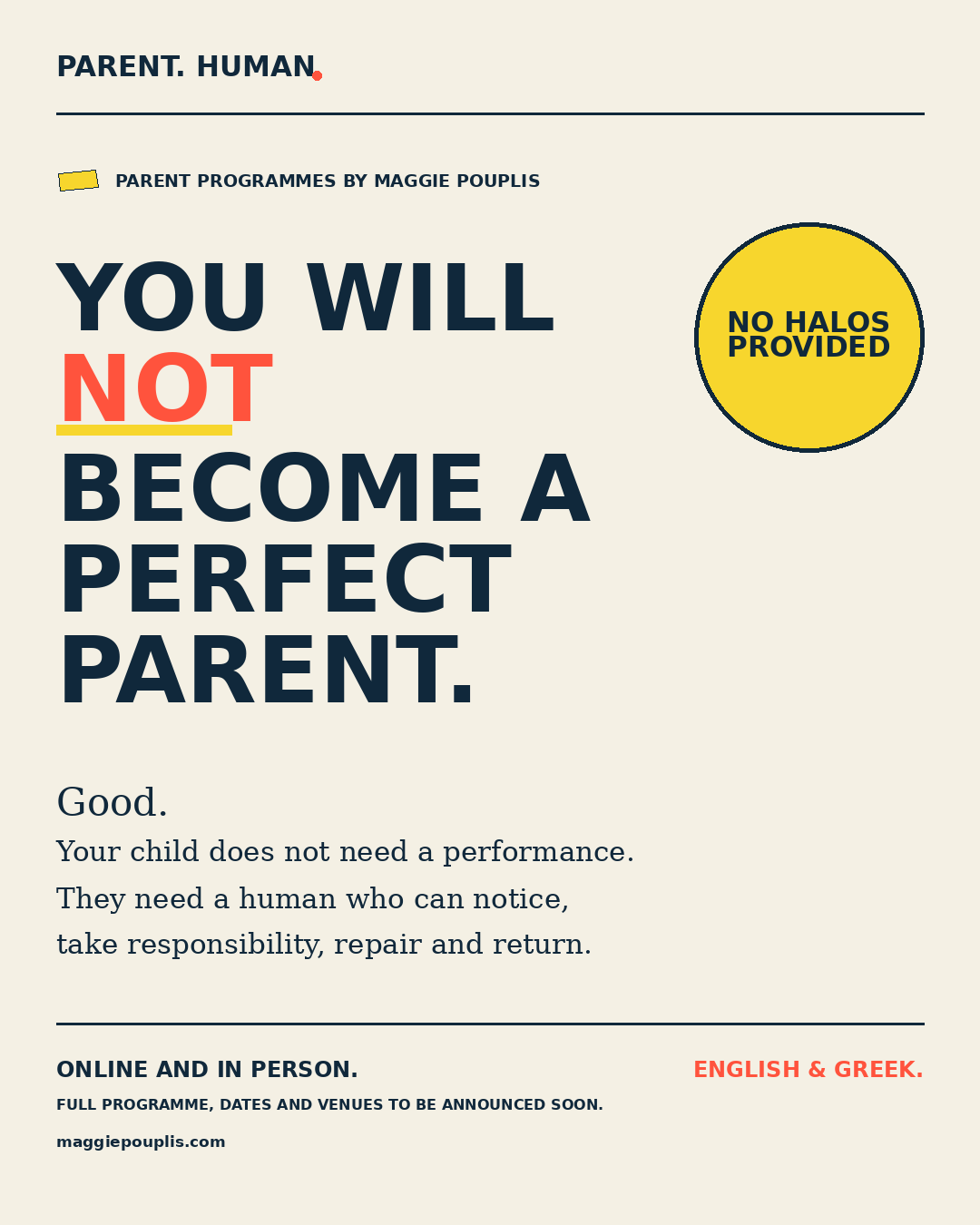
This Workshop Will Not Make You A Perfect Parent

A live, interactive parenting workshop in Athens or online
Parenting is not about being perfect. It is about understanding your own reactions, recognising what happens in your nervous system and finding your way back to connection without giving up healthy boundaries.
Led by Maggie Pouplis, this interactive 90-minute workshop, part of her PARENT. HUMAN. parent programmes, offers an introduction to the nervous system behind parenting reactions and practical ways to respond with greater awareness, regulation and responsibility.
Through four key steps — notice, understand, hold the limit and return — participants will explore how to recognise their own activation, better understand difficult moments and approach challenging interactions with their children differently.
Because understanding your child's feelings matters, but so does understanding your own.
For parents who wish to explore these practices in greater depth, a 12-week Parent Circle is also available. This guided parent-coaching programme includes weekly 60-minute meetings, a small group of up to 10 participants, lifetime access to English-language JAI parent learning materials and a closing eBook created for the programme. Sessions are available in person or online.
Neither option promises perfect parenting. Both offer space to develop a more regulated, responsible approach to family life.
The 12-week programme is a parent-coaching experience, not professional training or therapy.
Learn more or enquire about participation HERE!
Workshop Details
When: Open Dates
Duration: 90 minutes
Location: Athens or online
Language: Greek or English
Organizer's page: maggiepouplis.com
When: Open Dates
Duration: 90 minutes
Location: Athens or online
Language: Greek or English
Organizer's page: maggiepouplis.com
Published in
Workshops & Trainings
Tagged under
Monday, 12 October 2026 11:41
Your First 30 Days In Greece: Greek Phone Number, AFM, AMKA, Bank Account & The Order That Matters

You have arrived in Greece. You have a place to live, perhaps a job or a new business, and a suitcase that still needs unpacking.
Then reality sets in.
You need a Greek phone number. A tax number. A bank account. A registered lease. AMKA. Taxisnet. Suddenly, your first few weeks in Greece can feel like a tour of government offices and bank branches.
The good news? You don't necessarily have to do everything after you arrive.
The Greek administrative system is interconnected, and the order in which you complete these steps can make a significant difference. Some things can even be prepared while you are still abroad.
Here's how to approach your first month in Greece.
Step 1: Get A Greek Mobile Number
It might sound like the least important item on the list, but a Greek mobile number is often one of the foundations for getting everything else organised.
Many public services and online procedures require a Greek telephone number, particularly for registrations, verification and communication.
Using a foreign number can sometimes leave you unable to complete a procedure online, meaning you have to visit an office in person instead.
If you know you are moving to Greece, arranging a Greek number as early as possible can save you time later.
Step 2: Get Your AFM
The AFM (Αριθμός Φορολογικού Μητρώου) is your Greek tax identification number.
It is one of the most important numbers you will have in Greece and is needed for a wide range of everyday activities, including:
- opening a bank account;
- registering a lease;
- setting up utilities;
- buying or registering a vehicle;
- signing certain contracts;
- dealing with tax matters.
An AFM can also be obtained before you arrive in Greece, in some circumstances, through a power of attorney.
For someone moving from abroad, this can be particularly useful because it means you can start preparing the administrative side of your move before you land.
Step 3: Set Up Taxisnet
Once you have your AFM, the next important step is gaining access to Taxisnet, Greece's online tax platform.
Taxisnet is used for far more than filing taxes. It provides access to a range of digital government services and is used for processes such as registering and accepting rental agreements and accessing tax information.
Getting your Taxisnet credentials organised early can save you from having to visit offices for procedures that can be completed online.
Step 4: Check Your AMKA
The AMKA is Greece's social security number and is connected to healthcare, employment and certain benefits and services.
However, one important point for newcomers is that AMKA is not necessarily automatic.
Whether and when you can obtain or activate an AMKA depends on your individual status and residence or employment situation.
This is one reason the order of your paperwork matters. Don't assume that you can simply arrive and obtain every Greek administrative number immediately.
Step 5: Prepare Your Bank Account
Opening a Greek bank account is another common priority for newcomers, particularly if you are working in Greece or need to pay rent and household expenses.
Banks generally ask for documentation such as:
- your AFM;
- proof of identity;
- proof of address;
- proof of income or employment;
- your Greek telephone number.
Requirements can vary between banks and even between branches, so it is worth checking what your chosen bank requires before making an appointment.
Some of the groundwork can also be prepared before you arrive, meaning that your account-opening process can potentially be much smoother once you are in Greece.
Step 6: Make Sure Your Lease Is Properly Registered
Finding a home is only part of the process.
Your rental agreement needs to be declared electronically through the Greek tax system. The landlord submits the rental declaration and the tenant then accepts it through Taxisnet.
This is important because a properly registered lease can also serve as evidence of your Greek address.
And proof of address is something you will likely need for several other administrative procedures.
Why Proof Of Address Matters
A registered rental agreement or, depending on the procedure, a utility bill in your name can provide the proof of address that banks and public authorities require.
A hotel booking or simply giving a friend's address may not be enough for the procedure you are trying to complete.
This is why getting your lease properly registered early can make everything that follows easier.
Don't Forget the Documents You Bring From Home
Moving to Greece often involves bringing more than your luggage.
Foreign documents may need to be apostilled and officially translated before they can be used by Greek authorities.
The order matters, too. An incorrectly prepared document can mean going back to the beginning and obtaining it again.
If you are preparing documents before moving, check exactly what is required for your specific procedure. Where relevant, make sure you have the long-form versions of certificates rather than short extracts, and confirm the accepted requirements for apostilles and translations.
What If Your Residence Application Is Still Pending?
This is another area where newcomers need to be careful.
Your rights while an application is pending can depend on the specific certificate or document you have been issued at that stage.
This can be particularly important if you are planning to travel outside Greece.
Before booking a flight while your residence application is pending, make sure you understand exactly what your current documentation allows you to do, particularly when it comes to leaving and re-entering Greece.
Can You Do Some of This Before You Arrive?
Yes. Depending on your circumstances, some of the administrative preparation can be handled while you are still abroad.
With an appropriate power of attorney, Nikos can obtain your AFM, arrange Taxisnet access, deal with AMKA where applicable and prepare the groundwork for opening a Greek bank account.
That means your first weeks in Greece can be spent settling into your new home rather than spending every morning travelling between offices.
Planning your move to Greece? Nikos Paterakis can help you get the administrative groundwork in place before you arrive.
You can contact Nikos at info@paterakislegal.com or +30 694 760 1994 (WhatsApp & Viber), or connect with him on LinkedIn.
The Most Common Mistakes Newcomers Make
A few mistakes come up repeatedly:
Going to the bank before getting your Greek telephone number and AFM.
You may find yourself returning later with additional documentation.
You may find yourself returning later with additional documentation.
Signing a lease that is never properly registered.
Without a registered lease, you may struggle to prove your address when another service asks for it.
Without a registered lease, you may struggle to prove your address when another service asks for it.
Assuming AMKA is automatic.
Its availability and timing depend on your individual circumstances.
Its availability and timing depend on your individual circumstances.
Trying to use a foreign phone number for everything.
Some registrations and verification processes require a Greek number.
Some registrations and verification processes require a Greek number.
Travelling while your residence application is pending without checking your documents.
Don't assume that having an application pending automatically gives you the same travel rights as having a residence permit.
Don't assume that having an application pending automatically gives you the same travel rights as having a residence permit.
Arriving with documents that are not correctly prepared.
Missing apostilles, incorrect legalisation or unacceptable translations can create unnecessary delays.
Missing apostilles, incorrect legalisation or unacceptable translations can create unnecessary delays.
Why The Order Matters
Consider two newcomers.
The first arrives with a lease, a job offer and a suitcase full of documents. They spend the next three weeks moving between offices, only to discover that each procedure requires something that should have been obtained through another procedure first.
The second, in almost the same situation, arrives with their AFM, Taxisnet access and much of their banking paperwork already prepared.
Within days, they are largely set up.
The difference isn't necessarily effort.
It's preparation and, above all, the order in which things are done.
Your First Month Doesn't Have to Be a Paperwork Marathon
Moving to Greece involves plenty of exciting decisions: where you will live, which neighbourhood will become home, where you will have your first coffee and how quickly you will settle into Greek life.
Administrative paperwork may not be the most exciting part of the move, but getting it right early can make everything else considerably easier.
The key is to understand which steps depend on others and what can be prepared before you arrive.
Greece rewards the well-prepared and makes improvisation considerably more complicated. The right preparation can mean arriving with the groundwork already done, so your first 30 days can be about settling into Greece rather than simply figuring out how to navigate its paperwork.
Need Help Getting Set Up In Greece?
If you are moving to Greece and want to avoid spending your first weeks navigating paperwork and different public services, Nikos Paterakis can help you organise the administrative side of your move, including the steps that can be prepared before you arrive.
To get started, simply send Nikos a short email saying when you hope to arrive, who is moving with you and which steps you would like to have in place before you land, and he can advise you on the next steps.
You can contact Nikos at info@paterakislegal.com or +30 694 760 1994 (WhatsApp & Viber), or connect with him on LinkedIn. His office is located at 64 Panepistimiou Street, Athens 106 77, 3rd floor.
Published in
Settling-In Services
Tagged under
Monday, 12 October 2026 11:13
Greek Golden Visa: Thresholds, Timelines & Traps To Avoid
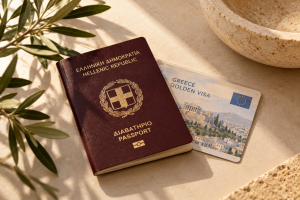
For international buyers, the Greek Golden Visa can look straightforward from the outside: find a property, make the investment and apply for residency.
In reality, the property itself is often the most important part of the process.
Nikos Paterakis, Attorney at Law and founder of Paterakis Legal, works with international investors looking to obtain Greek residence through investment. Based in Athens, he advises clients on the legal and practical steps involved, including property checks, the purchase process and the residence application.
For anyone considering the Golden Visa, his advice is simple: do not assume that a property qualifies just because the price appears to meet the threshold.
How The Golden Visa Works
The Greek Golden Visa is a five-year residence permit for non-EU nationals who make a qualifying investment in Greek real estate. The permit can be renewed as long as the investment is maintained.
There is no minimum stay in Greece required simply to maintain the Golden Visa.
This makes the programme particularly relevant to people who want the flexibility to spend time in Greece without immediately becoming full-time residents.
The permit also extends to certain family members. The spouse, children under 21 and the parents of both spouses can be included, making it important to consider the whole family from the beginning rather than treating family applications as an afterthought.
The Investment Threshold Depends On The Property
One of the biggest misconceptions about the Golden Visa is that there is one universal property price.
There isn't.
The minimum investment is currently €800,000 in Attica, Thessaloniki, Mykonos, Santorini and the larger islands. The threshold is €400,000 in other areas, while a €250,000 route remains available in specific circumstances, including certain conversions of commercial properties into residential use and the restoration of listed buildings.
The location of the property therefore matters just as much as its price.
A property that appears comfortably above €400,000, for example, may still not qualify if it is located in an area where the €800,000 threshold applies.
The 120 Square Metre Rule
For the €800,000 and €400,000 investment categories, the property must generally be a single property of at least 120 square metres.
The 120 square metre requirement does not apply to the €250,000 category, although that category has its own conditions depending on the type of property and the investment route.
There are also restrictions on how properties acquired through the Golden Visa programme can be used. In particular, properties acquired through the programme cannot be used for short-term rental.
This is why a listing describing a property as “Golden Visa eligible” should never be treated as the final word.
The Property Needs To Be Checked First
For an investor, the purchase price is only one part of the equation.
Before committing to a property, its legal and technical position needs to be examined. This includes the title, existing encumbrances, planning position and any unauthorised alterations.
A property can look perfect on a property website and still present a problem once its documents are examined.
This is particularly important when the investment is being made specifically to obtain a residence permit. A problem with the property can become a problem with the immigration application as well.
How The Money Is Paid Matters
The way the purchase price is transferred is another detail that should not be overlooked.
The investment needs to be paid through the banking system in a traceable way, with evidence of the payment in the form required by the authorities.
In other words, having enough money to buy the property is not the only consideration. The transaction also needs to be documented correctly.
This is one of the reasons it is better to consider the property purchase and the Golden Visa application as one connected process rather than two separate transactions.
Considering a property in Greece specifically for the Golden Visa? Nikos Paterakis can help you check whether the property and the proposed investment meet the relevant requirements before you move forward.
You can contact Nikos at info@paterakislegal.com or +30 694 760 1994 (WhatsApp & Viber), or connect with him on LinkedIn.
The Order Of The Process
A typical property-based Golden Visa process involves several stages.
First comes legal and technical due diligence on the property. Once the property has been checked, the purchase can proceed through the notarial process.
The residence application then follows, with a temporary certificate issued while the application is being examined.
The important point is that these stages should be planned together from the beginning.
There is little value in finding the right property if a legal or technical problem emerges after a deposit has already been paid.
How Long Does It Take?
There is no useful single number to attach to the entire process.
Legal due diligence can take days, while a technical inspection may take several weeks depending on the property. Completion of the purchase can also depend on how quickly the seller can provide the necessary documents.
The residence permit itself follows the application process.
For this reason, realistic planning is more useful than a promised timeline. The property, its location and the condition of its documents all influence how smoothly the process progresses.
You Do Not Necessarily Have To Live In Greece During The Process
Much of the Golden Visa process can be handled remotely.
An investor who is still abroad can generally arrange a power of attorney so that the necessary steps, from obtaining a Greek tax number to completing the purchase and submitting the residence application, can be handled in Greece.
A visit is still required for biometrics.
For international buyers, this means that buying a property and applying for residency does not necessarily require relocating to Greece before the process begins.
What The Golden Visa Gives You (& What It Doesn't)
The Golden Visa provides the right to reside in Greece and allows free movement within the Schengen area under the applicable rules.
It does not, however, give the holder the right to work as an employee in Greece.
Family members included in the permit can study in Greece, while the investor can maintain the flexibility to spend as much or as little time in the country as their circumstances require.
Citizenship is a separate matter altogether.
From Golden Visa Holder To Long-Term Resident
For someone who eventually wants to make Greece their permanent home, the Golden Visa does not necessarily have to be the end of the journey.
Under the relevant conditions, holders can later move towards long-term resident status. This involves requirements concerning the length and continuity of residence, income, health insurance and knowledge of the Greek language.
For those planning to live in Greece rather than simply hold a residence permit, this distinction is important.
Time spent in Greece and the way absences are recorded can matter later, so anyone considering this as a long-term plan should think about it from the beginning rather than at the point of their first renewal.
Further along the same path, certain long-term residents may also be able to apply for Greek citizenship through naturalisation, subject to the applicable residence, language, examination, and other requirements. Following recent rulings of the Council of State and a Ministry of Interior circular, income on its own is no longer a reason to accept or refuse an application. It is now one of several indicators of economic integration, assessed together with stable work or other lawful economic activity in Greece and consistent compliance with tax and social security obligations.
Owning a home in Greece that the applicant lives in is also assessed positively.
Owning a home in Greece that the applicant lives in is also assessed positively.
For a family that genuinely intends to settle in Greece, the Golden Visa can therefore be viewed as the beginning of a longer residence journey rather than simply an investment transaction.
The Proposed 15% Transfer Tax
There is another issue that anyone considering a property purchase in Greece now needs to have on their radar.
In September 2026, the Greek government announced plans to increase the property transfer tax for certain residential property purchases by non-EU buyers from the current 3% rate to 15%. The proposed implementation date has since been reported as 1 July 2027.
The measure has not yet been enacted, and important details remain subject to the final legislation. This includes how the measure will apply to different categories of buyers and whether particular transactions or Golden Visa investments will receive an exemption or transitional treatment.
This is particularly relevant to Golden Visa investors because the property route is aimed at non-EU nationals.
One important distinction is that holding a Golden Visa should not automatically be confused with holding long-term resident status. They are separate residence categories, with different conditions.
For anyone considering a purchase around the proposed change, the safest approach is therefore to check the position at the time of the transaction rather than treating an announcement as settled law.
What This Means For Timing
The proposed tax change does not change the Golden Visa investment thresholds themselves. Instead, it could affect the overall cost of buying a qualifying property.
For an investor considering a purchase in the coming months, this makes timing something to discuss early with both the legal and property sides of the transaction.
It is also important not to rush into a property simply because of a proposed tax deadline.
The property still needs to qualify, the title and planning position still need to be clean, and the purchase needs to be structured correctly.
A deadline should never replace due diligence.
The Traps To Avoid
Some of the most common mistakes are surprisingly simple.
Assuming the price is enough. A property needs to meet the requirements for its specific location and investment category.
Choosing the property first and checking it later. Legal and technical due diligence should happen before a significant commitment is made.
Relying on a property listing. “Golden Visa eligible” is not a substitute for independent verification.
Ignoring the way the money is transferred. The payment needs to be traceable and properly documented.
Overlooking the property's registered size. The relevant measurement is not necessarily the figure used in a property's marketing description.
Forgetting about the family. If family members are going to be included, it is sensible to plan for them from the start.
Treating the proposed transfer-tax change as settled law. The 15% rate is currently an announced measure, not a completed piece of legislation. Its final terms should be checked before any purchase is completed.
The Property & The Residence Should Move Together
The Golden Visa is not simply a matter of finding a property at the right price.
The location, size, legal title, planning position, payment method and intended use can all affect whether an investment is suitable for the residence route. And with the proposed changes to property transfer tax, the overall timing and cost of a purchase are also worth considering carefully.
Done properly, the property purchase and the residence application can be planned together from the beginning.
The first step is therefore not choosing a property. It is checking that the property you are being shown can actually carry the permit.
If you are considering the Golden Visa and would like to discuss your options with Nikos Paterakis, you can get in touch with him directly. Send a short email explaining which area you are considering, roughly how much you plan to invest and which family members you would like to include, and he can advise you on which route may make sense for your circumstances.
You can contact Nikos at info@paterakislegal.com or +30 694 760 1994 (WhatsApp & Viber), or connect with him on LinkedIn. His office is located at 64 Panepistimiou Street, Athens 106 77, 3rd floor.
Published in
Healthcare, Insurance & Visas
Tagged under
Monday, 12 October 2026 10:57
Greek Citizenship By Descent: How To Trace, Prove & Claim Your Greek Roots
For many people of Greek descent living abroad, the idea of becoming a Greek citizen begins with a family story.
A grandfather who left Crete before the war. A grandmother from a small village in the Peloponnese. A Greek surname that has stayed in the family for generations, even though nobody knows exactly where the original records are.
For Nikos Paterakis, Attorney at Law and founder of Paterakis Legal, these are often the starting points for citizenship cases he handles for people living outside Greece. Based in Athens, with a regular working presence in Chania, he works personally with international clients on Greek citizenship, residency and other legal matters.
When it comes to citizenship by descent, however, the first step is not filling in an application. It is finding out whether the family line can actually be documented.
Greek Citizenship Follows The Family Line
Being born in Greece does not, by itself, make someone Greek. For citizenship by descent, what matters is the connection to a Greek citizen and the ability to prove that connection through the generations.
A person may therefore have a route to Greek citizenship through a parent, grandparent or earlier ancestor. But the family relationship has to be established link by link.
That is where many apparently straightforward cases become more complicated.
It is not enough to say, “My grandfather was Greek.” The question is whether his Greek identity can be documented and connected to the next generation, then the next, until the documents reach the applicant.
The Paper Trail Starts In Greece
The most important piece of information is often the Greek ancestor's registration.
Greek municipal registers, and in some cases male registers, can provide the starting point for establishing that an ancestor was registered as a Greek citizen. Finding that entry can completely change the picture.
This is why establishing what exists in Greece before spending time collecting large numbers of documents abroad is usually the best approach.
Older records are not always digitised or easily searchable online. Depending on the family history, relevant information may be found in municipal archives, parish or church records, consular archives and older administrative records.
Knowing where to look is often as important as knowing what to look for.
What If The Family Says The Records Are Lost?
A relative may have been told decades ago that a document disappeared when the family emigrated. Or perhaps everyone simply assumes that nothing survived because the ancestor left Greece many generations ago.
That does not necessarily mean the trail has ended.
For older or particularly difficult family lines, Nikos Paterakis works with professional archival historians and genealogists in Greece and abroad. They can search sources such as parish registers, municipal and consular archives and emigration records.
The process is essentially about rebuilding the chain from the evidence that still exists rather than relying on family memory alone.
Names Can Create Another Problem
Greek family names do not always travel neatly from one country to another.
A surname may have been transliterated differently when a family emigrated. A Greek name might have been shortened, anglicised or simply recorded incorrectly by an official.
You could therefore find the same person appearing under different spellings in different records.
For example, one generation might be recorded as Papadopoulos, another as Papadopulos, while a later record uses an entirely different shortened version.
That does not automatically mean they are different people. Establishing whether the records refer to the same person is part of the work.
This is also why having a Greek surname, while an important clue, is not in itself proof of citizenship or descent.
If you have a Greek parent, grandparent or earlier ancestor, Nikos Paterakis can help you understand whether your family line may provide a route to Greek citizenship and what documents you may need.
You can contact Nikos at info@paterakislegal.com or +30 694 760 1994 (WhatsApp and Viber), or connect with him on LinkedIn.
The Documents From Abroad Matter Too
Once the Greek side of the family line has been established, the next challenge is usually connecting the generations.
Birth, marriage and death certificates may be needed for each stage of the family line. Documents issued abroad generally need to be properly authenticated, including apostilles where applicable, and officially translated for use in Greece.
The exact form of a document matters too. In many cases, long-form or full certificates are required rather than short extracts.
A common mistake is to collect documents first and check their requirements later. That can mean having to order certificates again, especially when an older document does not contain enough information to establish the connection.
A Useful Starting Point
Before ordering a large number of certificates, creating a simple family tree and identifying exactly where the Greek connection sits is extremely helpful.
Write down:
- the Greek ancestor's full name and possible spellings;
- their approximate date and place of birth;
- their parents' names, if known;
- when and where they emigrated;
- the names and dates of their children;
- and any Greek documents already held by the family.
Even apparently insignificant details can help identify the right record.
Where The Application Is Made
Once the family line and supporting documents have been established, the application is generally handled either through the Greek consulate responsible for the applicant's place of residence or through the competent municipality in Greece, depending on the circumstances of the case.
There is no single route that works identically for every family.
The location of the original Greek registration, the applicant's country of residence and the state of the records can all affect how the case is approached. For that reason, it’s important to establish the documentary position first and then determine where the application should be handled.
What Happens After Citizenship Is Recognised?
Once Greek citizenship has been registered, the applicant can proceed with the relevant Greek identity and passport documents.
For many people living abroad, however, the passport is only part of the reason they begin the process.
Greek citizenship can also provide the ability to live, work and study in Greece and elsewhere in the European Union, subject to the applicable rules. Citizenship may also have implications for the applicant's children, depending on their circumstances and the way their own registration is handled.
That is why establishing the family line correctly at the beginning is so important.
You May Not Have To Travel To Greece
One of the useful aspects of these cases is that much of the preparatory work can often be handled while the applicant remains abroad.
With the appropriate authorisation, searches of Greek registers and other administrative steps can be handled in Greece on the applicant's behalf.
For someone living in Canada, the United States, Australia, the United Kingdom or South Africa, this can make the process considerably more practical, particularly when the relevant ancestor came from a small Greek municipality many generations ago.
Born In Greece & Adopted Abroad?
Between the 1950s and the mid-1970s, many children born in Greece were adopted by families in the United States, the Netherlands, Sweden and other countries. Many of them were Greek citizens at birth.
Since 2025, people born in Greece and lawfully adopted by foreign nationals up to the mid-1970s have been able to apply for registration in a Greek municipal register as Greek citizens. This is not naturalisation. The process treats them as Greek citizens whose registration is missing or incorrect, rather than as foreigners applying for citizenship.
The starting point is usually the adoption decision and the Greek birth record. Older decisions often leave out key details about the birth parents, so these may need to be traced through the adoption court file in the Greek archives, the records of the orphanage or institution involved, baptism records and, for people adopted to the United States, their immigration file. Where the adoption was granted abroad rather than by a Greek court, the foreign decision must first be recognised in Greece.
Nikos handles these cases personally, from the first record searches in Greece through to the application for registration, and much of the work can be done while the applicant remains abroad. Once registered, the applicant can apply for a Greek identity card and passport.
An Example From Nikos’ Practice
In one case, a family in North America was convinced that their grandfather's Greek records had disappeared when he emigrated before the war.
The record had not disappeared.
It was eventually located in a municipal register in a village in Crete, but the ancestor was recorded under a spelling that nobody in the family had ever used.
That single discovery provided the starting point for rebuilding the family line through the generations. The case ultimately allowed the grandchildren to be registered as Greek citizens.
The important lesson is not that every case will have the same outcome. It is that a family story that seems impossible to prove can sometimes become much clearer once the original Greek records are found.
Start With The Evidence, Not The Application
Greek citizenship by descent can be deeply personal. For some families, it is about reconnecting with a place their grandparents left behind. For others, it is about creating a new connection to Greece for the next generation.
Before ordering certificates, contacting different authorities or beginning an application, however, it is worth taking the time to understand what can actually be proven. Identifying any gaps in the family line early can save applicants from spending years collecting documents that may not ultimately connect the generations.
If you are considering claiming Greek citizenship through your family, it may be worth getting in touch with Nikos Paterakis before you start collecting documents. He can look at your family line, help identify what needs to be established and explain which route may make sense for your circumstances.
To get started, simply send Nikos a short email with the name of the ancestor who connects you to Greece, roughly when and where they were born and which documents your family already holds, and he can advise you on the next steps.
You can contact Nikos at info@paterakislegal.com or +30 694 760 1994 (WhatsApp & Viber), or connect with him on LinkedIn. His office is located at 64 Panepistimiou Street, Athens 106 77, 3rd floor.
Published in
Everyday Tips & How To’s
Tagged under
Monday, 12 October 2026 10:40
Digital Nomad Visa Or FIP? Choosing The Right Route To Live In Greece

If you are considering moving to Greece, one of the first questions is likely to be: Which residence route is right for me?
Two options that often come up are the Digital Nomad Visa and the Financially Independent Person (FIP) route. From the outside, they can look quite similar. Both can allow non-EU citizens to live in Greece, both have financial requirements and both can include family members.
But there is one important distinction that is often misunderstood: the choice is not simply about how much money you earn. It is about where that money comes from and what you intend to do once you are living in Greece.
The 3 Questions To Ask First
Before choosing a route, ask yourself three simple questions:
- Where does my income come from?
- Will I need to work while living in Greece?
- Who is moving with me?
The answers can make the difference between the Digital Nomad and FIP routes much clearer.
Digital Nomad Visa: For Remote Workers
The Digital Nomad Visa is designed for people who work remotely for employers or clients outside Greece.
In simple terms, you can continue working remotely while living in Greece, but you cannot use this residence route to work for a Greek employer or provide services to Greek clients.
This makes it particularly relevant to employees, freelancers and business owners whose professional activity remains connected to another country.
FIP: For Those Who Do Not Need To Work
The Financially Independent Person (FIP) route is designed for people whose income does not depend on working.
This can include income from:
- pensions;
- rental properties;
- dividends;
- investments;
- savings and other financial resources.
It is sometimes described as a "retirement visa", but that is not quite accurate. You do not necessarily have to be retired. The important point is that your financial resources do not depend on employment or active work.
The FIP route does not allow you to work in Greece.
Is The Income Requirement The Same?
Currently, both routes start from a stable monthly income of €3,500 net, increased by 20% for a spouse and 15% for each child.
The important difference is not necessarily the amount but the source of the income and how you prove it.
For a Digital Nomad application, this may involve employment contracts, payslips, invoices or other evidence of remote professional activity.
For an FIP application, the evidence may instead include pension statements, bank statements, investment records or documentation demonstrating other stable financial resources.
This is why simply comparing your monthly income with the required figure is not enough. The origin of that income matters.
The Application Usually Starts Before You Arrive
One of the most important practical points is that the process generally begins outside Greece.
Both routes normally involve applying for a national visa through the Greek consulate in the applicant's country of residence, followed by the residence permit process in Greece.
The consular stage is often where avoidable delays can occur. Documents need to be prepared in the correct format, and requirements such as apostilles, translations, health insurance and criminal record certificates need to be considered in advance.
Getting the order right can make a significant difference to the overall process.
Lawyer Nikos Paterakis handles both stages, from the consular application to the residence permit application in Greece.
Not sure which route fits your plans? It is worth having your circumstances reviewed before you apply.
You can contact Nikos Paterakis at info@paterakislegal.com or +30 694 760 1994 (WhatsApp and Viber), or connect with him on LinkedIn.
What Happens After You Arrive?
The Digital Nomad Visa is granted for one year and leads to a two-year residence permit, which can be renewed as long as the relevant conditions continue to be met.
The FIP visa is also issued for one year, after which the FIP residence permit is granted for a longer initial period and can be renewed under the applicable conditions.
For both routes, the financial requirements do not simply disappear after the initial application. You need to continue meeting the relevant conditions when renewing your residence permit.
The Question That Could Change Everything: Can You Work In Greece?
This is perhaps the most important distinction between the two routes.
An FIP residence permit does not allow you to work in Greece.
The Digital Nomad route allows remote work for foreign employers or clients, but does not allow you to take employment with a Greek company or work for Greek clients under that permit.
So imagine you move to Greece as an FIP because you have sufficient passive income. A year later, you decide you would like to take a job with a company in Athens. Your FIP permit does not simply give you that right.
Equally, someone who applies as a Digital Nomad while already planning to build a client base in Greece may have chosen the wrong route from the beginning.
This is why thinking about your plans two or three years ahead, rather than only looking at your circumstances today, is important.
What About Your Family?
Both routes can accommodate eligible family members, including a spouse and children.
However, bringing family members changes the financial requirements and the documentation needed.
It is also important to understand that family members do not automatically acquire a right to work simply because the main applicant has a Digital Nomad or FIP residence permit.
If one partner may want to work in Greece in the future, this should be considered before choosing the initial residence route.
Don't Forget Tax Residence
Immigration status and tax residence are not the same thing.
If you spend more than half of the year in Greece, you may generally become a Greek tax resident, depending on your individual circumstances and the applicable rules.
This is why tax planning should happen before moving rather than after you have already established your life in Greece.
Your immigration route, income sources, existing investments, property and country of origin can all affect the tax implications of your move.
Nikos coordinates the tax side with the accountants he works with, so that the tax position and the residence application are planned together.
How Much Time Do You Need To Spend In Greece?
The residence permit gives you the right to reside in Greece and provides freedom of movement within the Schengen area, subject to the applicable rules.
However, it does not automatically lead to Greek citizenship.
For renewal purposes, the amount of time you spend in Greece also matters. You generally need to spend at least six months of each year in Greece to maintain the relevant residence status.
If your goal is long-term residence or citizenship, your physical presence and absences from Greece become even more important.
Is There A Path To More Rights?
Choosing the Digital Nomad or FIP route does not necessarily mean you will always have the same restrictions.
Under the applicable conditions, lawful residents can eventually move towards long-term resident status, which can provide broader rights, including access to work in Greece.
The long-term residence route generally requires five years of lawful and continuous residence in Greece together with the required Greek-language certificate, or twelve years of lawful residence without the language certificate. Other requirements also apply, including sufficient income, health insurance and limits on absences from Greece.
There are also longer-term residence options for people who have established their life in Greece.
For someone who starts on an FIP route but later wants to work, or a remote worker who eventually wants to take on Greek clients, this can be particularly relevant. Your first residence permit does not necessarily have to define your entire future in Greece.
For those who eventually want Greek citizenship, further requirements apply, including the relevant period of lawful residence and the naturalisation examination covering Greek language, history and institutions. Following recent rulings of the Council of State and a Ministry of Interior circular, income on its own is no longer a reason to accept or refuse an application. It is now one of several indicators of economic integration, assessed together with stable work or other lawful economic activity in Greece and consistent compliance with tax and social security obligations.
The Documents That Commonly Cause Problems
Even when someone clearly meets the financial requirements, documentation can create delays.
Common areas that need careful preparation include:
- proof of income in the correct form;
- health insurance meeting the applicable requirements;
- a clean criminal record certificate;
- apostilles and official translations;
- proof of accommodation or a Greek address;
- documentation supporting the source of your income.
The order in which documents are prepared can be just as important as the documents themselves.
Common Mistakes To Avoid
There are a few mistakes that can make the process unnecessarily complicated.
Choosing a route because a friend recommended it.
Your friend's financial situation and future plans may be completely different from yours.
Your friend's financial situation and future plans may be completely different from yours.
Applying as a Digital Nomad while planning to work with Greek clients.
The Digital Nomad route is specifically structured around remote work connected to employers or clients outside Greece.
The Digital Nomad route is specifically structured around remote work connected to employers or clients outside Greece.
Using the FIP route when your income actually depends on active employment.
The source and nature of your income matter, not simply the amount appearing in your bank account.
The source and nature of your income matter, not simply the amount appearing in your bank account.
Submitting documents without the required apostille or translation.
A document can be genuine but still unusable for the application if it has not been prepared in the required format.
A document can be genuine but still unusable for the application if it has not been prepared in the required format.
Arriving as a tourist and assuming you can simply convert your stay into a residence permit.
For these routes, the process normally starts through the Greek consulate abroad.
For these routes, the process normally starts through the Greek consulate abroad.
Ignoring tax planning.
Moving to Greece can change your tax residence and create obligations that extend beyond the immigration application.
Moving to Greece can change your tax residence and create obligations that extend beyond the immigration application.
A Typical Scenario
Consider a couple who chose the FIP route because their rental income met the financial requirement.
One of them, however, already worked remotely for clients abroad and planned to continue after the move.
The problem? Their FIP permit did not allow it.
The Digital Nomad route would have suited their plans from the start.
It is a good example of why choosing a residence route is about more than meeting an income threshold. Your plans for your life in Greece matter just as much.
So, Which Route Is Right For You?
The first question is not how much you earn.
Instead, ask:
Where does your money come from?
Will you need to work once you are living in Greece?
And what do you want your life in Greece to look like in the years ahead?
If your income comes from remote employment or clients outside Greece and you intend to continue working remotely, the Digital Nomad route may be the relevant option to explore.
If you have sufficient independent financial resources and do not need to work, the FIP route may be more appropriate.
But everyone's circumstances are different, particularly when family members, multiple income sources, property, investments or future employment plans are involved.
Need Help Choosing Your Route?
If you are unsure which option fits your circumstances, getting professional advice before you begin the application can save considerable time and avoid problems later.
For assistance with the Greek residence process, including the Digital Nomad and FIP routes, Nikos Paterakis can help you discuss your circumstances and understand which route may be appropriate for your plans.
To get started, simply send Nikos a short email saying where your income comes from, who is moving with you and when you hope to arrive, and he can advise you on the next steps.
You can contact Nikos at info@paterakislegal.com or +30 694 760 1994 (WhatsApp and Viber), or connect with him on LinkedIn. His office is located at 64 Panepistimiou Street, Athens 106 77, 3rd floor.
Published in
Relocation Greece
Tagged under