

XpatAthens

XpatAthens

Thursday, 22 November 2018 07:00

Pallas Theater To Introduce English Supertitles

The management of Pallas, Athens’ historical theater, recently announced that English supertitles will be added to its main evening performances. According to Pallas’ management, out of almost 1,500 productions taking place in Athens every year it is important that at least some cater for English speaking audiences.
 
Soon, foreign visitors will have the opportunity to expand their cultural scope and enjoy great performances in one of the city's best theaters.
 
Pallas is housed in an iconic 1930’s building and at the time of its opening it was the most remarkable cinema in Athens. Following a major restoration, Pallas was converted into a theater in 2006.

 
To read this article in full, please visit: ekathimerini
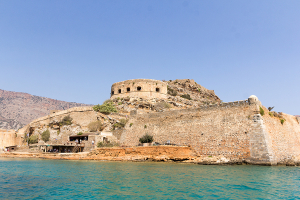
The Greek Ministry of Culture is expected to submit the final nomination file for the inscription of the island of Spinalonga on the UNESCO World Heritage List, at the end of the month.
 
“It will be Crete’s first monument to be included on the World Heritage List of UNESCO,” Culture Ministry Secretary General Maria Andreadaki-Vlazaki said.
 
After the Palace of Knossos, Spinalonga is the most visited archaeological site in Crete and the 6th in Greece. The small islet attracts countless visitors every year due to its unique architecture and historical importance. Spinalonga features a well-preserved 16th century Venetian defense fortification.
 
The Region of Crete has managed to secure 900,000 euros in EU funding in order to complete the 3rd phase of restoration which includes maintenance works on its fortification and buildings.
 
It is worth noting that from the early 20th century up until 1957, Spinalonga was used as a leper colony, while the last inhabitant left the island in 1962. The tiny island became famous as the setting of ‘The Island’ a best-selling novel by Victoria Hislop.
 
 
To read this article in full, please visit: Greek Travel Pages
Photo Credit: Wikimedia Commons
Everyone knows that we Greeks love music; in joy and in sadness, we sing! And truth be told there’s a great number of music genres to accompany all moods and mind states. There’s folk songs, rebetika, laika, entexna (sophisticated music), as well as mainsteam music like pop & rock.
 
The two golden decades of the 50’s and 60’s produced great composers, distinguished performers, and some of the best Greek songs that were ever written.
 
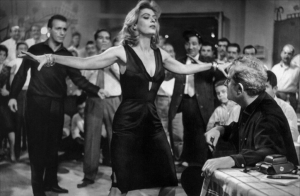
Undeniably, one of the most recognizable Greek tunes worldwide is that of the song ‘Τα Παιδιά του Πειραιά’ (The Children of Piraeus). The song was first performed by Melina Merkouri, in Jule’s Dassin’s film ‘Never on Sunday’ and fascinated cinema & music lovers all over the world. Furthermore, this song earned Manos Hadjidakis an Academy Award for Best Original Song in 1960. Since the 60’s ‘Τα Παιδιά του Πειραιά’ has been sung by various artists such as Nana Mouskouri, Pink Martini, and even Miss Piggy from the Muppet Show!
 
Discover more Greek songs that became international hits, here: omilo.com
Did you know that about 150.000 English words derive from ancient Greek? It shouldn't surprise you then, that many idioms and sayings also originate from ancient Greek.

The majority of English sayings with Greek origins have emerged from Greek myths and stories. Here some widely used English sayings and phrases that have a decidedly Greek touch.

Achilles Heel

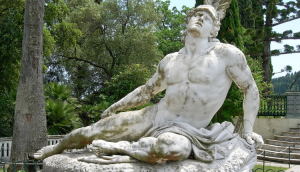
Your Achilles Heel literally means your weak spot. According to Greek Mythology, Achilles was invincible all over his body except for his heel because when his mother dipped him in the River Styx, she held him by one of his heels. During the Trojan War, Paris shot an arrow and struck the only vulnerable spot on Achilles' body: his heel.

Between a rock and a hard place

Between a rock and a hard place, means having to choose between two evils. In Homer's Odyssey, Odysseus had to pass between two sea monsters, Scylla and Charybdis, who dwelled on opposite sides of the strait of Messina. Odysseus chose to pass by Scylla, the lesser of the two evils, thinking he would lose fewer men, than passing through Charybdis, the whirlpool.

Knock On Wood

The habit of touching/knocking on wood, to avoid bad luck, or to bring good luck, goes back to ancient Greece, where it was believed that wood nymphs called dryads lived inside trees. The ancient Greeks would touch a tree, hoping to invoke good luck or protection from the wood nymphs dwelling within.

 
To read this article in full, please visit: Greeker Than The Greeks
 
Monday, 11 November 2019 07:00

A Short Guide To The Athens Marathon

In 490 BC the Persians are defeated at the Battle of Marathon, despite outnumbering the Athenians four to one. Pheidippides an Athenian messenger is sent to Athens, 42km away, to deliver the victorious news. Upon his arrival, Pheidippides manages to utter the joyful words, νικῶμεν (nikomen)—“we have won”—and then collapses. Most historical accounts suggest that he died there and then from exhaustion. This could be a romanticized version of the events; though to be fair, Pheidippides had also just legged it 240km from Athens to Sparta and back again to ask for help when the Persian fleet landed in a bay near the town of Marathon.

Today, more than 1,500 marathon races are organized around the world. However, Greece is where it all began; at the first modern Olympic Games that were held in Athens in 1896, the 42km race from Marathon to Athens was one of the defining events of the new Olympic era, a way of reviving the ancient glory of Greece. Fittingly, a Greek water-carrier, Spyridon Louis, won the race in 2 hours, 58 minutes and 50 seconds. Every year, long-distance runners from all over the world come to Athens to challenge their body and spirit to retrace the legendary footsteps of Pheidippides. With its combination of hills, heat, and history, many consider it the toughest—but most poetic—Marathon route of them all.

About a decade ago, there were 10,000 participants running through the city in various races during the Athens Marathon. In 2019, there were about 50,000 runners, and thousands cheering on the sidelines, celebrating the power of human endurance and the strong bonds of international community!

To read this article in full, visit: www.thisisathens.org


Instagram_Banner_-_Leaderboard.png
Wednesday, 27 October 2021 07:00

Interesting Facts About The Flag Of Greece
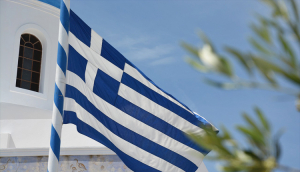
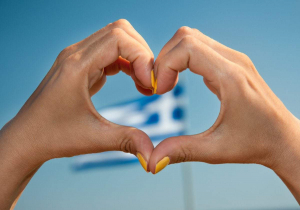
Usually referred to as the blue and white ('galanolefki' or 'kyanolefki' in Greek), the national flag of Greece consists of a white cross on a blue background in the upper left corner of the flag and nine horizontal stripes of blue alternating with white.

There is a blue canton in the upper left-side corner bearing a white cross which represents Eastern Orthodox Christianity, the official religion of the Greek nation, and follows a proportion of 2:3. Even though there is no designated shade of blue, most flags in Greece tend to feature dark or royal blue.
 
Even though it is widely accepted that the nine stripes represent the nine syllables of the phrase 'Eleftheria I Thanatos' which means Freedom or Death, some people say they are intended to symbolize the nine letters of the Greek word 'freedom' (eleftheria). A third theory states that the stripes derive from the nine Muses of Greek mythology. However, there is a consensus on chosen colors, which symbolize the colors of the Greek sky and sea.
 
The current Greek national flag was adopted in 1978 and is used on both land and sea is also the war and civil ensign, replacing all other designs surviving until that time.
 
To learn more about the national flag of Greece, please visit: Wikipedia
Wednesday, 09 February 2022 07:00

How To Express Your Love In Greek

Valentine's Day is just around the corner, and Athenian streets are immersed in a lingering romantic mood. Flower shops are overflowing with red roses, and chocolatiers are preparing tiny delights to please lovers' palates.
 
How can you show your affection to your significant other, the Greek way? What are the best words to express your love and affection? Even if you're single, how would you go about flirting with a Greek lady?
 
We have put together a concise list of useful words and phrases:
 
Will you be my Valentine? | Θες να γίνεις ο Βαλεντίνος μου; | Thes na yínis o Valentínos mu?
 
I love you | Σ' αγαπώ | S' agapó
 
I adore you | Σε λατρεύω | Se latrévo
 
May I kiss you? | Μπορώ να σε φιλήσω; | Boró na se filíso;
 
Ι miss you | Μου λείπεις | Moo lipis
 
Baby | Mωρό μου | Moro moo
 
You mean a lot to me | Σημαίνεις πολλά για μένα | Siménis polá ya ména
 
Υou make me happy | Mε κάνεις ευτυχισμένο / ευτυχισμένη | Me kanis eftihismeno (man) / eftihismeni (woman)
 
Would you like to go out to dinner with me? | Θα ήθελες να βγούμε έξω για δείπνο; | Tha itheles na vgume exo ya dipno?
 
When can I see you again? | Πότε μπορώ να σε ξαναδώ; | Póte boró na se xanadó?
 
Ι’ll call you | Θα σε πάρω τηλέφωνο | Tha se páro tiléfono


Happy Flirting and Happy Valentine's day! 

For any Greek language learner, memorizing verbs and learning to conjugate them correctly, is one of the first things you need, in order to make a correct Greek sentence.

Two Greek verbs that many Beginners and even Intermediate students find quite confusing are ρωτάω (rotao) and ζητάω (zitao). The main obvious cause of this confusion is that both verbs mean “to ask” in English. However, in Greek, there is a difference in “asking”!

Both verbs mean to ask, but: 

ρωτάω = to ask (a question)  
ζητάω = to ask for something

Take a look at the video below, where teacher Marina explains how to use these verbs. The video will also help you with the correct pronunciation.


If you'd like to learn more grammar and do a small exercise to test your knowledge, please visit: omilo.com


Omilo Greek Language and Culture inspires people from all over the world to learn Greek, while exploring Greece. They offer 1- and 2-week courses for adults that combine beautiful course locations, experienced teachers, and a balanced combination of Greek classes with cultural activities. All these make Omilo a place where people enjoy learning modern Greek and have fun.

Besides the courses, Omilo also creates online publications to help adults expand their language skills through Language Books and eBooks for different language levels.


Visiting folk museums that present how houses and other spaces were set up in the past can be a fascinating experience, but during one’s visit, it’s hard to forget one is in a museum.

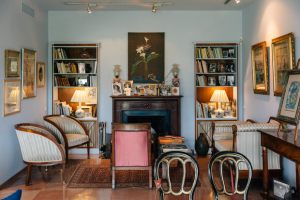
One of the key charms of the Katakouzenos House Museum (KHM) is that it almost feels still lived in. The 300m sq apartment on Vas. Amalias Ave is filled with impressive and highly elegant furnishings, books, and paintings by the likes of Chagall, who was one of the illustrious and globally famous friends of the owners. It is a cultural gem on the 4th floor looking out to the Parliament Building that still, not enough people know about.

The KHM was once the private residence of acclaimed psychiatrist Angelos Katakouzenos and his intellectually pioneering wife Leto, who belonged to the cultural elite of Europe’s so-called “1930s generation,” and were cultural ambassadors of Greece abroad and arbiters of international tendencies in Greece.

When she was a young woman, the museum’s director Sophia Peloponnisiou, connected with Leto Katakouzenou during the last decades of her life.

They developed a close and loyal friendship during which Peloponissiou made her dedication to her friend’s cultural visions a priority, offering her time and efforts in helping her publish her autobiography, soon published in its fifth version, and helping to organize cultural initiatives. Following Leto Katakouzenos’s death, the young woman discovered that she had been assigned the honor of continuing the pair’s cultural vision by keeping the apartment and its legacy ‘alive’.

Hosting a year-round series of cultural events such as talks, music and theatre performances, readings, and screenings, the KHM contains an extensive collection of over 40 paintings, some drawings, and prints, numerous works of art (decorative objects, sculptures), paintings in various media from the 1930s-1970s and a quality collection of 18th and 19th C. French and Hellenic furniture. The series of paintings includes a set of four large mahogany doors especially painted for the Katakouzenoi by their close friend Nikos Chatzekyriakos-Gkikas and many more paintings by the same artist in various media.

Further works by Spyros Vasileiou, Giannis Tsarouches, Giorgos Gounaropoulos (all prominent artists of the “1930s generation”) are hung all over the house. The watercolor and pastel portrait of Leto by Marc Chagall is perhaps the best work of art by a non-Hellene artist. “What makes the KHM collection of paintings quite unique, apart from their undoubted artistic and monetary value, is the way they were acquisitioned” notes Peloponissiou. “None of the works was purchased; indeed most were given by the artists themselves as gifts, tokens of friendship or gratitude.

To read this article in full, please visit: greekcitytimes.com
Greek mothers get kind of “traditional” when it comes to their children, always repeating several cliché sayings that make children laugh while setting their teeth on edge.

The relationship between a son or a daughter and a Greek mother is something that goes beyond imagination! Is it because of the social circumstances of Greek society? Is it the climate? The special temperament of Greeks? Who knows.

The point is, without the legendary, iconic ‘Greek mother,’ Greeks would simply be completely different people. And, as we can imagine, this special relationship comes with some special ways of communication—certain sayings that only a Greek mother says to her children regardless of how old the son or daughter is or whether or not they’ve heard it all a million times before.

1. “If you do/say this again I’ll have a heart attack!” 

– Because guilt is best used by Greek mothers…

2. “There is no ‘why’! It’s because I said so.”

– She’s right, she’s your mother…

3. “You’re like your father.”

– He’s to blame for everything bad that happens, including a possible alien invasion.

4. “Do you know what time you came home last night?”

– Of course, your Greek mother sure does!

5. “Won’t you become a father/mother one day? I hope your children will do to you the same things you’ve done to me.”

– Family justice must be served…

6. “Stop walking barefoot on the floor or you’ll get a cold.”

– Every Greek mother has graduated from med school and everyone in the house knows that. 

7. “Take a coat or you’ll fall sick.”

– Even if it’s mid-summer outside, a sudden snowstorm could always be around the corner. You never know! 

8. “Eat something! All that is left of you is skin and bones.”

– A Greek mother’s sense of perception, however, is not always overly accurate.

To read this article in full, please visit: greekreporter.com


Page 157 of 463