
XpatAthens
Olympia Odos Patra-Bound Highway Opens to Motorists
Greece Featured In Travel + Leisure's Picks For World's Best Islands
Our Picks For The Best Events In Athens This July
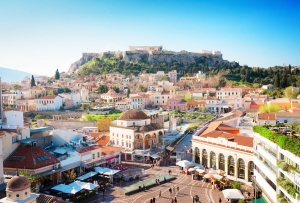
Athens & Epidaurus Festival 2018
Athens Open Air Film Festival - July Screenings
The beloved film-loving summer festival returns with its 8th edition of magical screenings from June to August. Special city corners, archaeological monuments, parks, squares, beaches and some of the most beautiful museums and sites in Athens transform into an open-air cinema with free entrance to the audience.
The main exhibition of the Athens Photo Festival will go through the month of July at the Benaki Museum. At the core of this festival is a range of events, including portfolio reviews, screenings, talks and discussions, workshops, and various community and participatory projects.
George Condo at the Museum of Cycladic Art
The Museum of Cycladic Art in Athens has the special honour of hosting the exhibition of George Condo from June to October. Condo is an artist who was vital in reviving the movement of figuration in America in the 1980s and he is also considered one of the most important American figurative sculptors and painters to this very day.
The Meet Market - The Association of Greek Archaeologists
Keeping with tradition, before we all head off on our vacations and much needed city breaks, we are getting together for one last Meet Market of the summer season at the Association of Greek Archaeologists. Set in an ever-so-enchanting garden in the city center, this is one of our all time favorite venues… surrounded by flowers and shade… right next to the Thisio Metro… and with a direct view to the Acropolis.
SUP Yoga In Athens
Street Artist Dedicates Mural To The Mati Wildfire Victims
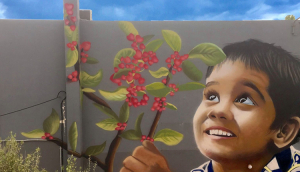
The Greek street artist who goes by the name 'Hambas' has recently created a touching mural on the wall of an elementary school in Rafina, eastern Attica.
His touching tribute to the 102 victims of the 2018 fire in Mati depicts a bright-eyed boy holding a branch of 102 heart-shaped fruits, symbolizing each of the victims of the dreadful wildfire.
The blazes in Mati are the second-deadliest fires so far in the 21st century, after the 'Black Friday' bushfires in Australia, which claimed the lives of 180 people in 2009.
Article Source: GreekReporter.com
Photo: @hambas_
Greek NGO Wins $2M Humanitarian Prize

METAdrasi's founder, Lora Pappa, said of the award: "It will enable us to strengthen our advocacy and help us be heard. This is an ongoing crisis. We are so grateful to receive the prize at a time when urgent needs regarding the refugee situation continue to emerge."
To read this article in full, please visit: The Guardian
About METAdrasi
METAdrasi was founded in December 2009 with the mission to facilitate the reception and integration of refugees and migrants in Greece. Believing that migration leads to development, METAdrasi is determined to uphold and protect the fundamental human rights of all those displaced and persecuted through innovative interventions. The name of ΜΕΤΑdrasi was coined by the synthesis of the Greek words “meta”+“drasi” (meaning: and then? + action) and encapsulates our purpose and philosophy.
Guided by the principles of consistency, efficiency, transparency and flexibility to adjust to needs as they emerge, METAdrasi is active in the following key areas:
•The provision of quality interpretation, enabling vital communication with refugees and migrants through the deployment of over 350 interpreters, trained and certified by METAdrasi in 43 languages and dialects – an activity that lies at the heart of any effective provision of humanitarian support;
• The protection of unaccompanied and separated children, through a comprehensive safety net of activities including accommodation facilities, escorting from precarious conditions to safe spaces and the pioneering activities of guardianship, foster families and supported independent living;
• The protection and support of other vulnerable groups through the provision of legal aid to asylum seekers, certification of victims of torture and deployment of humanitarian aid wherever needed;
• The education and integration of refugees and migrants through educational programmes, Greek language lessons, multilingual support guides and remedial education for children that enables access to the right to education, as well as soft-skills training, traineeship opportunities and work placements.
Ancient Frieze From Zeus Temple Found Near Shore
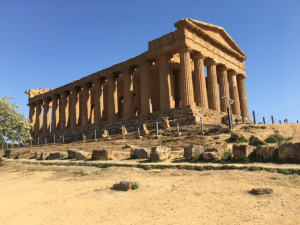
Originally published in Greek, on: enikos.gr
A Practical Guide To Free & Reduced Admission At Archaeological Sites In Greece
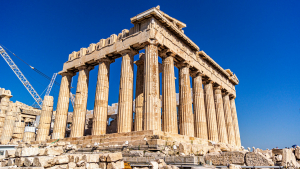
Free Admission Days for All Visitors
- March 6 (Melina Mercouri Remembrance Day)
- April 18 (International Monuments Day)
- May 18 (International Museums Day)
- The Last Weekend of September (European Heritage Days)
- October 28 (National Holiday)
- First Sunday of the Month (November - March)
- Youth from EU Member States (up to 25 years old): Upon presenting an ID or passport.
- Children from Non-EU Countries (up to 5 years old): Verification through a passport.
- People with Disabilities and One Escort: Proof of disability is required (minimum 67% disability).
- Unemployed Greek Citizens: Must present an ID card and unemployment verification.
- Students and Teachers on Educational Visits: Includes primary, secondary, and tertiary students from EU and EEA countries.
- Large, Single-Parent, and Three-Child Families: Greek families with official status can benefit from free admission.
- Refugees and Military Service Members: Present the appropriate identification documents for free entry.
- Archaeologists, Historians, and Related Professionals: Graduates and professionals in fields like archaeology, history, and cultural management.
- Active and Retired Employees of the Ministry of Culture: Including those from the Acropolis Museum and other key institutions.
- Educators: Both active and retired teachers in Greece, as well as substitutes, may apply for this pass.
- Non-EU Youth (6-25 years old): Verification through a passport is required.
- Seniors Over 65: From Greece, EU, and EEA countries, with ID or passport verification.
- Parents Accompanying School Visits: From EU and EEA countries.
Somadhi yoga lab
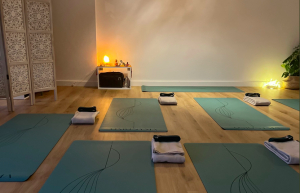
At Somadhi, we offer more than just yoga—we offer space. Space to breathe, to move, to observe, to feel.
Our classes are thoughtfully designed to meet you exactly where you are—sometimes more physically or mentally challenging, sometimes gentle and restorative—always aligned with your personal needs and rhythm.
With intentionally small class sizes, each session becomes a personal journey. We focus on helping you reconnect with your breath, your body, and the present moment.
Beyond yoga, meditation and pranayama, our Bach Flower Remedies and Somatic Experiencing sessions provide deep emotional and mental relief. These gentle yet powerful tools help release internal patterns that keep us stuck in repetitive cycles, opening the door to greater freedom, resilience, and presence.
Contact Info
Address: Antoni Tritsi 76, Halandri
Website: www.somadhiyogalab.gr
Instagram: @somadhi_yoga_lab
Facebook: Somadhi yoga lab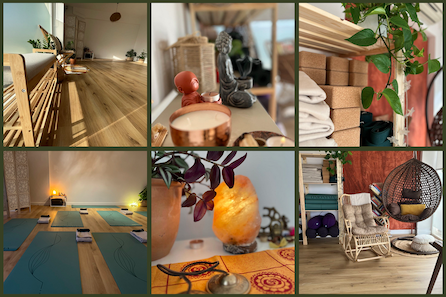
Times Change – Or Maybe Not…
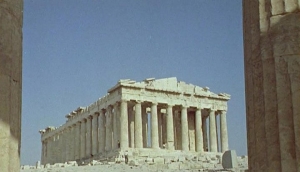
At the end of this post, there is a link to a video which some of you may have already seen. The video has been around for decades it seems, but is recently getting shared around social sites. The video is a ‘street view’ commentary on Athens in the 1960s. And watching it has made me wonder…
I was at a friend’s house over the weekend, for an ‘end of summer’ party. Great people, music, drinks, nice vibe… With a mix of expats and locals, the conversations invariable steered to why are you here, what do you think of Athens, the love/hate list that each of us carries, no matter where we live…
One such discussion was about the various ‘scenes’ of Athens – is there a hippie scene? Has the foodie scene come here? Are there any hipsters? What about the gay scene? I wasn’t sure what to answer, since for me the answer is equally ‘yes’ and ‘no’. What I came up with is that those ‘scenes’ seem to be more prevalent, and more clearly delineated, in a more ‘western’, perhaps more North American context, and while there are very clear elements of those ‘scenes’ here, Athens and Athenians are less likely to be defined by such social sub-groups.
Athens is a centuries-old city, with a culture that is more deep than it is broad, having brewed for thousands of years across empires and invasions, cultures and religions. It is a place equally eastern and western, with a long history that has as much to do with the Near and Middle East as it has with Western Europe. There is a strong definition of self here, and being Greek in itself forms a big part of that. In other places, that over-riding cultural identity is not as present, and sub-cultural affiliation is more prevalent… Maybe it’s similar in Italy or Lebanon? Clearly I’m no anthropologist or sociologist, but this was what went spinning through my head on Saturday night.
And then I saw this video, where – it seems to me – we can see how much has not changed among all the things that have changed. I mean the essence of the video – the spirit of the city - for me, is clear in the video. And it’s the same essence I feel today.
Or maybe it was the wine.
What do you think? Watch here: https://www.youtube.com/watch?v=0HqzEjdn4yQ
Until next week,
Jack
In this weekly space, keep up with ‘Jack’ as he navigates daily life in Athens… Anecdotes, stories, hits & misses, the good, the bad and, well, the rest…
Top Beaches In Rhodes
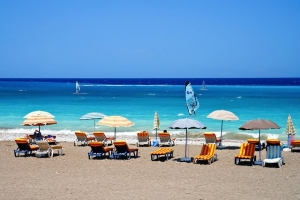
Rhodes (or Rodos) is an island in the Aegean Sea, the largest of the Dodecanese Island complex. It is located at the southeastern edge of the archipelagos of the Dodecanese, facing the shores of Asia Minor, which are about 9-10 kilometers away. The population of the island exceeds 110,000 and it covers an area of 1398 square kilometers.
It is one of the largest and most beautiful Greek islands. Its landscape mainly comprises of hills and low mountains, which in their majority are covered with forests. Its climate is subtropical and healthy. Refreshing westerly winds moderate the summer heat, while the winter is nearly always mild, with long periods of sunshine.
What could be better for you and your family than a trip to one of the Blue-Flag winning beaches on the island? Here is a short list:
(1) From Psínthos, head to Afándou bay (on the east coast of the island, 18 km from Rhodes City) by car or public transport. Here you will find beach sport centres, sections equipped with umbrellas and sun loungers, plus food and accommodation. This extremely long sandy beach has room for everyone: families with ice-boxes and folding chairs, couples with tents, Brits with their hot dogs and beers at the canteen, young people racing their jet-skis, locals tasting fresh fish at the tavérnas. Alongside the coastal road you will also find Rhodes golf course.
To read more, please go to visitgreece.gr & rhodesguide.com