
XpatAthens
The Third Largest City In Greece - Visit Patras
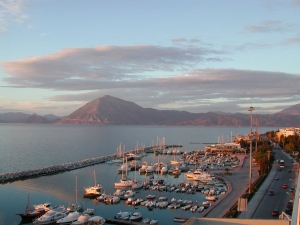
Welcome to Patras, a bustling student city, a place where entertainment, history and culture mingle together to create a destination filled with wonderful discoveries. Start your exploration around the city from Aghiou Nikolaou (Ayiou Nikoláou), the most famous pedestrian street. There, 192 steps await to lead you to the Old City. A romantic stroll around its cobbled streets will reveal grand colourful neoclassic mansions, reminders of the city’s glorious past.
Visit the city’s Medieval Castle, built in the second half of the 6th century A.D. on the ruins of the ancient Acropolis. Its walls enclose an area of about 22 sq.m.; it consists of a triangular external compound enhanced with towers and ramparts.
Walk past the remaining buildings, and take in breathtaking views of the city.
West of the Acropolis, in the “Áno Póli” (upper city), you will find Patras Roman Odeum, which was actually built earlier than the Athens Odeum (Herodion 160 AD). The geographer Pausanias, who visited Patras in 170 AD, wrote: “It has the most beautiful decoration I have ever seen, excluding of course that of Athens". The surrounding space is turned into an archaeological area where mosaics, sarcophagi and other ancient findings are displayed. The romantic souls should seek for the city’s landmark, the Lighthouse, in order to enjoy a breathtaking panorama of the port.
A visit to Spinney, the pine-tree-covered hill, the so-called “Veránda” of Patras will certainly uplift your senses. Its specially formed paths and the shade offered by the tall trees make it an ideal place for you to enjoy leisurely walks, or even go jogging. There you can also find a Municipal tourist kiosk from where you can admire a breathtaking view of the city, the port and the Patras Gulf.
In the centre of the city, two historical monuments will certainly draw your attention: Saint Andrew Church, one of the biggest churches in the Balkans, and “APOLLON" Municipal Theatre, one of the first opera houses in Europe. It was designed in 1972 by the German architect Ernest Ziller. Since 1988 it permanently houses the Patras Municipal Regional Theatre.
To read more, please see visitgreece.gr
ELSTAT: Internet Use In Greek Households

The Hellenic Statistical Authority (ELSTAT) conducted research on the use of information and communication technologies by households for 2013. The research revealed that in the first quarter of 2013, 60.4% of Greek citizens between the ages of 16 and 74 used a computer and 59.9% used the internet.
The vast majority of internet connections at home were broadband connections. Compared to the first quarter of 2012, the largest increase in internet connections was recorded in Attica (6.8%) and the smallest in Central Greece (1.5%).
More than 6 out of 10 men were using the internet and the ratio was almost the same among women. There was a strong variation, however, between different age groups. More than 9 out of 10 Greeks aged between 16 and 24 were using the internet, compared to 1 out of 10 Greeks aged between 65 and 74.
The variation between groups of different educational levels was also considerable. The internet was used by 9 out of 10 Greeks of high educational level, by 7 out of 10 Greeks of moderate educational level and by about 2 out of 10 Greeks of low educational level.
Moreover, in the first quarter of 2013, 93.3% of Greeks used the internet at least once a week, showing a 2.7% increase in use, compared to 2012 (91.7%).
By Evgenia Adamantopoulou
Fire-Scarred Central Athens Cinemas To Receive Facelift
Bill Granting More Cohabitation Rights Up For Consultation

To read more, please visit: ekathimerini
Best Spots For Counting The Stars In Athens
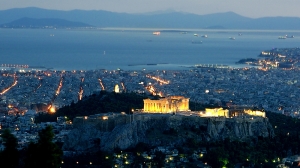
Verdant Ardittou Hill lies in the centre of Athens just above Kallimarmaron Stadium. Of enormous archaeological value due to its position, Ardittou Hill is a favorite spot among Athenians for romantic strolls as well as a great spot for jogging. It probably has the best views of the Acropolis, Lycabettus Hill, and the Columns of Olympian Zeus. A night walk along its cool paths reveals many charming secrets, both ancient and modern. Continuing along these paths brings you to Mets, an area with a growing reputation for fun and entertainment. What better way, in fact, to end your meander down lovers’ lane than with a drink in-hand soaking up the atmosphere with other Athenian fun-seekers!
Climbing up the picturesque steps of Kallidromiou Street in Exarhia, picking your way through the playfully cunning cats who’ve made this place their domain and admiring neoclassical buildings of exceptional beauty, you will find yourself on Strefi Hill. This particular hill is one of the favourite haunts of the Athenian young, and it’s not uncommon for parties to be held there, just below the little stone theatre. The night, as we all know, is made for romance, but if you prefer something less intimate, during the summer months you have the option of “Exostrefis”, one of the best known restaurants in Athens which serves excellent food and wine. The panoramic view of the city from the hill is invigorating, its trees, shrubs and flowers offer a breath of cool fresh air.
Perhaps the most iconic hill in Athens, second only to the Acropolis, Lycabettus is the highest point of the Athens basin, standing at 227 metres above the city. Access to this wonderful hill can be on foot but the most popular way is the picturesque cable car. Romanticism without the weariness of the climb and the whole of Athens at your feet! Atop the hill of Lycabettus sits St. George’s chapel in its whitewashed splendor, as if on permanent loan from the Cyclades. Before you decide to visit the hill, check if there is a concert on that day, as the theatre of Lycabettus is one of the most popular open air venues, and its stage has hosted top acts from the international music scene. However, even without musical accompaniment the climb to the top of Lycabettus is well worth it because of the unrivalled view when you get there. Sprawling Athens is at once tiny and vast, its myriad of lights is a starscape to match the heavens.
Named after the monument discovered there, Philopappou Hill is one of the most beautiful spots in Athens. With a strong flavour of ancient Greece, full of olive trees and in full view of the Parthenon, Philopappou Hill seems to encapsulate huge swathes of Greek history, ancient and modern, in a single image. Besides the Parthenon, you can cast your eyes down on the Acropolis Museum, the Odeon of Herodes Atticus, the whole of Apostolou Pavlou Avenue and the Observatory. On a clear day you can see the sea. Especially at night Philopappou Hill is transformed into an Athenian beacon, its monument bathed in a single orange spotlight. After a romantic walk on Philopappou, there are many districts resting in its shade to discover. Theseion, Monastiraki, Koukaki, Petralona. Pick one and have fun until the stars disappear from the sky.
On the southernmost tip of Greater Athens lies the headland of Sounion, with its iconic Temple of Poseidon, which adorns the clifftop 60 metres above the sea. Sunsets at Sounion are cinematic to say the least and have served many a passionate liaison with a sumptuous mauve and orange backdrop. So if you are in Athens, don’t miss the opportunity to visit Sounion at dusk so you too can marvel at the sun’s majestic descent into the Saronikos gulf and – if you are lucky – perhaps a bright full moon rising a little later on. In the summer months don’t miss out on a night dip on one of the nearby beaches. The sea, an ancient floodlit temple and you. A leisurely jaunt down the coast from the city and this paradise can be yours.
How To Rent Your Flat On Airbnb

According to the current tax system, income from renting properties is taxed according to the following scale: for income less/equal than 12,000 euros, the tax rate is 11 percent, while for income over 12,000 euros, the rate is 33 percent. These rates may change once new tax legislation is voted in parliament.
Source: Greek Travel Pages
Trip To Greece By Melina Mallos
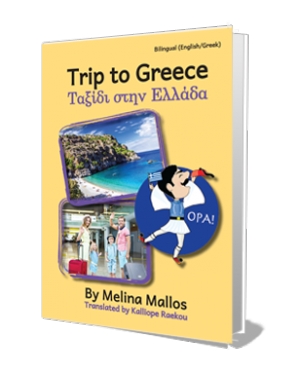
To purchase 'Trip To Greece,' please visit: Melina Mallos
About The Author
Ms. Mallos is a passionate writer, researcher and teacher with over 15 years’ experience working as a child educator in art museums in Australia. Ms. Mallos is also a frequent presenter at conferences, schools, libraries and community events. Her work has been featured in international journals, television and on the radio. In 2010, she was awarded a prestigious Queensland-Smithsonian Fellowship to research early learning programs in Washington D.C.
Athens On The NY Times List Of '52 Places To Go In 2017'
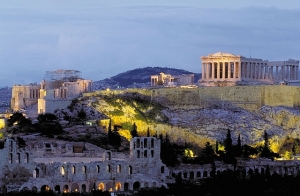
Meet Culture - When Greece Meets China

Epidaurus Lyceum 2019 – Applications Are Now Open!
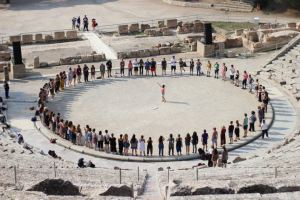
Prospective students can now apply. For more information, terms and conditions, and application forms, prospective applicants may click HERE!
This year’s theme, Reinventing ancient drama on the contemporary stage will pervade all Lyceum classes and related events.
The 2019 teaching staff will include the following: Xu Jiali, actress and professor of Chinese Opera at the Shanghai Theatre Academy; Ichinosuke Umekawa, teacher and actor of Kabuki theatre; the dance group known as Sine Qua Non ART (Jonathan Pranlas – Descours and Christophe Beranger); Kamila Klamut, director, co-founder of ZAR Theatre and collaborator of the Grotowski Institute; Christiane Pohle, award- winning director and head of programme of the Academy of Performing Arts Baden- Wuerttemberg; Andrea De Rosa, director; Gabriele Vacis, director, writer and theatre scholar; Vangelis Theodoropoulos, director, and Anastasios Karakatsanos, composer and music teacher. Lectures and masterclasses will be given by the following: Kostas Georgousopoulos, writer, translator and theatre critic; Konstantinos Markoulakis, actor and director; Efimia Karakantza, assistant professor at the Department of Philology, University of Patras; George Sampatakakis, assistant professor at the Theatre Studies Department, University of Patras; Anna Tsichli, member of the special teaching staff at the Theatre Studies Department, University of Peloponnese; Maria Mikedaki, assistant professor at the Theatre Studies Department, University of Peloponnese, and Georgina Kakoudaki, director and theatre scholar.
The programme is realized with the support of the Institut Français de Grèce, the Istituto Di Cultura – Atene, the Ministry of Cultural Heritage and Activities in Italy, the Municipality of Epidaurus and the Ephorate of Antiquities of Argolis. The Epidaurus Lyceum is a member of the International Network of Ancient Drama of the Hellenic Ministry of Culture and Sports.