XpatAthens

XpatAthens

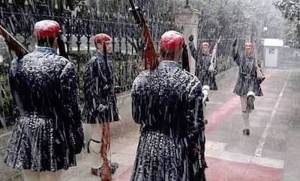
Nothing stands in the way of the Evzones doing their diligent duty as the members of the Greek Presidential Guard. They have been serving their country since December 12, 1868. Even when it is cold, rainy and snowing the guards are responsible for guarding important sites such as the House of Parliament and the Tomb of the Unknown Soldier.

The Evzones are like statues who are so precise from their uniforms to their routine. This is because they are trained to be able to march with their legs expanding to shoulder width and to stand motionless for over 100 hours a month.

The Evzones are allowed a coat when it gets cold, but regardless of the weather, they must stand at their posts and perform their duties in the snow, sleet or the cold!

To read this article in full, please visit: Greek Reporter
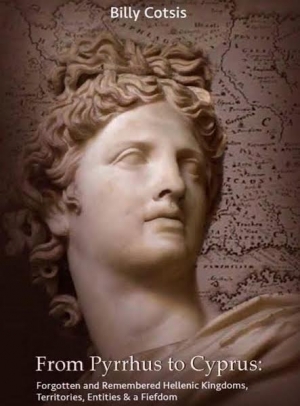
In his new book, Billy Cotsis explores 36 Hellenic kingdoms, territories, empires and a fiefdom to demonstrate the extent of the Greek world. From Pyrrhus to Cyprus covers the period following the end of the Alexandrian empire to the fall of the Byzantine Empire in 1453. Added to the mix are a number of independent Greek entities which existed during and post Ottoman times. The book has a twist and a connector in that it is told by a fictional Thucydides, who has managed to survive for an eternity thanks to a spell cast by Apollo. This is his tribute to the brilliance of Thucydides as the first ever historian who truly presented primary facts with minimal bias.

Why From Pyrrhus to Cyprus matters?

The Greek world was never about mainland Greece, it was always much bigger… The Hellenes travelled in search of colonies, new territories and empires. They founded hundreds of colonies and territories in the Mediterranean, Black Sea, Africa and Asia. A number of these survive to this day, with many of its inhabitants speaking a dialect of Greek and maintaining differing aspects of Hellenic culture. It is important that we never forget how far the Hellenes were able to reach and in many cases directly rule vast territories far beyond the Greek heartland. This book therefore brings you an overview of 36 identified Greek “territories,” after the disintegration of the empire built up by Alexander the Great. Starting with Pyrrhus, the king of Epiros, the book also provides an overview of the conquests of Alexander and the Hellenistic Age, Byzantine Empire, Trebizond, Ionian Republic and many more. These many more include the fascinating Indo-Greek Kingdom, which is the furthest point for the Greek conquerors, Empire of Nicaea which was the only Greek empire to retire without being subjugated, the independence of Samos and Icaria, the will of Crete and the creation of a fiefdom in the Crimea.

This book would not exist without the generous support of the Hellenic Club of Sydney.
 
To purchase Billy's book, please visit: Amazon
 
About The Author

Billy Cotsis was first published in 1995 in the Greek media in Sydney. Since then he has featured in dozens of publications in four continents and is the author of over 100 articles. In 2013 he began developing short film projects and they are listed below. His first book was the acclaimed, “The Many Faces of Hellenic Culture,” and he occasionally delivers a lecture series on Greek communities.

Billy can also be found on MerakiTV and is a member of a Community Board.

All this work is undertaken as a hobby and to promote interest in his true love, Greek history and satire. His second book has been out since February 2017 and he is currently developing a new book.

Having lived in London and Greece, he has travelled extensively over the years and can be found on www.herculean.wordpress.com

An avid Manchester United and Canterbury Bulldogs fan, sport is something he enjoys but is not actually good at.
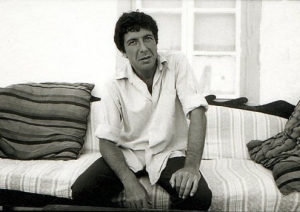
The Municipality of Hydra will honor late song-writer Leonard Cohen by naming the street outside of his house after him, during a tribute this June 2017 on Hydra.

The Canadian songwriter poet, novelist and painter bought his three-storey house on Hydra in 1960, where he lived with his partner Marianne Ihlen. While living on the Greek island, he created some of his most renowned works including songs “So long, Marianne” and “Bird on a Wire”, his novel “The Favorite Game” and the poem collection “Flowers for Hitler”.

The Municipality will also reveal a stone bench in his memory, donated by the International Forum of the Friends of Leonard Cohen.

To read this article in full, please visit: Greek Travel Pages

Photo Credit: Leonard Cohen Files 
After traveling to Greece with family in the spring of 2017, Ontario-based artist Lynn Pinchin became inspired to create. Her new work is titled 'Glorious Greece' and is now on display at the Art With Panache in London, ON.

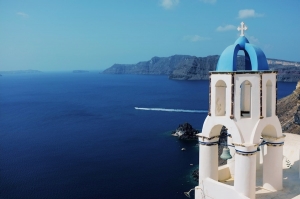
Pinchin said to the London Free Press, “I attempted to capture in these paintings the feeling of joy that is everywhere in Greece by choosing dancing colours and recreating fun in the movement of windswept brush strokes inspired by the spectacular views of dazzling white houses and hills, along with the amazing Blue Domes of Santorini."

Her work is popular at the art gallery and is a regular contributor of beach scenes. If you find yourself in London from now until September 29, 2018, head to the Art With Panache gallery.

Article source: The London Free Press
Iliada is a born and raised Athenian, and even though she traveled a lot for my work (and still does), she never felt the urge to move abroad. She loves Athens; it's her home. Iliada studied marketing, advertising, and PR and then specialized in digital marketing, which was quite an innovative space to be in. She worked in the corporate world in different marketing positions and ended up as a wholesale manager for a big Greek lingerie brand. Then, in 2012, in the midst of the Greek financial crisis and one of the toughest periods of our Greek nation, she had a vision.

5 Things To Know About Iliada

Connoisseur
Digital Storyteller
 
Enabling Greek Entrepreneurs
Nature Lover
City Pools

Besides her full-time job, Iliada started connecting with local entrepreneurs that were doing remarkable things in their fields of expertise. Her vision began to materialize as she expanded her network or truly daring people that were doing their best to move their dreams forward in difficult and uncertain times. Iliada wanted to show the world the artisans, products, and brands and the richness of Greek creativity while helping fellow Greeks build their brand presence abroad while sustaining themselves and their families. It took 6 months to turn her vision into a tangible business. Living Postcards was born.

Living Postcards started partnering with global websites and introducing the new faces of Greece to the world, through strategic product placements, followed by organizing events and global representations.

The next phase of Living Postcards is about showing the gastronomy and the local entrepreneurship of Greek cities and regions. The whole project will take place through interactive events in the form of "pop-up stores" throughout the country.

Read Iliada's full inspiring story on Guts & Tales.


About Guts & Tales

Guts & Tales is a storytelling platform founded by Eleni Meraki but grown to be a global collective of writers, dreamers, doers, shifters, visionaries, and generally people with guts. On this website, you can find change-stories of people that have made major career and life changes in pursuit of personal fulfillment. Alternatively, they offer a coaching program for people that want to make a change in their life or career themselves.

The platform recently started sharing stories of people living in Greece and is always looking for more inspiring tales to share. If you’d like to share your tale, looking for a professional coach, or just want to get inspired click here.

As recent surveys expect digital nomads to skyrocket to 1 billion by 2035, the Greek government is getting ready to claim its share from the so-called digital nomads market by launching a Digital Nomads Visa, specifically targeted to UK citizens.

Greek officials consider that Brexit will help boost the number of professionals seeking to work elsewhere and wish to encourage them to live and work remotely from Greece.

Even though this phenomenon has been widely known in other countries, Greece currently ranks 50th among 85 countries, as the pandemic became one of the main causes that this trend was brought to light here in Greece.

An MIT study showed that if Greece managed to attract 100,000 digital nomads in one year who lived and worked remotely for 6 months, the annual revenue could reach up to 1.6 billion euros, an amount that almost corresponds to revenue generated by a weekly stay of 2.5 million tourists.

The Greek government is well aware of the fierce competition this industry faces abroad, but with its stunning sceneries, easy access to other EU countries, and the thousands of visitors it welcomes each year, it hopes to gain a competitive advantage and become a key player, when it comes to attracting and providing high-quality hospitality to foreign employees.

Originally posted in Greek on kathimerini.gr
Translated by: Codico Lab

Introduction

Paul Cartledge
, a renowned Greek classicist, has authored significant works on Alexander the Great, democracy, Thebes, and Sparta. He is a frequent contributor to BBC programs and the radio show "In Our Time." As the A. G. Leventis Professor of Greek Culture at the University of Cambridge, Cartledge has received numerous accolades, including prestigious awards from the city of Sparta. In a recent interview, Cartledge delves into the essence of the Olympic spirit and its reflection on the competitive nature of Greek city-states and human achievement. The below conversation illuminates the historical context and enduring legacy of the ancient Games, offering insights into the cultural and social dynamics that shaped one of history's most celebrated sporting events.

The Competitive Spirit of Greek City-States

What do the Olympics say about the competitive spirit of Greek city-states and about human achievement in general?

It’s important to be clear that, although Greek city-states went to a lot of trouble and expense to encourage and reward athletes from their home communities, competitors entered themselves as individuals and ran, boxed or whatever on their own account, not as ‘citizen of, say, Thebes’. The Games were administered by officials from the nearby city of Elis, 11 in number, who decided whether or not a potential competitor was fit enough to compete. There were indeed some ‘working class’ competitors, but, since achieving the high level of competence required to compete adequately demanded leisure and resources, most competitors came from the upper social orders. The spirit in which they competed was called in Greek agônia, competitiveness, from which English derives its word ‘agony’. Enough said. Any religious festival which included a contest could be called an agôn, which meant struggle, competition. Silver coins were struck bearing a symbolic emblem representing Agôn. The spirit in which ancient Greeks competed at the Olympics (and any other of the 50 or so Games being held in the Greek world in any one year) was extremely agonistic – and agonizing. Since only men could compete in person in any Olympic event (women might compete only indirectly, as owners of horses, mules or chariot-teams), other terms used for the ‘virtue’ displayed by successful athletes meant literally ‘manliness’ or ‘manly virtue’: aretê, andreia, andragathia.

The Importance of Winning

How important was winning?

Was there one winner, or a few top ones? Winning was not the main thing: it was the only thing. No silver or bronze medals at the ancient Olympics. On the other hand, there was no equivalent of a gold medal on offer, either (let alone the bounty now being ladled out): the winning was considered to be by itself glory enough, a token of divine favour, so the only prize on offer was a symbolic wreath made of leaves of sacred olive trees growing at Olympia.

Famous Competitors & Their Awards

Who were the most famous competitors? What were the awards?

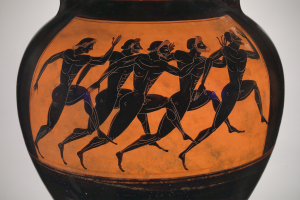
Let’s start at the beginning. The first stade winner in 776 BCE was one Coroebus/Koroibos, a local boy from Elis. Ever after, the winner of that particular race gave his name to the Olympics as a whole, so that Olympiad 1 was ‘the Olympiad of Coroebus/Koroibos’. Even more famous, though, or notorious was the winner of the 15 th Olympiad in 720, Orsippus from Megara, just across the Isthmus of Corinth that divides the Peloponnese from central mainland Greece. His claim to – dubious - fame was that by the time he ended his 200-metre dash he was more lightly clad than when he’d started, having somehow ‘lost’ or shed whatever loincloth type thing he’d been wearing at the starting grid. That story’s highly dubious as a matter of fact, since it was invented to explain why runners ran stark naked, and that had almost certainly been the case from the word go, as it was universally the case for all athletic sports at Olympia later on.

Milon of Croton was a wrestler, peerless in a sport that the Greeks prized above all others except the stade race. He opened his Olympic account by winning the Boys’ event, then proceeded to win five adult wreaths in a row, in the 62 nd through 66 th Olympiads. Unsurprisingly for such a supreme athlete (cf. Muhammad Ali), Milon attracted a host of legendary stories in life, such as that he was capable of carrying a four-year-old cow the length of the Olympic stadium, but also in death: allegedly in trying to split a tree trunk with his bare hands he got them inextricably caught and thus became fodder for a wild animal.

Diagoras of Ialysus on the island of Rhodes, winner of the boxing at Olympia in 464 BCE, was commemorated not only by a statue at Olympia but also by an epinician (victory) ode composed by Pindar of Thebes (no 7 in his collection of Olympian Odes). Pindar was not one to belittle his own contribution to the fame of those whose victories he celebrated, but here he was comparatively restrained, and persuasively placed Diagoras’s victory under the sign of Charis, the goddess of Grace. Diagoras sired a veritable dynasty of successful athletes, and a daughter, Callipateira, whose impromptu self-exposure we have noted elsewhere.

Leonidas of Taras/Tarentum (modern Taranto in the instep of Italy) was – before Michael Phelps – the holder of the greatest tally of Olympic wreaths of all time, a round dozen won at four successive Olympiads between 164 and 152 BCE. He was a runner supreme, winning not only the stade and the two-stade (diaulos) races but also the race-in-armour (hoplitodromos). And since the Olympics programme was so compressed, he had to win all three on the same day – which he did, four times over.

I have left to the last Theogones or Theagenes from the island of Thasos. He was a boxer, but he was also a pancratiast and – the reason for climaxing with him – a periodonikês or ‘Circuit-winner’. See next answer for the nature of the Circuit. And besides wins at these most prestigious Circuit games he was reputed to have won altogether over 1300 prizes. It helped him achieve that feat that by the 5 th century there were in all a total of 50 or so games being staged per annum all over the Greek world.


Richard Marranca is an author who teaches ancient world, myth, and religion at Montclair State University. He writes for various print and digital publications, and his upcoming book, "Speaking of the Dead: Mummies & Mysteries of Egypt," will be published by Blydyn Square Books. Richard has had the honor of receiving a Fulbright to teach at LMU Munich and spent a semester in Athens during his doctoral studies at New York University. In his career, Richard has had the privilege of interviewing esteemed classicist Paul Cartledge on topics ranging from Alexander the Great to Greek philosophy.


Thursday, 05 February 2015 14:10

My Week in Athens… Mar 7

This week we all heard the great news about the Rethink Athens design competition. For those who are just tuning in, Rethink Athens is an international competition, where urban designers from around the world could submit their plans for revamping, restructuring and rebuilding the heart of the city centre. Sponsored by the Onassis Cultural Foundation.

The whole thing has been in the works for many months, with lots of talk and speculation and Facebooking on the topic.

When the winner was announced this week at a big event at the Onassis Centre (attended by Mr. Samaras and a host of other important political and cultural officials), I followed it with much interest.

The winning design was submitted by Dutch design firm ‘Okra’, and involves a beautiful and eco-friendly plan for pedestrianizing Panepistimiou St., along with a revamp of Omonia and Syntagma squares. The plan is supported by politicians of many stripes, with completion for the entire re-do set for 2015.

I got to thinking… this could be the best news I’ve heard in months. The biggest breath of fresh air that Athens has been offered in ages. It reminded me of the period leading up to the Olympics in 2004, where, despite setbacks, schedule scares and the usual naysayers, the city came together in a feeling of great pride and accomplishment. I hope that this has the same effect. Rethinking Athens has been a long time coming, but maybe, just maybe, it’s the emotional boost that the city needs to weather the storms ahead.

Rethinking Athens is perhaps the easy part – re-making Athens will be the challenge. But I can’t deny the awesome feeling of ‘What if…’ that nags at the back of my mind. What if it all happened as they say…

Until next week,

Jack

In this weekly space, keep up with ‘Jack’ as he navigates daily life in Athens… Anecdotes, stories, hits & misses, the good, the bad and, well, the rest…

Monday, 16 February 2015 11:45

Hama Sushi Restaurant In Glyfada

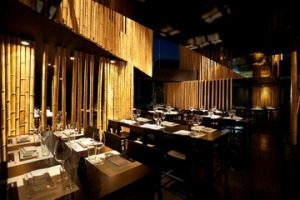
Athens’ chic residential neighbourhood Glyfada has a new dining destination. Designed by K-Studio, HAMA’s décor is a veritable bamboo explosion, welcoming visitors into the multicultural world of this Japanese/Brazilian fusion restaurant. Inspired by traditional Japanese dwellings, the interior features a large open central space, with natural bamboo screens on the upper floor creating dining booths that are ideal for smaller gatherings.

The whole space is expertly lit to bring out the contrast between the dark wooden furniture and light golden bamboo. Japanese chef Fujikawa Tatsuo was raised in Brazil and creates a unique melange of both food cultures. The menu is focused on fish, with dishes like Salmon-Crab tartar with yuzu sauce and truffle oil, Black Cod glazed and cooked with miso or the Sato Mix Fish uramaki.

Address: Grigoriou Labraki 34, Glyfada, Athens, Greece; www.hamasushi.gr


Do you have a recommendation or recipe to share? Send it to us at ideas@xpatathens.com!

Thursday, 19 February 2015 11:26

Greek Beer Sales Show Significant Increase

While consumption has not yet returned to normal levels, this summer, Greek beer was the undisputed champion. Greek beer sales showed a significant increase in consumption by Greeks, as well as tourists. According to Greek news, market experts estimate that during 2014, beer sales will increase from 2% to 5% and that despite the disappointing news of bad weather during summer 2014, beer sales will make a dramatic rebound.

The production of several types of beer, the active operation of small breweries, as well as advertising, helped keep customers interested in the product.

Small breweries made a small revolution in Greece over the last five years. Despite competing against multinational companies such as Heineken and Carlsberg, new small breweries have started operating across Greece, producing quality products and implementing innovative ideas.

To read more, please visit greekreporter.com

By Ioanna Zikakou

Page 103 of 452