XpatAthens

XpatAthens

Learning Greek can be a rewarding and enriching experience, especially for expats living in Greece or regular visitors who wish to deepen their connection with the local culture. Greek is known for its rich history, beautiful script, and cultural significance, but it also presents unique challenges such as complex grammar, pronunciation, and vocabulary. This guide will provide you with essential tips and strategies to successfully learn Greek and navigate these difficulties.

Why Learn Greek?
  • Cultural Enrichment: Greek is one of the world's oldest languages, with a literary tradition that spans millennia. Learning Greek allows you to read classical texts in their original form and better understand Greek culture and history.
  • Enhanced Daily Life: For expats and regular visitors, knowing Greek can significantly improve your daily interactions, making it easier to navigate, shop, and connect with locals.
  • Cognitive Benefits: Learning a new language boosts cognitive abilities, improves memory, and enhances problem-solving skills.
Getting Started

1. Set Clear Goals 

Determine why you want to learn Greek and set specific, achievable goals. Whether it's having a basic conversation, reading Greek literature, or passing a language proficiency test, clear goals will keep you motivated.

2. Learn the Greek Alphabet

The Greek alphabet is different from the Latin alphabet, and all the other alphabets to be honest. It's unique! Start by familiarizing yourself with the 24 Greek letters and their sounds. Practice writing and pronouncing each letter. Resources like flashcards and alphabet charts can be very helpful.

3. Basic Vocabulary & Phrases

Begin with essential vocabulary and common phrases. Learn greetings, basic questions, numbers, and everyday expressions. This foundational vocabulary will help you start forming simple sentences and engaging in basic conversations.

4. Use Language Learning Apps

Language learning apps like Duolingo and Memrise offer structured courses in Greek. These apps provide interactive lessons, quizzes, and practice exercises to build your skills progressively.

Challenges of Learning Greek

1. Complex Grammar

Greek grammar can be challenging due to its use of cases, verb conjugations, and three grammatical genders (masculine, feminine, and neuter). Understanding these concepts is essential for proper sentence construction.

2. Pronunciation

Pronunciation can be tricky, with certain sounds and double letters (like μπ, ντ, γγ, αι, ει) that do not exist in English. Listening to native speakers and practicing regularly can help you master these sounds.

3. Vocabulary & Dictation

Greek has a rich vocabulary with many words derived from ancient Greek. Dictation can be challenging because Greek uses different letters or combinations of letters to represent similar sounds (like η, ι, υ, ει, οι all make the same sound).

4. 3 Genders

Greek nouns are divided into three genders, which affect articles and adjective endings. Memorizing the gender of each noun and their corresponding articles is crucial for accurate communication.

Effective Learning Strategies

1. Immerse Yourself

Immerse yourself in the language as much as possible. Listen to Greek music, watch Greek movies with subtitles, and try to think in Greek. Immersion helps you get accustomed to the sounds and rhythms of the language.

2. Practice Speaking

Speaking is crucial for language acquisition. Engage with locals to practice speaking Greek regularly. This not only improves your language skills but also helps you connect with the community. Language exchange platforms like Tandem and HelloTalk can connect you with native Greek speakers.

3. Use Flashcards

Flashcards are a great way to memorize vocabulary and phrases. Apps like Anki allow you to create digital flashcards and use spaced repetition to enhance retention.

4. Study Grammar

Focus on key grammatical concepts such as verb conjugations, noun cases, and sentence structure. Use grammar books and online resources for structured learning. Practice by creating sentences and using grammar exercises.

5. Take a Class

If possible, enroll in a Greek language class at a local community center or language school. A formal class provides structured learning, expert guidance, and the opportunity to practice with fellow learners.

Advanced Tips

1. Read in Greek

Start with simple texts like children's books or short stories and gradually progress to more complex material. Reading helps you expand your vocabulary, understand sentence structure, and improve comprehension.

2. Write in Greek

Practice writing essays, journal entries, or even social media posts in Greek. Writing helps reinforce vocabulary and grammar while allowing you to express your thoughts in the new language.

3. Use Greek Media

Engage with Greek media, such as newspapers, podcasts, and TV shows. This exposure to contemporary language usage will enhance your listening skills and keep you updated on current events and popular culture in Greece.

4. Engage with Locals

Practice your Greek by engaging with locals. Participate in community events, join clubs, or simply strike up conversations. Real-life practice is invaluable and helps you become more comfortable and fluent in the language.

Learning Greek is a journey that requires dedication, practice, and patience. By setting clear goals, immersing yourself in the language, and using a variety of learning strategies, you can make steady progress and enjoy the rich rewards of speaking Greek. Whether you're reading ancient texts, conversing with locals, or simply appreciating Greek music, your efforts will open up a world of new experiences and opportunities. So start today, and embrace the beautiful challenge of learning Greek!
Athens, the birthplace of democracy, philosophy, and ancient civilization, is one of the most fascinating destinations in Europe. It offers a perfect blend of history, culture, and modern life. But there's one thing that could put a damper on your explorations—carrying heavy bags around. Thankfully, with Bounce luggage storage, you can travel light and hassle-free in Athens, ensuring you get the most out of your adventure.


Why Athens Is a Must-Visit Destination
 
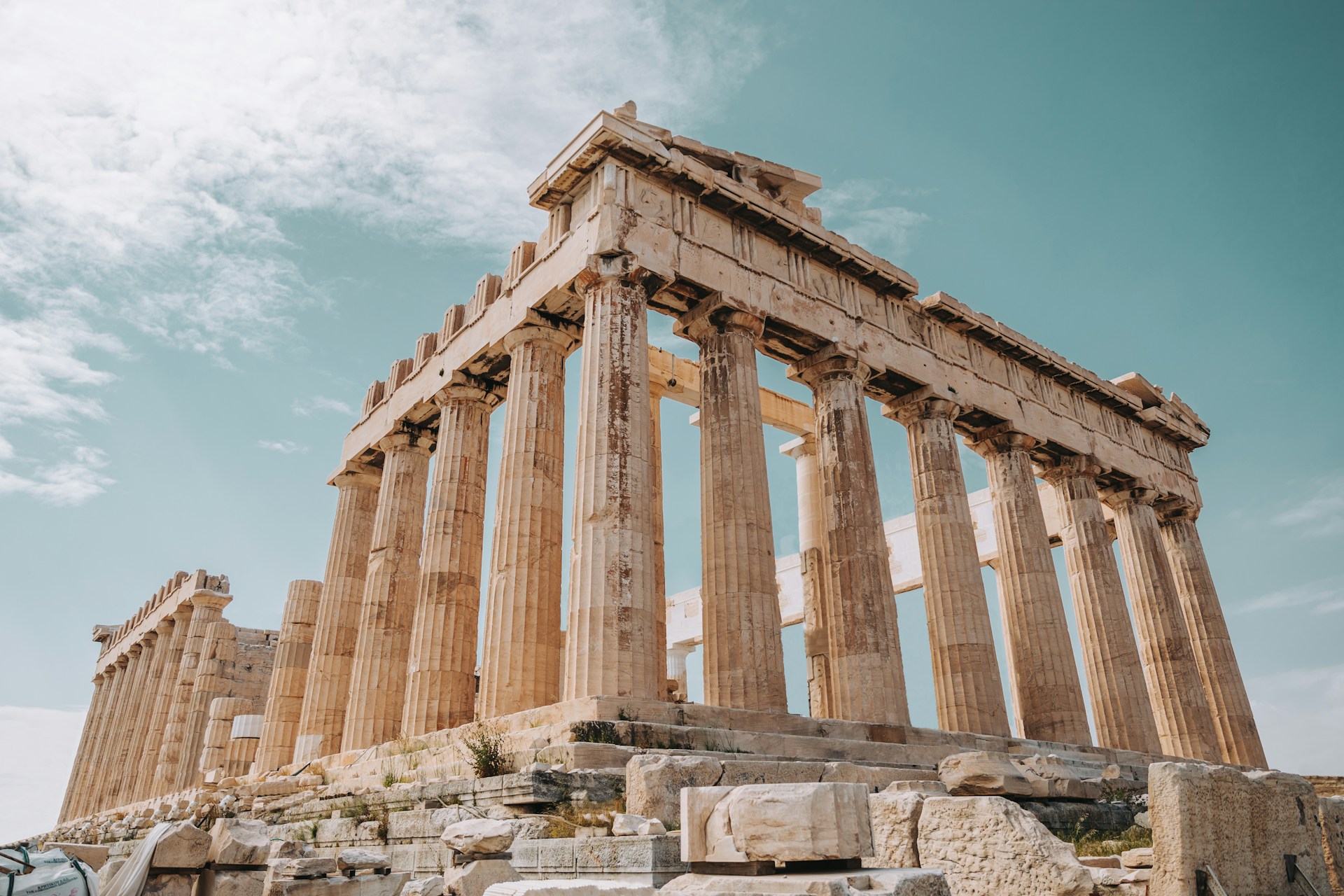
Athens, with its iconic landmarks like the Acropolis and the Parthenon, is a treasure trove of history. As you wander through its charming streets, you’ll be transported back to the times of the great philosophers and warriors. Explore the ancient ruins, relax in the buzzing Plaka neighborhood, and experience world-class Greek cuisine. Athens is a city that is both ancient and contemporary, offering travelers a variety of experiences that cater to all interests.

But, as with any major city, navigating Athens with luggage can be overwhelming. The city's narrow streets, busy public transport, and long walks between tourist hotspots make lugging heavy bags a real challenge. That’s where Bounce luggage storage comes to the rescue!

 
spencer davis ilQmlVIMN4c unsplash

Travel Light with Bounce Luggage Storage

Bounce provides a simple, convenient, and secure solution for travelers who want to explore Athens without being weighed down by their luggage. The beauty of using Bounce lies in its flexibility. You can book a bag drop location in Athens with Bounce, and enjoy your day without worrying about your belongings.

Imagine arriving in Athens and immediately heading out to see the Acropolis, without having to worry about your suitcase or backpack. Or perhaps you’re spending your last day in Athens, and you don’t want to be dragging your bags around while exploring the quirky shops in Monastiraki. Bounce allows you to store your luggage in trusted local shops, cafés, or hotels, allowing you to make the most of your day.

Bounce Friends

How Bounce Makes Your Athens Trip Hassle-Free
  • Convenient Locations: Bounce partners with trusted local businesses across Athens, from cafes and shops to hotels. You can easily find a Bounce location close to major tourist attractions, transport hubs, and neighborhoods like Plaka, Syntagma Square, and Monastiraki.
  • Easy Booking Process: With Bounce, booking a luggage storage spot is incredibly easy. Simply go online, find a nearby location, and reserve your storage space. You’ll be able to drop off your luggage in no time and get on with your Athens adventure.
  • Affordable and Flexible: Bounce offers affordable rates, and you can store your bags for as little or as long as you need. Whether you’re looking for a few hours of freedom or need a full day to explore the city, Bounce has you covered.
  • Safety First: Your luggage will be stored securely, so you can focus on your sightseeing without a care. Bounce’s partners ensure that your bags are in a safe environment, protected by insurance for added peace of mind.
  • Luggage Types: Whether you have a backpack, a suitcase, or something more unusual, Bounce can accommodate different sizes of luggage. This means you don't have to worry about finding a place that fits your specific needs.
Top Spots to Explore in Athens Without Your Luggage

Once your luggage is safely stored, you’re free to dive into all that Athens has to offer.
  • The Acropolis & Parthenon: No visit to Athens is complete without experiencing the Acropolis. This iconic hilltop complex is home to the Parthenon, the Temple of Athena Nike, and the Erechtheion. You’ll be able to wander freely and soak in the history without the burden of your bags.
  • Plaka and Anafiotika: Wander through the quaint streets of Plaka, Athens’ historic neighborhood. Lose yourself in its narrow alleys, filled with traditional Greek tavernas, artisan shops, and cafés. If you want to go further, visit the picturesque Anafiotika area, a hidden gem with whitewashed buildings that resemble a Greek island village.
  • Monastiraki Flea Market: A must for shoppers and culture lovers, Monastiraki is the place to be for street markets, antique shops, and local vendors. With Bounce, you won’t have to drag your purchases around—you can take your time and pick up souvenirs at your own pace.
  • National Archaeological Museum: For history buffs, this museum is a treasure trove of ancient artifacts, including the famous Mask of Agamemnon and statues from the Acropolis. It’s one of the largest museums in Greece, so it’s better to visit without the extra weight.
Bounce Product 2

Travel Smarter with Bounce in Athens

Athens offers endless adventures, and with Bounce luggage storage, you can make the most of your trip by exploring the city unencumbered. Whether you're gazing at ancient ruins, shopping at local markets, or sipping coffee in a café, having the freedom to travel light will make your experience even more enjoyable. So, next time you're in Athens, let Bounce take the weight off your shoulders—literally and figuratively—so you can immerse yourself in the wonders of this incredible city!

Don’t let your luggage hold you back. Travel smart, travel light, and let Athens captivate you!
Located next to OAKA (Olympic Athletic Center of Athens “Spiros Louis”), the beating heart of the 2004 Athens Olympics, stands the Athens Olympic Museum, and it truly couldn’t exist anywhere else. Every corridor, every artifact, every sound inside speaks of athleticism, Olympic ideals, and the spirit of human striving. It’s location  here, next to the Olympic stadium that once hosted the world, feels almost inevitable.

The museum’s Main Exhibition stretches across 1,800 m² and is more than just a collection of objects; it’s an experience of following a storytelling carefully designed for everyone. Are you interested in exploring the city of Athens through its Olympic history? Then ask for the “Agon, Classic Researcher” tour, through a printed guide that connects 25 points within the exhibition to 35 sites across Athens, making the city itself part of the story. The complete exhibition is bilingual (Greek and English) in texts and in an audio guide available through signage that appears in Greek, English, and Braille. The audio tour is part of the program Listen to Our Story, developed with the help of accessibility specialists to be suitable for visitors with visual impairment. The program includes 30 audio narrations and 8 tactile stations. These elements  invite visitors to explore the museum not only through vision, but also through touch and sound, turning exhibits into living voices.

For children, the museum adds extra fun with the “Agon, Family” program -a card game for the entire exhibition, included with your ticket. Each card corresponds to a gallery’s point of interest and players race to find the spot, complete the task, and record their time. The player who collects the most spots wins the red winner’s ribbon to wear at the end, a playful, interactive way for kids (and adults!) to explore and learn.

In this article, we’ll lead you through the museum as we experienced it, but think of this as a map, not the journey itself. To truly feel its pulse, you need to wander its galleries, hear the soundscapes and dramatized stories, discover artifacts and memorabilia, and let the stories of athletes, victories, and struggles unfold around you in real time, because no description can capture the full thrill of discovery.
XpatAthens photo2

A Time Capsule Opens

The journey begins in a space that feels less like a gallery and more like a portal. The centerpiece is a 3D projection  shaped after the κότινος, the olive wreath once placed on the heads of Olympic champions. Award-winning in its design using the technology of video mapping, the exhibit glows in the hushed light, alive with scenes and memories from past Olympics, accompanied by the music of Evanthea Reboutsika. Already, the past feels near enough to touch.

The second gallery resembles a cave, an otherworldly chamber where myths breathe again. Small “nests” shelter objects and stories: Hercules cleaning the Augean stables; Pelops charging forward in his chariot; the Curetes dancing, their shields clashing to drown out infant Zeus’ cries; and finally, the head of formidable Zeus, crowned with a wreath, a vision inspired by the lost golden statue.

From Myth to History

Stepping onward, we find ourselves surrounded by the world of competition throughout ancient Greek times.  A great wall lays out the Panhellenic Games, not only the Olympics, but also the Isthmian, Pythian, and Nemean contests, as well as a special tribute to the Panathenaia. In this moment it becomes clear: this museum tells not just the story of the Olympics, but of Greece itself, and by extension, of the world.

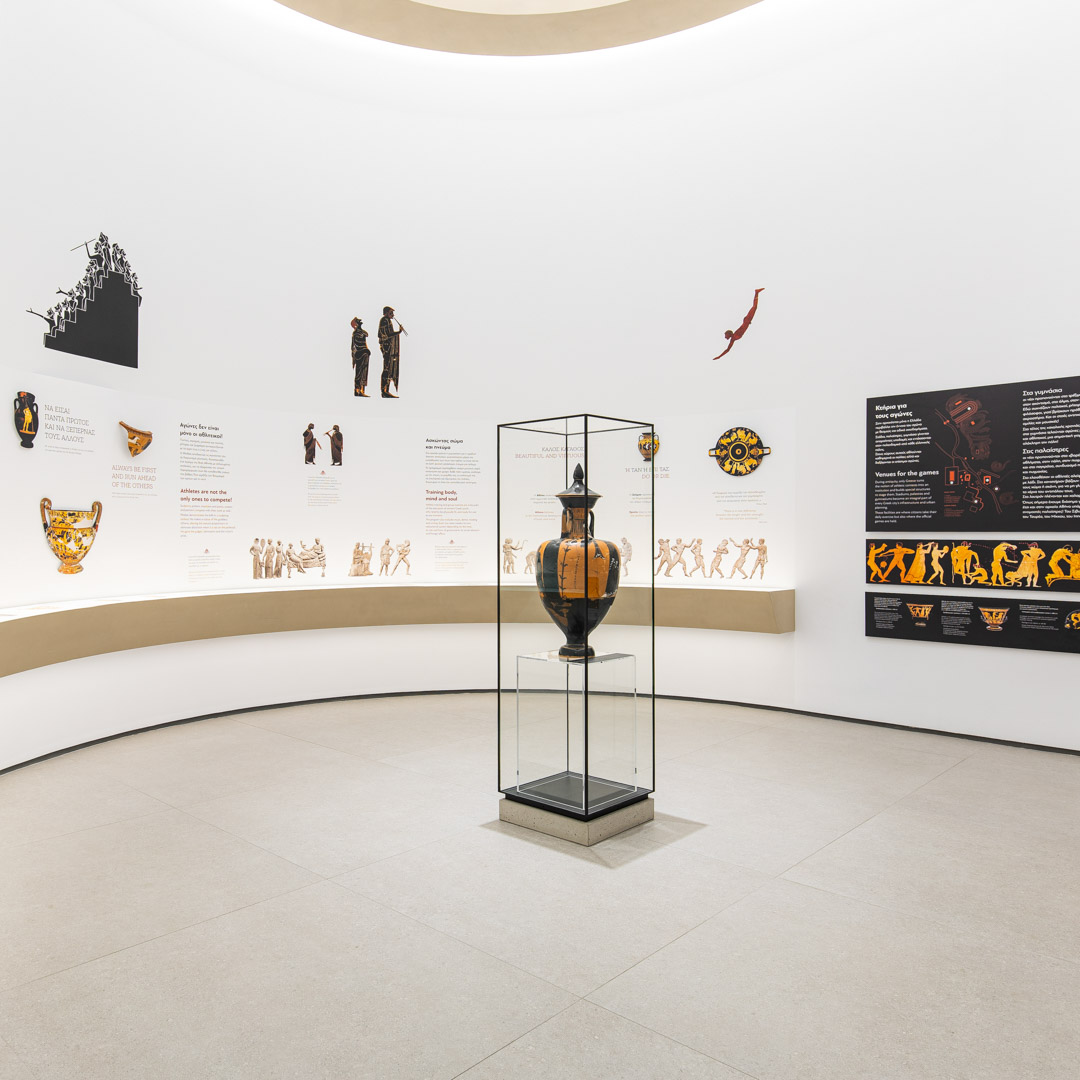
On the opposite wall, Athens and Sparta confront one another in a timeless contrast. Athens proclaims καλός καγαθός, “beautiful and virtuous”, while Sparta answers with the uncompromising ἢ τὰν ἢ ἐπὶ τᾶς, “with your shield, or on it.” We also see an amphora, a faithful replica of those once full of olive oil, the treasured prize awarded to winners of the Panathenaic Games. 

The fourth gallery adds a modern twist: an interactive video map. With a touch, we uncover the meaning of the sacred truce (ἱερή ἐκεχειρία) and read about the Discus of Ifitos, reminders that even in times of war, the Games called for cease of fire and harmony across the world.

Experiencing the Ancient Games

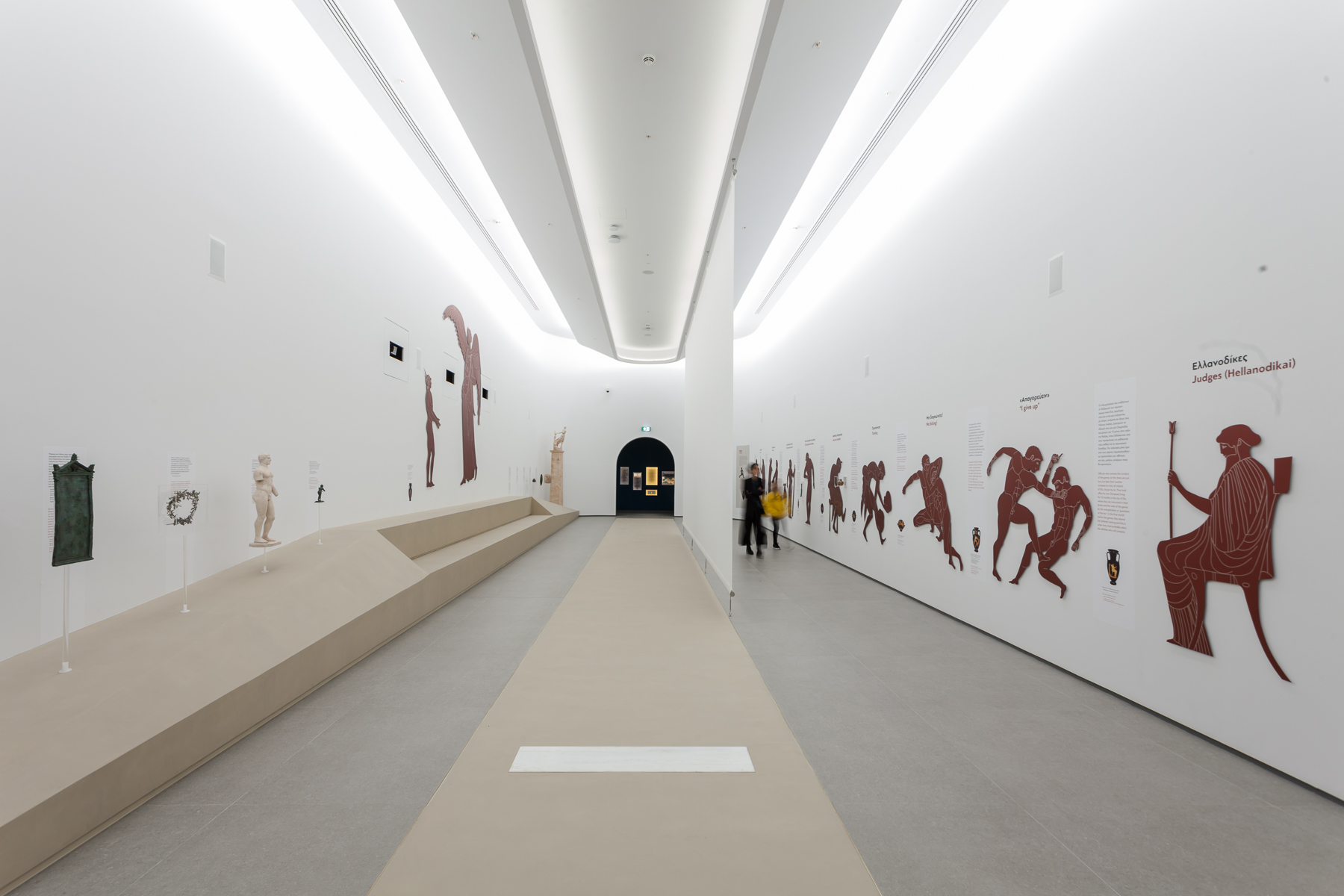
Then comes the fifth gallery, perhaps the most thrilling in the section of antiquty. Here, the stadium of Olympia unfolds before us in scale, and visitors are invited to run the δρόμος, the ancient sprint. High above, the statue of Nike by Paionios watches silently. The walls around us speak of rules: no biting, no foul play, and the ritual of ἀπαγορεύειν, where an athlete admitted his defeat by raising his finger.

The Hellanodikai, the judges of the Games, come into view, alongside the question: who could truly become an Olympic champion? At the tactile station, visitors can feel the shape of a κότινος olive wreath, or the crimson woolen ribbon once tied around the Olympic champions. The ribbon, it was believed, carried strength to its wearer. A “book of fame” completes the gallery, and we can turn the pages to reveal champions whose names still echo through time.
XpatAthens photo3

From Byzantium to the Revival

As we follow the route to the next gallery, the mood shifts dramatically. Designed to resemble a Byzantine church, with fonts, music, and aesthetics from the era, the gallery takes us from a period when the Games had faded and stopped, to the travels of the Europeans seeking to rediscover Olympia. A photograph of the excavations, bathed in light, symbolizes the rebirth of the ancient historical site.

The narrative continues with the path to the revival of the Games, leading us to Pierre de Coubertin and the Greek intellectual Demetrios Vikelas. Exhibits include extracts from their lengthy correspondence, Vikelas’ actual office desk, and a sizeable variety of documents from the 1896 Athens Olympics: letters, guides, flyers, and commemorative stamps on the occasion of that first modern celebration.

Into the Stadium Once Again

Next, we step inside a projection and exhibition hall designed as the Panathenaic Stadium. Sitting among its seats, we relive the atmosphere of the first modern Olympics. We learn how medals were originally awarded, with only the first two places recognized, as gold was introduced later in the history of the Games, and how participation was firstly limited to men.

We step into history as we learn all about the first modern Olympic Games of 1896. On the walls, we even see the figures of Harilaos Vasilakos and Spyros Louis, running towards the finish line—witnessing their struggle, their triumph, and their determination.

A Timeline of Every Games

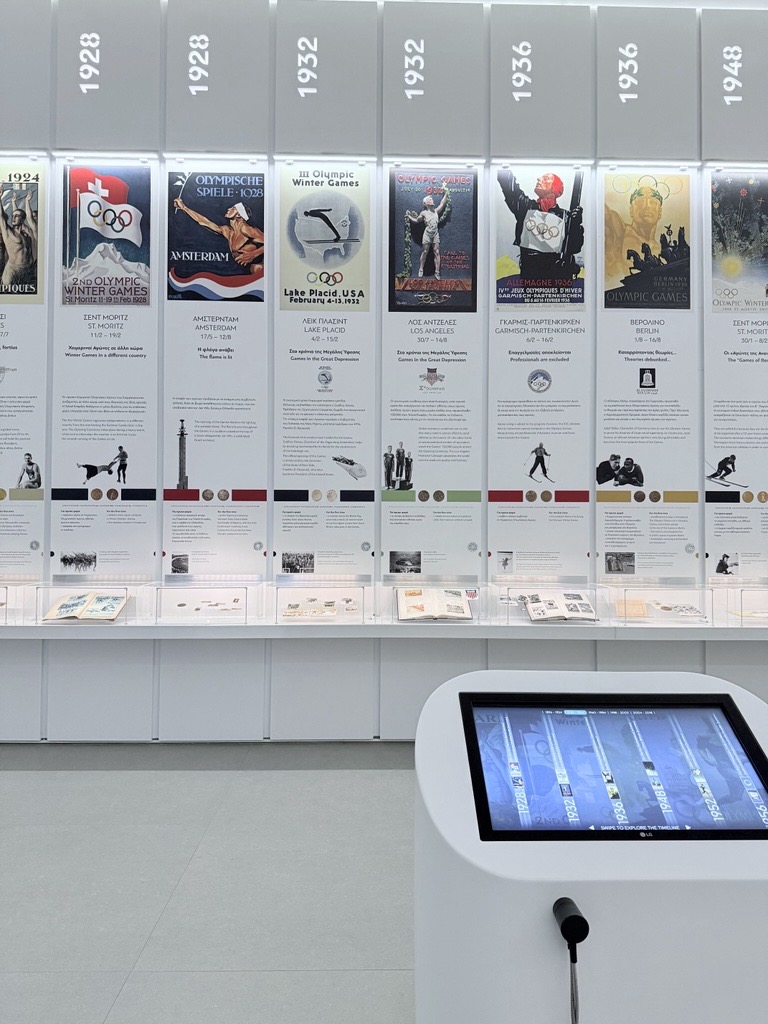
In the next gallery, the story expands. A timeline of every Olympic Games edition - both Summer and Winter - unfolds before us, enriched with a collection of objects from each era, among which medals and athletes’ memorabilia. We learn so many meaningful facts and stories like how in 1932 Lake Placid, Mollie Phillips became the first woman to carry the British flag at the Winter Olympics. Or in 1964 Innsbruck, Italian bobsledder Eugenio Monti famously lent a part of his own sled to the British team, allowing them to win gold while his team took bronze, a story of true Olympic spirit.

Perhaps most exciting of all is the interactive touchscreens that let us explore what took place historically in the world during each Olympiad, proving once more that the Athens Olympic Museum is far more than a museum about the Games; it’s living chronicle of history itself.
XpatAthens photo4

Athens 2004: The Games Return Home

Then, the journey brings us back home. The next exhibition gallery is an allusion to the Olympic Stadium of Athens (OAKA) and is dedicated to the Athens 2004 Olympics. We saw original sketches of Kouroudis’ Olympic sports “pictograms,” inspired by Cycladic figurines, as well as of the first medal engraving featuring Paionios Nike of Olympia ascending from the Panathenaic Stadium of Athens, designed by Elena Votsi; the permanent design of every summer edition ever since. 

We follow the journey of the 2004 Olympic Torch Relay across all 5 continents, mapped in an artistic wall installation, and meet the mascots Phevos and Athena, inspired by the archaic ceramic daidala. On a video wall, we trace the massive public works that transformed Greece to host the Games.

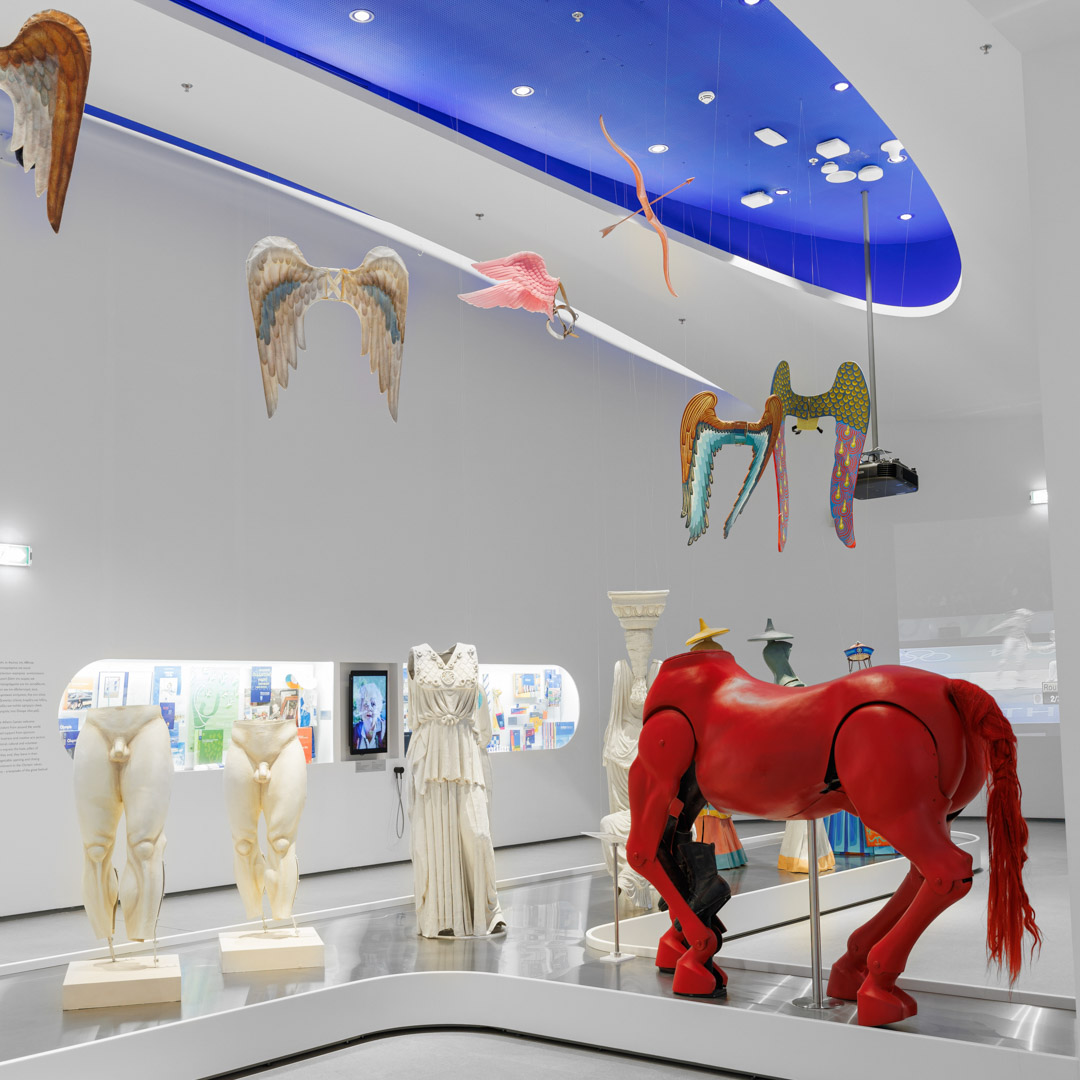
The surprises continue: a parade of the original performers’ costumes, including the imposing Centaur, which the visitors can even touch, transfers us to the night of the Athens 2004 Opening Ceremony. Here also lies another treasure of memory, the medal of the decorated taekwondo Olympian Alexandros Nikolaidis, offered to the Museum for exhibition by his family.

And then, the focus shifts to the Athens 2004 Paralympic Games, presented through an audiovisual production and a collection of objects. A tactile station allows visitors to feel the 2004 Paralympics medal design featuring the Parthenon, and the neighborhood around the Acropolis, as well as a carefully reproduced larger tactile version making it accessible to visitors with visual impairments. This thoughtful detail captures the essence of the Games: accessibility, inclusivity, and the celebration of every athlete’s achievement.

Then the timeline of the modern Olympics continues in the next gallery where we encounter some empty slots waiting patiently to be filled with items of the future editions. 

Kids will especially love the many close-up looks of the many mascots, before we see the Games motto in Latin that takes us to the next section of the exhibition.  
XpatAthens photo5

Symbols You Can Touch

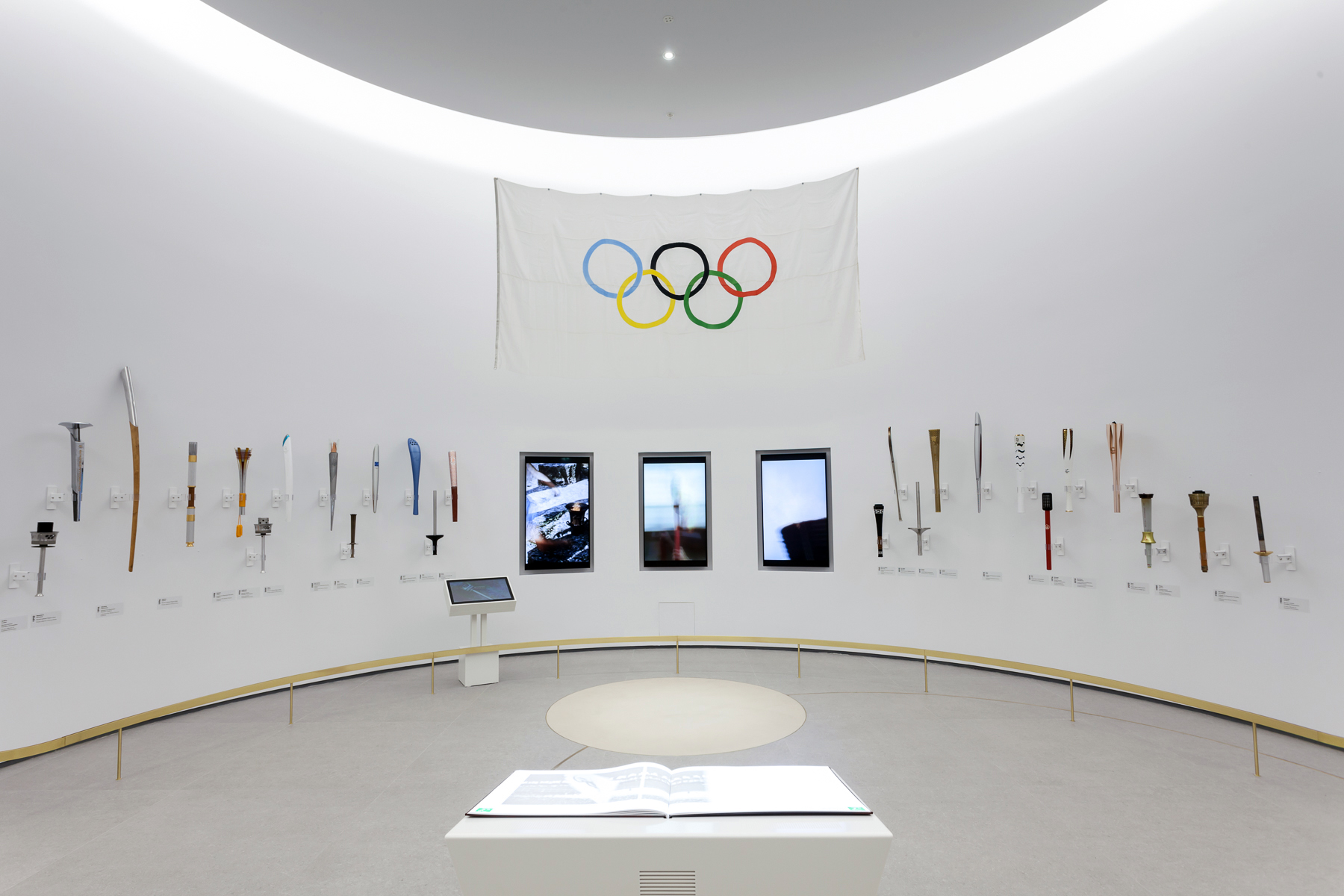
The visit continues into a gallery where the Olympic symbols are presented together. Under the Olympic Flag we, again, find a tactile station, where visitors are invited to hold two original torches (δάδες) and to run their hands across the embossment of the Olympic rings symbol. For visitors with visual impairment especially, this is a revelation: the Games are not only something to watch, but something to feel, a universal language made tangible.

On display is the priestess’s chiton of Artemis Ignatiou, the current choreographer of the ceremony of the lighting of the Olympic Flame, a garment woven with tradition and ritual. Around us, the walls present the Museum’s collection of Olympic Torches, each design carrying its own meaning, each flame its own journey. 

The visit in the gallery cannot skip the innovative central interactive installation, which received an Ermis award in 2021. It features a “seemingly unwritten” large book that come to life when its pages are flipped. The book is inspired by the Olympic Charter and vividly presents the Olympic Movement, the symbols and the philosophy of Olympism. 

Stories Stitched in Fabric

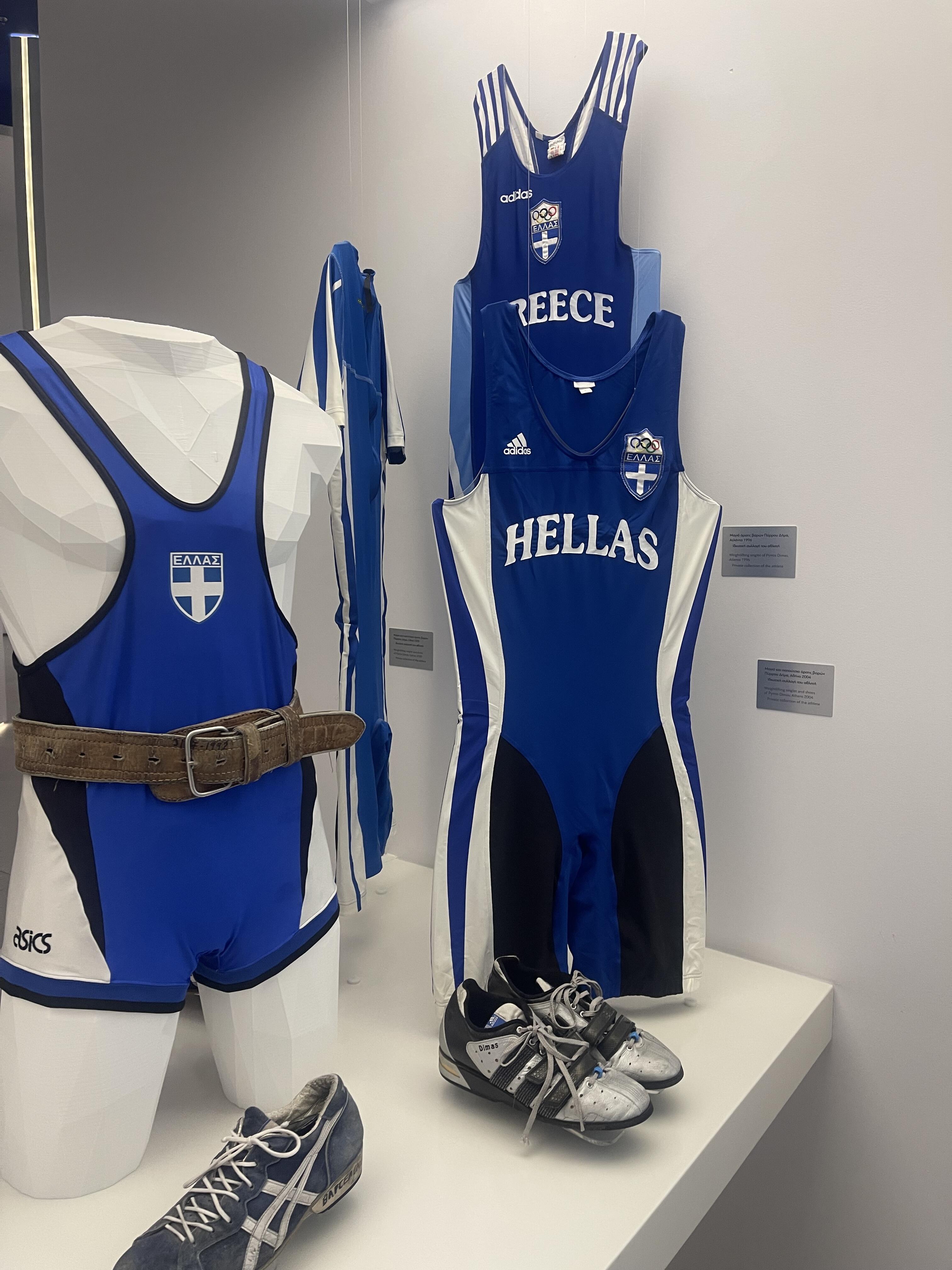
In the next gallery, we find two large digital stations that let us dive deeper in discovering the stories of every Greek Olympic and Paralympic medalist, their victories, and seeing excerpts from their performances. Around the gallery we see their performance apparel and equipment from their participation to the Games, some instantly recognizable, others less known, like the Paralympic sport boccia. Before us the tribute to one of the legends: Pyrros Dimas, with the entire collection of the singlets he wore across his Olympic career. Then inclusivity takes center stage. At first glance, a simple piece of equipment whose purpose isn’t obvious. But then its significance soon emerges: it is the running tether worn by the blind sprinter Paraskevi Kantza, the link connecting her to her guide as they competed side by side. Suddenly, it’s no longer just an object, but a story of resilience, determination, trust, and teamwork. 
XpatAthens photo6 3

Become an Olympian

This is where the exhibition shifts from being a spectator to being a participant. We are invited to become athletes ourselves, to use a real Olympic bow in archery (Summer Olympics), to feel the rush of wheelchair racing (Paralympics), and to balance ourselves on the slopes in skiing (Winter Olympics).

For children, especially, this is a revelation: to learn by doing, to understand how difficult -and how extraordinary - the life of an athlete truly is.

The back wall glows with a Hall of Fame, but it is not only about medals and records. In the same gallery we meet athletes as people, their struggles as real as their triumphs. We learn about Michael Phelps, who faced the shadows of depression even as he stood on the podium and how Nikolaos Kaklamanakis thought his greatest rival was none other than himself. The exhibition host his sail of the 2004 Games, centrally presented in front of a mirror that is there to remind us that we too battle our own rivals within.

This is where the line between athlete and visitor blurs, as we can see our paths from the perspective of their stories.

An   Inspiring Farewell

The exhibition closes with a large audiovisual show. An audiovisual production without words, without narration, sweeps across the large screen. We see some of the most powerful moments in Olympic history: the struggle of the athletes such as the emblematic barefoot marathon runner Abebe Bikila, the tears, the embraces, the impossible victories. With no explanation, only music, the images speak directly to the heart.

And so, the tour ends where it began, with silence, with awe, with the timeless flame of the Olympic spirit.
XpatAthens photo7

A Must-Visit for Everyone

What struck us most about the Athens Olympic Museum is how every detail has meaning. Nothing is random: every gallery, every symbol, every object is part of a carefully curated story. We loved how seamlessly it blends myth, history, personal stores and living memory into one journey. For children, blind and visually impaired visitors, the tactile stations, audio descriptions and narrations, as well as the interactive exhibits make the experience deeply, movingly inclusive and the Games’ stories accessible in a way that truly touches the heart.

The museum’s reach extends far beyond its walls. Its educational program “Μουσειοβαλίτσα” (AOM Suitcases) available in Greek, English, French, Arabic, and Farsi, brings the Olympic ideals to every classroom, group and community it reaches. Meanwhile, Live online Tours bring the history of Olympism to every corner of the globe. It’s a reminder of its mission to share values of inclusivity, excellence, and peace across languages and cultures. And yet, as much as we saw, we realized we had barely scratched the surface. The exhibition is so rich, the storytelling so layered, that the just one visit feels like an introduction, a welcome to the world of Olympism. We left with the sense that we must return, because there is always more to learn, more to feel, and more to discover in this place where history, humanity, and hope meet. The Olympic Museum is not just worth visiting; it is worth visiting again and again.


Wednesday, 18 February 2015 13:51

Nekromanteio at the River Acheron

Within a short distance of Parga (about 25 minutes) lie the ancient ruins of the Nekromanteio of Acheron. It is a little known archaeological site in Greece and it is located in the province of Epirus. I visited Nekromanteio when I was a child and the location and mythology of the place stuck with me for life. I always wanted to return, and I finally made the journey one recent summer with my sister Vivi.


Nekromanteio is a small archaeological site, easily navigated in one or two hours. I wandered through the rooms and storage areas before entering the long corridor where in ancient times so many must have walked trembling in anticipation of an encounter with the dead. Of the three arched gates in the labyrinth two survive in good condition and the labyrinth with its massive walls is still an imposing structure. Imagining the path of the ancients, I walked through the third door into the main hall where the hallucinating pilgrims believed in the encounter with the underworld inhabitants.

Through a small hole on the floor of the main hall I descended a steep metal staircase down into the dark crypt that was the palace of Persephoni and Hades. The passage even today appears ominous--like the descent to the underworld should feel-- and the room is stunning in the contradiction of its irregular rocky floor and the perfectly masoned stone arches that soar overhead. The crypt was probably carved out of the live rock in the same place where an ancient cave may have started the cult.

Above this, the passage to the underworld of a pagan cult, in later times a Christian church was built that crowns the ancient stones. It stands as a silent witness to the long history of the land that manifests itself on strata of symbolic monuments to conflicting ideologies.

Nekromanteio is not as well known as the other oracles of Greece, but well worth a visit for its charm and the fascinating cult that made it all possible. I enjoyed my walk through the ruins as I tried to imagine the gamut of feelings that an ancient believer must have experienced on his/her way to meet the dead with shaking knees and a spinning head.

I didn't fear, nor believed, but driving away I smiled and secretly adored the fact that I had just descended and escaped from the dwelling of Hades himself; a feat reserved for the bravest of men: Orpheus who went for love, Hercules who went for the three-headed dog, and Odysseus who went for the future to be told.

Source: Greek Landscapes

Friday, 20 February 2015 16:17

Vegetarian Yiouvetsi

Vegetarian Yiouvetsi, with orzo and fresh veggies, is delicious, hearty, healthy, and perfect for spring!

Ingredients

1/2 cup plus 3 tablespoons extra virgin Greek olive oil
2 large red onions, finely chopped
½ teaspoon cinnamon powder
4 large carrots, peeled and diced
1 lb. / 450 g orzo or Greek kritharaki
3 cups chopped, canned or fresh plum tomatoes
2 bay leaves
3 sprigs fresh or dried oregano
Salt and pepper to taste
1 ½ lbs./ 750 g zucchini, diced
2 garlic cloves
2 tablespoons balsamic vinegar
Grated Greek kefalotyri cheese, parmesan, or other hard cheese

Instructions

1 Heat 2 tablespoons olive oil in a large skillet and sauté the onions for 10 minutes over medium heat, until soft. Add the cinnamon, stir, and gently cook the onions for another 3-4 minutes, until lightly colored. Remove and set aside the onions. Wipe the skillet dry.
2 Heat 2 tablespoons more of olive oil in the same skillet over low heat and cook the carrots for 15 minutes, until softened but al dente. Stir occasionally.
3 Preheat the oven to 375F/190C.
4 Bring 6 cups of salted water to a rolling boil and cook the orzo for about 5 minutes, until al dente.
5 Transfer the orzo and cooking liquid to a large baking pan. Mix in the onions, carrots, tomatoes, 2 tablespoons of olive oil, bay leaves, and oregano. Season with salt and pepper. Bake, covered, for 20-25 minutes.
6 In the meantime, heat two more tablespoons of olive oil in the skillet and sauté the zucchini. Add the garlic and stir. Add this mixture to the orzo. Add a little hot water to the baking pan if necessary, to keep the pasta from drying out. Continue baking the orzo for another 40 minutes to one hour, or until almost all the liquid has been absorbed. Remove, stir in remaining olive oil, and serve, garnished, of desired, with grated cheese.

greek food - greek cooking - greek recipes by diane kochilas http://www.dianekochilas.com/

Have you ever met a Greek mother? It was Mother’s Day recently and maybe you visited Greece or plan to, or you may have Greek friends around the world, or maybe your roommate is a Greek. Next time you hear these phrases from their Greek mothers, it is good to know what they mean.

What a Greek Mother will say and what it means
  •     Keep your eyes fourteen! (Means: be cautious).
  •     The feet revolted and want to hit the head (Means: denouncing authority).
  •     I ate the whole world to find you (Means: I looked everywhere).
  •     That’s just a small chandelier (Means: It’s not that big a deal).
  •     If that is true you can pierce my nose (Means: No way that is true).
  •     She/He will fit your two legs in 1 shoe (Means: She/He will do with you as he/she pleases or/and push you around).
  •     The lid rolled and found the kettle (Means: These people are the same or/and think the same way, one fits on the other).
  •     I got fleas in my ears (Means: I am suspicious for something I am thinking or have heard. By the way, it’s origin is from an actual torture in Byzantine times).
  •     She/He will cook the fish on your lips (Means: She/He will torture you with nagging or other psychological way).
  •     She/He will change your lights (Means: Same as above. The actual origin of this phrase comes too from an actual torture).
  •    Though we haven’t seen him yet, we call him Yiannis (Means: We still don’t know what/who is, yet we have labeled him with something. The origin comes from an anecdote with Kolokotronis and Nikitaras at the Greek revolution of 1821).
Common phrases a Greek Mother will use to “work you around”
(Some are used by Greek fathers too)
  •     If you or your brother want to kill each other, get out. I just finished cleaning the floor.
  •     Pray the carpet stain can be removed.
  •     I am going to get your semester grades. If they are not good you better leave the house and not find you when I come back.
  •     What do you mean “why?”. Because, I said so!
  •     If you fall and bleed your knees, you will get spanked because you would have ripped your trouser too!
  •     Change your underpants! Suppose you have an accident and end up to the hospital. What would doctors say.
  •     Stop crying without a reason, or I will give you a reason to cry.
  •     Sure, that is a nice shower you had. Can’t you see that the back of your neck is still black/dirty?
  •     Close your mouth and eat your lunch.
  •     Your room is like being hit by a hurricane.
To read more, please visit: A Greek Adventure
One Monday in late November 2015, a big charity event took place in Manhattan, New York.  Spiros Menegatos, a young Greek-American entrepreneur and owner of the famous Nerai Restaurant undertook an initiative to support children suffering from cancer in Greece.  His selfless effort employed a unique approach.  He brought together people from different social and economic backgrounds to combine forces around one single goal; to build awareness that as Greece plummers deeper into the stagnant waters of recession and misery and public sector funds dry up, the people must step in to provide aid to social groups that require it.

Although he has created great success in the U.S, Spiros Menegatos never forgot his motherland, Greece.  His decision to open a Greek restaurant in Manhatten was just the first step he made towards remaining connected with the modern culture of Greece. But that, for him, was not enough.

To read more, please visit: Huffington Post


Cosco Pacific is pushing for the inclusion of Piraeus in the plans of all major international cruise groups, and for its use as home port.

The aim of the Chinese company that won the tender for the acquisition of Piraeus Port Authority (OLP) is to swiftly develop the major potential of the Greek market and for Piraeus to emerge as one of the world’s biggest cruise ports as early as next year.

To that end, as soon as it has undertaken OLP’s management, Cosco will embark on infrastructure investments that will gradually reach up to (or even exceed) 135 million euros.

It is also beginning a consultation process with cruise groups such as Carnival, Royal Caribbean, MSC, Celestyal and others in mid-March in Florida, in the context of the industry’s main annual exhibition, Cruise Shipping Miami.

To read more, please visit: ekathimerini
Monday, 27 June 2016 07:00

Glyfada Bike Sharing Takes Off

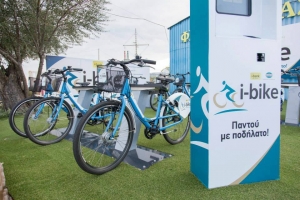
There's something new in the southern Athenian suburb of Athens - Glyfada is now home to i-bike - an excellent bike sharing system available to locals and visitors.

There are two i-bike stations at Glyfada, one at the beach by Vergoti Square and one at the old City Hall. Cyclers can choose from 20 available bicycles for transportation purposes, strolling or just for fun.

Users must be over 18 and can rent a bike for as long as they wish with the use of a credit card or via cell phone, returning it to any of the installed stations across town. Regular users, applicable only to Glyfada residents, can sign up for the system and receive a special e-card which provides 24-hour access. Cards are available from Glyfada City Hall.

Bike sharing, first implemented in European cities in 1965, gives people the chance to borrow a bike from one point and return it to another point in the city.

For more information in English, please click HERE.
To read this article in full, please visit: Greek Travel Pages
EasyJet has recently announced new flight additions, including Greek destinations, to their summer schedule. The airline will connect Chania, Crete with Lyon and Nice in France, as well as connecting Corfu with Venice, Italy.
 
Flights between Chania and Lyon will be twice a week, beginning June 25, and flights between Chania and Nice will be every Tuesday beginning June 26. Easyjet will also conduct a weekly flight between Corfu and Venice every Sunday, starting on July 1.

By adding the new itineraries to its summer schedule, easyJet is expected to operate more than 5,700 flights in July and August with more than one million seats on sale, a four percent rise compared to the same period in 2017.

To read this article in full, please visit: Greek Travel Pages
Page 11 of 452