
WELLNESS HUB

XpatAthens
Wednesday, 20 May 2015 12:51
We Don’t Visit Greece, We Live In Greece!
Featuring
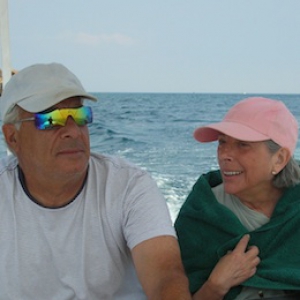
Anthea Sylbert and Richard Romanus
Costume Designer
Actor
Having spent the last forty years in Hollywood in the movie and television business on both sides of the camera, we decided to retire. When we first arrived in Skiathos we were on our way to no place in particular and had planned to stay only six months. It was the week they were changing from the drachma to the euro and all we had was dollars and nobody would accept them because the exchange rates hadn’t been established. In Richard’s book, ACT III, he mentions the moment in the second chapter:
“Climbing down the steps of the police station, I couldn’t help but laugh in disbelief. Where had we landed where without hesitation, without questioning, without exception, people opened their hearts and wallets to complete strangers?”
And we’ve never left.
We’ve been to the capital, all over the Peloponnesus, there's so much to see, Thessalonica - excellent shopping, breathless Meteori, Metsovo, which Richard used as the setting for his novel Chrysalis, and Richard has been to Mt. Athos and is returning again.
A story that we treasure most is when we stopped in Selegoudi, a small village below Sparta, which is Anthea’s ancestral home. After first thinking it deserted, two dozen relatives appeared and a large table was set for a feast, with each carrying another food or wine. During World War II and the ensuing Civil War, Anthea’s father sent a large box every week to the village containing clothes, canned goods, and toys and candies. Towards the end of the meal, an old man sitting next to Anthea leaned in and whispered “I was married in one of your father’s suits.”
To read more, please visit Discover Greece blog.
Published in
People
Tagged under
Friday, 29 May 2015 07:00
The Greek Behind Bulgari

Sotirios Voulgaris (1857-1932) was the Greek creator of Bulgari, one of the world's most famous jewellery brands today. Born in the Greek village of Kalarites in March of 1857, Sotirios began his career as a jeweller in his home village of Paramythia (Epirus, Greece), his parents were George Voulgaris and Eleni Strougari. Of the eleven children of the family, Sotiris Voulgaris was the only one who survived and managed to continue the family tradition. The passion with jewellery started from his grandfather Constantine, who was a street vendor in the villages of Epirus. The talent to create jewellery was inherited by Sotiris, who along with his father opened a jewellery shop in Paramythia.
At that time, Paramythia and other villages in the region were facing problems from the Turks. Continuous burning of the village and serious damage to the shop, forced the Bulgari family to move to Corfu and then to Naples, Italy. In Naples, the family opened their first gold jewellery shop. The city crime posed a major problem for their valuable jewellery. So, after several burglaries, they were forced to close.
In 1881, Sotirios Voulgaris and his family moved to Rome. Three years later, in 1884, he founded his company and opened his second shop in Via Sistina. The store in Via Sistina was then replaced by the current flagship store in Via dei Condotti opened in 1905 by Bulgari with the help of his two sons, Constantino (1889–1973) and Giorgio (1890–1966).
After Giorgio's death in 1966, his son Gianni led the company as co-chief executive with his cousin Marina. As chairman and CEO of Bulgari in the early 1970s. Bulgari opened its first international locations in New York City, Paris, Geneva, and Monte Carlo in the 1970s.
To read more, please visit: Greek Getaway
Published in
People
Tagged under
Wednesday, 24 June 2015 07:00
Interview With Emmy Award Winning Actor And Director Yannis Simonides - "Socrates Now"
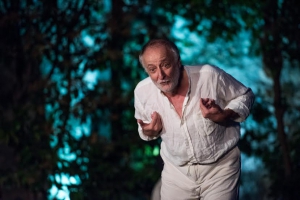
We all know who Socrates was: only one of the greatest Greek philosophers of all time. Socrates Now is a 75 minute solo theatre performance (in English with Modern Greek subtitles) highlighting the Apology of Socrates. Performed in seventeen countries so far—festivals, universities and theatres—in 2015 performances are planned from 27th June until 19th July and is expected to attract over 2000 viewers of all ages.
Starring and co-directed by the Emmy Award Winning actor and scholar Yannis Simonides, he gives us some insight.
Born in Constantinople, raised in Athens and educated at Yale in the United States, you are truly an international, Mr. Simonides…but where do you feel your roots really lie?
Absolutely and fully in Greece, on every rocky path I have traversed, in every harbour I have anchored in, every sprig of thyme I have inhaled, every amphitheatre I have been graced with, every modern Odysseus I have encountered
Whilst your tour a lot worldwide, have you ever spent an extended period of time living and working in Athens? What has been your experience?
I have and quite often, and now I have a pied-a-terre in Psyrri, facing the Rock, listening to bongos and santouri all night long, taking in the fantastic graffiti, agonizing with the rest of my compatriots, performing in English and Greek for my fellow citizens and the citizens of the world, this 69 year old wandering minstrel could not be happier and more privileged
You’ve been performing Socrates Now for 10 years. You must feel a personal connection to the philosopher by now. Do you feel yourself identifying with any of his character traits?
10 years, 18 countries, over 200,000 audiences – there is no way that one could attempt this pilgrimage without being fundamentally altered by the experience. My morality has evolved into simple ethics, my humor has gotten sharper yet gentler, my attitude more childlike, my wisdom more prudent, my joy in life more delicious, my peace with my mortality more genuine; though, unfortunately, my Socratic determination to change the world has gotten out of hand and something needs be done about it. Any ideas?
To read more, please visit: Life Beyond Borders
For detailed event information and to book tickets, please click HERE.
For detailed event information and to book tickets, please click HERE.
Published in
People
Tagged under
Thursday, 29 October 2015 07:00
Student Volunteers Of The ACT Learn Life Lessons
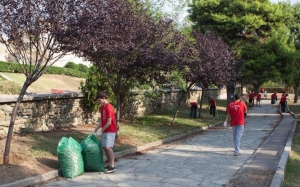
Andrew woke up on a recent Friday morning, had a quick breakfast and headed to the Church of Aghia Varvara. Once there, he uncovered the baskets of bread and started slicing the loaves. He had to be ready on time because a large crowd was expected to gather soon in the courtyard for the daily food handout, one of the biggest in the northern port city of Thessaloniki.
The American College of Thessaloniki, a postgraduate, nonprofit institution run by Anatolia College, offers high-caliber education, but for 18-year-old Andrew it is the experience of giving food to the needy every Friday morning that he finds riveting – a real lesson, in every sense of the word.
“I have worked as a volunteer back home – but nothing as enlightening as this. For a lot of us who come from privileged backgrounds, this really puts everything into perspective. It is one thing to watch it on the news and entirely another to see people in front you who can’t afford food. The refugee crisis is different on the screen than it is when you see huge groups of people,” he says.
Andrew Croy from Massachusetts is one of 300 students who made the trip in September to Thessaloniki to attend the fall semester at ACT as part of the study abroad program. The students come from some of the finest educational institutions in the US, such as Brown, Rutgers and the universities of Illinois and Mississippi. Volunteer work is part of the curriculum and they will be completing a total of 7,000 hours at places such as the Aghios Dimitrios Physical Rehabilitation Center for Children, the Arsis center and hostel for homeless minors, the Smile of the Child charity, various churches, and the Friends of People with Disabilities, among others.
Theoretically, the volunteers could also work on large group campaigns but ACT decided to individualize the program by splitting the students into small groups so they could gain a more in-depth knowledge of what they are doing and the society they have become a part of.
The cost of managing the program is high, but so are the rewards.
To read more, please visit ekathimerini
The American College of Thessaloniki, a postgraduate, nonprofit institution run by Anatolia College, offers high-caliber education, but for 18-year-old Andrew it is the experience of giving food to the needy every Friday morning that he finds riveting – a real lesson, in every sense of the word.
“I have worked as a volunteer back home – but nothing as enlightening as this. For a lot of us who come from privileged backgrounds, this really puts everything into perspective. It is one thing to watch it on the news and entirely another to see people in front you who can’t afford food. The refugee crisis is different on the screen than it is when you see huge groups of people,” he says.
Andrew Croy from Massachusetts is one of 300 students who made the trip in September to Thessaloniki to attend the fall semester at ACT as part of the study abroad program. The students come from some of the finest educational institutions in the US, such as Brown, Rutgers and the universities of Illinois and Mississippi. Volunteer work is part of the curriculum and they will be completing a total of 7,000 hours at places such as the Aghios Dimitrios Physical Rehabilitation Center for Children, the Arsis center and hostel for homeless minors, the Smile of the Child charity, various churches, and the Friends of People with Disabilities, among others.
Theoretically, the volunteers could also work on large group campaigns but ACT decided to individualize the program by splitting the students into small groups so they could gain a more in-depth knowledge of what they are doing and the society they have become a part of.
The cost of managing the program is high, but so are the rewards.
To read more, please visit ekathimerini
Published in
People
Tagged under
Friday, 06 November 2015 14:44
Lynn's Thanksgiving In Lesvos
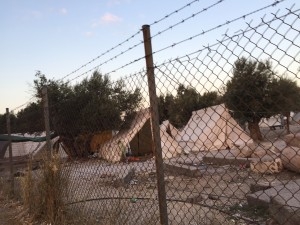
I’ve decided to go back to Lesvos for American Thanksgiving because the reports coming from the island continue to be extremely disturbing. Several friends expressed interest in going with me so we’ve formed a group to go together. Yeehaw! Life is always better in teams.
Our plan is to help address some of the basic shortages, particularly with the fact winter is coming. We’re researching viable options including tent structures, emergency blankets, jackets, waterproofing, etc.
We’ll go with at least two vehicles and our supplies by ferry to arrive in Lesvos on November 25th. We’ll stay through the 29th. While there, we’ll probably spend most of our time either on the beaches or in the camps of Moria/Kara Tepe, depending on where we feel we can do the most good. This may change as the needs and situation changes.
My brother and his family made a donation that we’ll use to buy our initial shelter supplies. We aren’t formally fundraising as we aren’t a non-profit organization but we are giving people the opportunity to join in by sending us donations if they are so inclined. For those of you who didn’t know me before the current yoga instructor era, for many years before that I was a high tech and venture capital chief financial officer. So while we may not be the most qualified to take donations, we’re probably not the least qualified either. Our commitment is that 100% of any donations go directly to help the refugees. Please contact us directly if you’d like to donate.
We’ll be posting updates here as we kick the project off.
And for anyone reading, I’ll add that before I went to Lesvos for a weekend in September, I hadn’t actually done anything to help with the crisis. I point that out just to say if you haven’t done anything to help, don’t feel guilty. We are all a bit confused about how to get involved….
For me the evolution was: do nothing–> read the news/see the pictures of the crisis and start feeling kind of terrible–> walk around wondering if I can/should be doing something to help–> make some attempt to do something helpful (in my case go to Lesvos for a weekend, unsure if that was even going to be useful…)–> refine the effort and offer some more meaningful help. You are probably somewhere on that continuum…. And this might be your moment.
Published in
People
Tagged under
Friday, 13 November 2015 07:00
Coming In From The Cold: Homeless But Not Hopeless Gives Compassion A New Meaning.
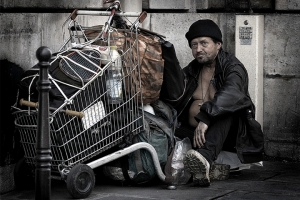
Journalist and editor Lorraine Eyre runs the “Homeless but not Hopeless” charity. In a piece written for GreekTV, Lorraine reflects on the misguided attitudes about the homeless community in the country, the reasons many find themselves on the streets, and offers vignettes of individual stories.
“We think sometimes that poverty is only being hungry, naked and homeless. The poverty of being unwanted, unloved and not cared for is the greatest poverty.” (Mother Teresa)
Individuals and families who are sleeping rough on the streets of Athens without access to shelter, food, and laundry facilities have become outcasts of society. Sometimes referred to as “bag” people, they are almost socially invisible to those who consider them to be second-class citizens. The plight of the growing homeless community in the city continues to spiral out of control. The situation sadly remains unnoticed by those whose responsibility it is to help them. Fortunately, however, there are kind and compassioante people living here in Greece and abroad who do care. Large numbers of dedicated volunteers and members of organizations are fiercely committed to providing help and offering their support. Those volunteers who have come face to face with the harsh realities out on the streets and have listened to the heart-wrenching stories, many from families with young children, have realized that everyone is important in this word and commands the same respect.
To read more, please visit: Greek TV
Published in
People
Tagged under
Friday, 27 November 2015 07:00
Yussuroum, A Slang Term That Hides Fragments Of History
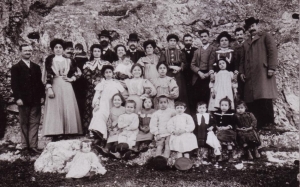
The stories about Athens and its people are endless. Many of them have faded from memory over time. Others are remembered in fragments that come together at some point for the story to be told. The case of the Yussuroum family is one such Athenian tale. As charming as it is distant, the family name has retained its currency in everyday usage: Yussuroum (also rendered as giousouroum) in Greek has come to mean flea market.
The Athens Jewish community held an event in October in honor of Mois Yussuroum, aged 95, for his voluntary service over the decades. A garden in the community’s synagogue was named after the benefactor and the event, held on the initiative of the Jewish Museum in Athens and the Jewish community, was an occasion to bring back to light the history of the Yussuroum family.
While many Greeks use the term yussuroum when referring to a flea market, few know that it stems from this family and, in particular, from the antique market it created in the Jewish quarter of central Athens. Mois Yussuroum is the descendant of a long line of successful merchants with a presence in Athens. The Yussuroum home on Karaiskaki and Ermou streets was located in the middle of the city center’s commercial district and also housed the capital’s first synagogue. This was the heart of the Jewish quarter, which lay between Aghion Asomaton Square, Sarri and Ermou streets.
To read more, please visit: Ekathimerini
Published in
People
Tagged under
Friday, 11 December 2015 07:00
Supporting Children In Greece Suffering From Cancer
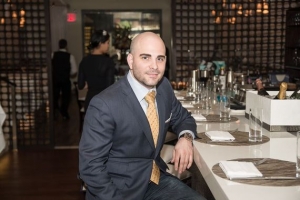
One Monday in late November 2015, a big charity event took place in Manhattan, New York. Spiros Menegatos, a young Greek-American entrepreneur and owner of the famous Nerai Restaurant undertook an initiative to support children suffering from cancer in Greece. His selfless effort employed a unique approach. He brought together people from different social and economic backgrounds to combine forces around one single goal; to build awareness that as Greece plummers deeper into the stagnant waters of recession and misery and public sector funds dry up, the people must step in to provide aid to social groups that require it.
Although he has created great success in the U.S, Spiros Menegatos never forgot his motherland, Greece. His decision to open a Greek restaurant in Manhatten was just the first step he made towards remaining connected with the modern culture of Greece. But that, for him, was not enough.
To read more, please visit: Huffington Post
Published in
People
Tagged under
Friday, 18 December 2015 17:02
What You May Not Know About Maria Callas
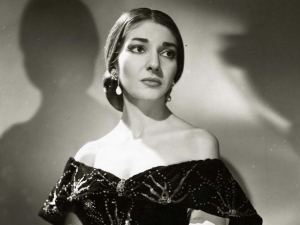
This month (December), Maria Callas would have been 92 years old, and almost four decades after her death, the Greek American opera singer still commands the news and media. At her peak, Callas was one of the most famous and written about women in the world.
Callas was born Maria Kalogeropoulos in New York City in 1923 to Greek immigrant parents. She impressed many as a child singer and pursued her training when her family returned to Greece. She began singing professionally in 1941 and was soon performing in major opera houses throughout the world.
Her voice is considered as one of the most dynamic in operatic history.
She died in Paris in 1977 at age 53 following a heart attack, but her persona and legendary status as a diva on and off the stage is entrenched in the public’s persona until this day.
To commemorate her 90th birthday two years ago, The Los Angeles Times published five extraordinary rumors about the soprano that have never been confirmed — nor denied. Follow are a couple of these:
1) She bore a son with Aristotle Onassis, but the child died soon after birth. Though she is believed to have been infertile, Callas was rumored to have had a love child with Onassis, the shipping tycoon and a Greek compatriot. The son was born in 1960, the rumor has it, and died hours later. Other rumors state that she had at least one abortion while she was with Onassis. Her relationship with the multimillionaire was stormy, as he is believed to have been compulsively unfaithful.
2) Callas continued her affair with Onassis during his marriage to Jacqueline Kennedy.Onassis left Callas to marry the widowed Jacqueline Kennedy in 1968. But it was widely believed that Callas continued her liaison with Onassis well into his marriage with the former first lady. “Greek Fire,” Nicholas Gage’s 2000 book about their love affair, portrays Onassis banging on Callas’ door, begging to be let back in.
1) She bore a son with Aristotle Onassis, but the child died soon after birth. Though she is believed to have been infertile, Callas was rumored to have had a love child with Onassis, the shipping tycoon and a Greek compatriot. The son was born in 1960, the rumor has it, and died hours later. Other rumors state that she had at least one abortion while she was with Onassis. Her relationship with the multimillionaire was stormy, as he is believed to have been compulsively unfaithful.
2) Callas continued her affair with Onassis during his marriage to Jacqueline Kennedy.Onassis left Callas to marry the widowed Jacqueline Kennedy in 1968. But it was widely believed that Callas continued her liaison with Onassis well into his marriage with the former first lady. “Greek Fire,” Nicholas Gage’s 2000 book about their love affair, portrays Onassis banging on Callas’ door, begging to be let back in.
To read this article in full, please visit: Pappas Post
by Gregory Pappas
Published in
People
Tagged under
Friday, 08 January 2016 07:00
Muslims Of Today Were Yesteryear's Greeks
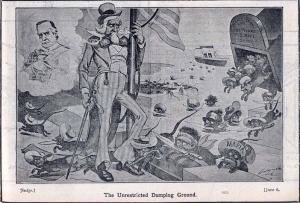
There are some things you might not know about Greek immigration to the United States. This history becomes particulalry relevant when watching the news these days and political candiates like Donald Trump, supported by huge and vociferous crowds, call for the complete ban of people from entering the United States based in their race or religion.
This is nothing new. In fact– today’s “undesirable” Muslims (in Donald Trump’s eyes), were yesteryear’s Greeks.
It’s a forgotten history— something that only occasionally comes up by organizations like AHEPA or the occasional historian or sociologist. In fact, many Greek Americans are guilty of not only perpetuating— but also creating— myths of our ancestors coming to this country and being welcomed with open arms.
A look back at history will prove that this usually wasn’t the case for the early Greek immigrants to the United States. Greeks, their race and religion, were seen as “strange” and “dangerous” to America and after decades of open discrimination, Greeks were finally barred— by law— from entering the United States in large numbers.
The Immigration Act of 1924 imposed harsh restrictions on Greeks and other non-western European immigrant groups. Under that law, only one hundred Greeks per year were allowed entry into the United States as new immigrants.
Much like today, when politicians and activists like Donald Trump use language against a particular ethnic group— like his call to ban all Muslims from entering the United States, the same was the case a hundred years ago. Except then, Greeks were one of the main targets.
There was a strong, loud and active “nativist” movement that was led by people who believed they were the “true Americans” and the immigrants arriving— mainly Greeks, Italians, Chinese and others who were deemed “different” and even “dangerous” to American ideals, were unfit to come to America.
As early as 1894 a group of men from Harvard University founded the Immigration Restriction League (IRL), proponents of a United States that should be populated with “British, German and Scandinavian stock” and not by “inferior races.” Their biggest targets were Greeks and Italians and the group had a powerful influence with the general public and leaders in the U.S. government in their efforts to keep “undesirables” out of America.
To read more, please visit: Pappas Post
Published in
People
Tagged under