
WELLNESS HUB

XpatAthens
Wednesday, 08 February 2017 15:59
Between Two Cultures - Εffie Spilioti Describes The Benefits & Hardships Of Returning To Homeland
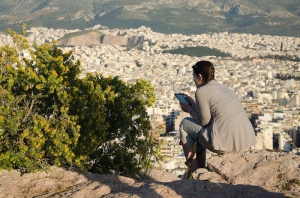
Attorney Effie Spilioti was born and raised in Chicago. Her parents were first generation Greek immigrants who arrived in Chicago in search of a better future for their family. Like most immigrants, they left Greece with almost no resources, but with hope for the future and with a dream of returning to Greece someday.
“I followed my family to Greece after they decided to relocate there, for their retirement. When I arrived in Greece, I initially studied at the American College of Greece, but I had my mind set on studying law. After studying intensively for a year, I took the exams and was admitted to the Law School of the University of Athens.”
“I always believed that my upbringing in an immigrant family, watching them succeed through hardships and limited resources, has guided me and even assists me today in adapting to the insecurity of the current situation in Greece. If there is one thing that I learned from my parents as immigrants, that is importance of perseverance, hard work and “ethos” in all aspects of life. These are the traditional values that are common in all Greek immigrants, whether they are in the United States, Australia or other countries.”
Being exposed to two cultures has not been easy. When you are exposed to two cultures it is inevitable that you compare them to each other. As a woman living in Greece, I cannot say that I faced discrimination based on my gender in the workplace. It should be noted that Greece has laws that significantly protect the rights of mothers in the workplace.
To read this article in full, please visit: Greek TV
Published in
People
Tagged under
Thursday, 23 February 2017 09:01
Celebrating 40 Years Of Living In Greece - '40 Things I Learned About The Greeks'

Susan from Greeker than the Greeks celebrates 40 years of living in Greece by sharing 40 things she as learned from the Greeks! Forty years ago, Susan left England on February 5th in 1977 to marry her love and start a new life. Here are 40 things Susan has learned from living in Greece.
- Punctuality is a dirty word - Time has no meaning, Greeks live for the moment!
- Everything is better with feta - Feta cheese, served with absolutely everything!
- Traffic lights, traffic laws and the Highway Code, were made to be broken.
- Everyone is someone’s cousin - All Greeks seem to be related to one another!
- Every family has a Yiannis - Yiannis is one of the most popular boy’s names in Greece, and as the tradition is to name the first born son after the grandfather, every family has one, I have one of my own, my son Yiannis!
- Greeks talk with their hands - Don’t stand too near to a Greek; you are likely to be whacked in the face by their wild hand gesticulations!
- Greeks force feed their guests - Greeks are such generous people. Don’t bother trying to refuse food from a Greek, just accept everything and then diet for the next two weeks!
- Greeks never say “I don’t know” - The Greek ego, I have learnt to my detriment, if they don’t know the answer, they’ll tell you anything, always best to check and double check from some other source.
- Greeks are consistently one year older - When you ask a Greek how old they are, they will always add a year.
- Greeks are passionate - In everything and every way, they love life, whatever they do, they do it with ‘meraki,’ their heart and soul.
Published in
People
Tagged under
Monday, 20 March 2017 10:26
From Chicago To Greece - How One Woman Started A Business In Kavala
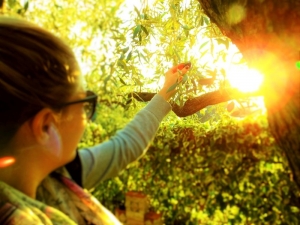
This is a great story from WindyCity Greek about an American woman, who after having met and married her husband in Chicago, returned to his family’s homeland of Kavala in Greece. It was there that she began down a path much different from her corporate career in the US. Staci Wagner learned the art of traditional soap making and founded the successful Vilia Soap Company.
Vilia Soap Company - A Blooming Business
American Staci Wagner Hamalis met her husband in Chicago, where she lived for four years. The city was especially romantic for him because that is where his own parents met. Since he proposed to her in 2012 at The Bean (a sculpture in Chicago’s Millennium Park), she began visiting his homeland. Gradually, she fell more and more in love with Greece — and his family — while also learning about traditional soap making. Her life changed dramatically when she settled in her husband’s hometown of Kavala.
Home Is Where The Heart Is
Her high-flying career had her traveling around the world and living in cities such as Brussels and London, but she found her true path upon settling in northern Greece in 2015. She moved soon after her marriage, and was immediately inspired by the fertile Greek landscape and its cornucopia of natural products — most of which have curative and cosmetic properties. Above all, she became fascinated by what her father-in-law, a retired chemist, began teaching her in 2012: traditional soap-making. Using the purest of nature’s bounty and employing old school artisanal methods, she is now running the successful Vilia Soap Company. Her use of old methods is most impressive, especially in a world of mass produced, chemically-laden products.
From Kavala With Love
Vilia Soap Company uses Greek organic olive oil from Kavala combined with almond oil from Volos in central Greece. Inspired from local flora and fauna, they use lavender from the local market, and various other indigenous herbs like rosemary. Ingredients like Tea Tree oil and lemongrass are sourced from foreign suppliers.
Their soaps have already proven a great success among customers in 11 countries across the world. Their largest demographic is women, from late 20s and up, who seek pure, handmade, high-quality, chemical-free and uniquely fragranced soaps. But they aren’t stopping there.
To read this article in full, please visit: WindyCity Greek
To read this article in full, please visit: WindyCity Greek
Photo Credit: Vilia Soap Company
Published in
People
Tagged under
Friday, 28 April 2017 11:06
The Uncomfortable Project By Greek Designer Katerina Kamprani

Katerina Kamprani is a young talented designer from Greece. Her 'Uncomfortable Project,' which started as a study of everyday objects and what makes them useful, went viral and has become a big success. The 'Uncomfortable' objects have been exhibited in Greece and abroad and few of them were used in an ad campaign for SMART.
Greek TV: What is the idea behind the Uncomfortables?
KK: The idea is to redesign everyday objects so they are uncomfortable to use, but not completely useless. The challenge is to make minor changes to the object so the user will recognize it, simulate the steps he needs to make in order to use it and then be surprised from the faulty design.
Greek TV: How did you come up with the idea of the Uncomfortable Project?
KK: First of all, I am a design enthusiast so I was always following blogs that showcase creative design or art projects with all sorts of unusual objects and I always wanted to do something of my own one day. After working a few years as an architect, I decided to begin a master’s degree on design. There I got familiar with the terms User Interaction and User Experience. I found out that the design process of an architect is quite different from that of an industrial designer which is very user-oriented. I never got to finish my studies and some months later I found myself drawing a sketch of an uncomfortable toilet room in a piece of paper while I was at work. I thought it would be hilarious to make uncomfortable objects and I tried to think of some more until I realized it was actually a challenge to break the established images I had for everyday objects. And then I got stuck. I had to think and design more!
To read this interview in full, please visit: Greek TV
To read this interview in full, please visit: Greek TV
Published in
People
Tagged under
Monday, 08 May 2017 10:44
Meet Culture - When Greece Meets China
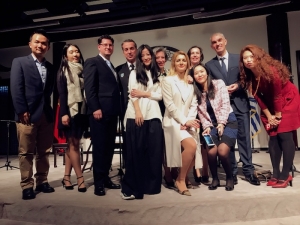
Meet Culture, the culture company founded in Athens, was invited by the Consulate General of Greece in Shanghai to attend the Reception of Greek National Day. Miao Bin – the Founder and CEO, Chang Jing – the Artistic Director and Zhang Di – the Music Director met with the Consul General Mr Vassilis Xiros in Yuyuan, Shanghai.
In August 2016, Meet Culture organized the Aegean Music Tour in China, including several cities such as Lishui, Chengdu, Nanjing, Wuxi and Shanghai. In the concert in Shanghai, Meet Culture invited Mr Vassilis Xiros to join the Chinese and Greek musicians with his bouzouki to perform the Greek traditional music. Since then, Meet Culture has kept close relationship with the Consulate on the culture projects.
Based on the great contribution to the culture exchange between Greece and China, Chang Jing was awarded the Cultural Ambassador by the Consulate General of Greece in Shanghai.
As said by Mr. Consul General, Music unites the two civilizations. Chang Jing has been contributing to the culture exchange between China and Thailand as the teacher of the Princess of Thailand, and now she devote her efforts to the relationship of Greece and China.
Chang Jing invited Miao Bin, the founder of Meet Culture, to the stage to present the gift from Meet Culture to the Consulate General. This is gift is the calligraphy from Mr Xie Qianhong, the calligrapher in Chengdu.
To read this article in full, please visit: Meet Culture
Published in
People
Tagged under
Monday, 12 June 2017 22:47
Fulbright Greece Celebrates 70 Years Of Educational & Cultural Exchanges With US
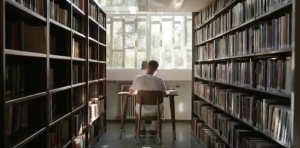
Fulbright Greece is celebrating 70 years of educational and cultural exchanges between the Unites States and Greece!
The Fulbright Program is the premier international educational exchange program in the world. It was established in the United States in 1946 by Senator J. William Fulbright of Arkansas. The Fulbright Foundation in Greece offers scholarships to Greek and American citizens – students, teachers, scholars, and artists – to pursue a wide variety of educational projects. Since 1948, more than 5,000 Greek and American citizens have received scholarships from the Fulbright Foundation in Greece to participate in US-Greece educational and cultural exchanges.
The Foundation awards grants to Greek and US citizens to study, teach, lecture, or conduct research in the United States and Greece respectively. Fulbright Greece collaborated with filmmaker, alumna Eirini Steirou and cinematographer Antonis Katrakazis to produce a series of portraits of US and Greek scholars, who share their Fulbright experience.
Breiana Pledger, English Teaching Fellow
“Education is life-changing, I‘ve seen it change lives. It changed my own”.
Breiana, with a background in psychology and experience in incarcerated youth education came to teach English in Greece, out of her love for Greek mythology. She believes that education has the power to change lives.
Elizabeth Duclos Orsello, Fulbright Scholar, Salem State University Professor
“Education is about opening your heart, opening your eyes, going into places, into thoughts, into experiences that are new”.
Elizabeth came to Greece with her teenage son, to teach American Studies in Aristotle University of Thessaloniki and research on how the humanities and academy can deal with real issues people are facing today. She believes education has the power to make people and the world better.
To read this article in full and to watch the videos, please visit: Greek TV
Published in
People
Tagged under
Tuesday, 11 July 2017 10:53
A Little Taste Of Home - Meet Ahmad Alssaleh
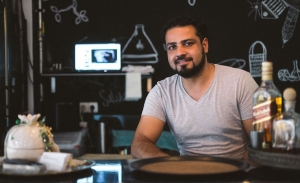
Meet Ahmad Alssaleh from Palmyra, Syria. Although he is only 31 and the youngest of ten children, he is not only unstoppable, he is about to celebrate the first anniversary of one of the most imaginative and best restaurants Culinary Backstreets has ever been to anywhere – not just Athens. His restaurant is called A Little Taste Of Home.
It all started back in 2009 when Alssaleh met Magda, a Greek girl who’d gone to Syria as a tourist. In those days he had been working in tourism himself, organizing “camping safaris” into the desert around the ruins of Palmyra on camelback and horseback and cooking traditional food for his groups. He was extremely successful and is even mentioned in foreign blogs about those happier days.
But happy as they were to be together, finding a job proved impossible in those early years of the “crisis,” and it took 18 months to get a residence permit.
“By now I had a little money, and I went to Poland, where a friend had a hostel for sale, but that didn’t work out. So instead I bought a five-room apartment near Omonia and rented it to refugees. This was when the border with Macedonia closed, and there was a housing shortage. All this time I wanted to open a café with Syrian snacks. Monastiraki was too expensive, but this place [in Gazi] was empty and affordable. Again it took many months to get the permit, and I needed more money to fix it up. My brother had an idea. He was among the refugees stuck at Idomeni, and he said, ‘Why don’t you bring up some bread from Athens? We can’t eat what they give us.’
To read the rest of Alssaleh’s inspiring story, please visit: Culinary Backstreets
Photo Credit: Manteau Stam for Culinary Backstreets
Photo Credit: Manteau Stam for Culinary Backstreets
Published in
People
Tagged under
Monday, 18 September 2017 20:37
From-Hand-to-Hand - Greek Artisans & Craftsmen Rediscovered
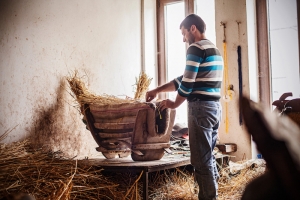
There are professions that we thought were lost for long and totally replaced by industry. How many times did you have the chance to meet a saddler, a basket weaver, a sandal maker or a luthier? However, they survive away from the spotlight, because there are still people dedicated to craftsmanship either because they “inherited” it from their ancestors or because they have discovered it and developed it themselves.
Cultural worker and artist curator Laura Bernhardt and photographer Benjamin Tafel have created a project called from-hand-to-hand where they search, they document and they present to us still active craft workshops in Greece and the stories of their protagonists. According to their mission statement “the project examines their situation, their emotional relationship with their profession and their prospects. The result is a series of portraits that show the artisan in relation to his or her profession and the current situation of upheaval”. Here, Greek TV interviews Laura and Benjamin in order to learn what motivated them to initiate this project.
How did from-hand-to-hand start? What gave you the idea to begin?
Benjamin: The initial idea for this project was driven by our personal relationship to Greece. Both of us have been closely linked to Greece since our childhood. Over the last few years we have observed that craft workshops seem to be gradually disappearing. With this project we wanted to draw attention to something that is only sparsely visible.
Laura: And, also the ongoing economic crisis, the negative news about Greece have moved Benjamin and I to take a different perspective. We wanted to focus on the makers. Together we wanted to search for traces of still active craft workshops in Greece. Through dialogues with the craftspeople we wanted to examine their situation and their emotional relationship to their profession, their prospects and desires.
To read this article in full, please visit: Greek TV
Published in
People
Tagged under
Tuesday, 20 February 2018 17:02
Echoes of Athens - A Taste Of Home In America
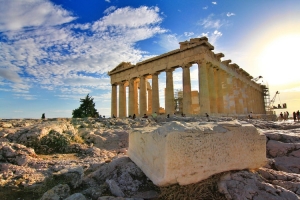
At the age of 16, Vivian Economy came to the U.S. from Kalamata. Her adopted country offered many more opportunities than her beloved Greece. The young woman missed ‘home’ and came up with an idea to bring some of her old home to her new home. In 1949, at the tender age of 18, she launched the very first Greek radio show in the Southeast.
‘Echoes of Athens was broadcast on WATL in Atlanta, GA for 50 years. Vivian’s daughter, Vickie Henson, the show’s current host, recalled those days. “The entire Atlanta Greek Community would rush home after church each Sunday to tune in. Imagine, my mother, the young woman, a trailblazer! Her listeners would find out the latest in the world of Greek news, politics, music, concerts, local community events. From marriages to deaths — she covered it all.”
When Vivian retired in the 1990s, there was a void in the community. Vickie took up the torch in recent years, armed with a new technology her mother would never know — the internet — which now allows ‘Echoes of Athens’ to be broadcast all over the world.
To read this article in full, please visit: Windy City Greek
Please click HERE to listen to Echoes Of Athens!
Published in
People
Tagged under
Wednesday, 23 May 2018 17:06
How The Lost Art Of Traditional Cretan Weaving Is Making A Comeback
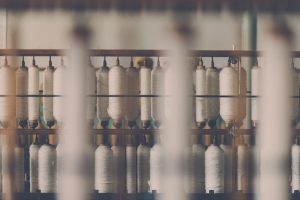
Alexandra Theohari, owner of KLOTHO, is reviving a traditional art of weaving in Crete by creating clothes, bags, and other objects using these techniques. Theohari and her team's designs are all handmade, with displays of motifs and patterns that symbolize classical Greece. Why Athens delves further into this lost art form and how Theohari is bringing it back.
"The entire production process occurs in Klotho’s studio which was set up in Rethymno to support the local economy. To be true to this ancient practice, products are handmade, producing short run collections or on demand."
Alexandra says, “The process is done in the traditional weaving method. It’s not a motorised process at all. The pattern is chosen and woven on the traditional wooden looms as we remembered them from our grandmothers.”
To read this article in full, please visit: Why Athens
Published in
People
Tagged under