

XpatAthens

XpatAthens

The National and Kapodistrian University of Athens (NKUA) - E-learning Programme of its Center of Continuing Education and Lifelong Learning addresses the international public through the universal language of culture. Perceived as an inherent part of their mission, they have set out an extrovert effort to introduce fascinating facets of Greece to the world. And this, by deploying the distinguishable and longstanding features of its cultural heritage, as well as via the contemporary identity shaped in country’s everyday life.
 
YouGoCulture, an initiative of the E-Learning Programme of the NKUA, constitutes an innovative and unique attempt to promote Greek culture in an extrovert manner and on two levels: on the one hand it shall showcase the country's priceless cultural heritage and on the other, familiarize the international public with aspects of the Greek society of today.

Balancing learning and entertainment in a promising and technologically updated way, this interactive online platform offers unique and individualized experiences regarding Greece's great history and the uniqueness of the cultural flourishing of its regions (including the broader south-eastern Mediterranean).

YouGoCulture offers exceptional Virtual Tours of certain “sites” of the longstanding culture of Greece and the Eastern Mediterranean. YouGoCulture is an integrated environment of images and information, but also of consolidated popular knowledge. The platform records points of global interest and offers access to them by familiarizing the world with the achievements of civilizations that constituted the cradle of the evolution and the values of the modern world as we know it.

Each destination is presented on the basis of its important cultural heritage (the “Myth”) and its contemporary life (the “Experience”). Points of Interest (POIs) are identified, having as reference marks the archaeological sites and other spots of cultural significance, based on the rationale of consolidated documentation of each destination, providing the history and the contemporary life, through the production of original audiovisual material, accompanied by informative text.

The vision of the people behind this project started as the need to utilize the competitive advantages of the Greek environment, while it was founded upon the experience and high level of specialization of the academic staff of the UoA, and hopefully of others, who are also embracing the effort.


Find YouGoCulture on Social Media:

Facebook

Wednesday, 13 November 2024 12:41

Local Facebook Groups

This article has been created for your ease of reference in finding Facebook groups that are for English-speakers living in Greece. Please keep in mind that these are groups created and managed by others on Facebook. XpatAthens is not responsible for the content nor if they are no longer valid.
 
If you would you like to see your group on this page, let us know here.
This group is a place for you to communicate with other girls in that are in the same boat as you. You can ask questions, share ideas, post fun events, anything really! The idea is to have a sense of community while living away from 'home'. Oh, and meet up for drinks ;)
This is a group with the purpose of getting people of similar cultural backgrounds all together, on and off Facebook. It does not serve as an advertising group. Prime interest is to bring people together and to have fun.
Expats from any countries living (and working) in Greece. Tips about the day-day life, jobs, events.

Find a Job in Athens
This group was created to help people find a job in Athens, Greece. If you are looking for some work, if you are aware of some open vacancy or maybe you are in a position to offer a job - please share this information here and hopefully, it will change your or someone else's life :-)

A networking group for all us foreign girls/women who for one reason ( a man? ) or another (job, adventure?) have ended up living in Greece.
We will arrange Girls' Nights where life in Greece can be discussed, wine enjoyed, etc etc. Most important for this group and any events arranged is: the more the merrier! So please invite any of your foreign girlfriends to join the group!!!
The group is created for foreigners living in Greece and Greeks to get in touch, exchange ideas, impressions about their startups, the challenges, achievements, and any useful information to get around.
Being a "new mother-to-be" I found myself with soooo many questions and very few clear cut answers as to how to approach this new chapter of my life here in Athens. So thought I would start this offshoot to "foreign girls living in Athens" and create a group where mothers and pregnant women can exchange advice and experiences.
This is a group that welcomes Blokes and Sheilas from Down Under who have made the big move and now LIVE OUT IN THE STICKS (greece). So if your FAIR DINKUM and are willing to 'HAVE A GO YOU MUG' come join the rest of the FLAMING GALAHS and be a SPORT MATE.
The International Club was formed to give a regular meeting point for foreigners, Greeks born abroad and Greeks living in Athens. The idea of this group is that is that members can meet the other foreigners living in this city, make friends and create a network together. Most of all though, it's to have fun!

This group is for you to sell & buy anything that's electronic from laptops to mobile phones. ATHENS, GREECE!!

Thursday, 05 February 2015 12:42

My Week in Athens… February 23

One of my favourite things to do is wander through the historic centre and ‘see what I see’… Early on Sunday afternoon I was in Psiri, with no real agenda except to feed my coffee addiction. Psiri is one of those colourful neighbourhoods where you tend to notice something new with each visit. Call me naïve, but I feel it’s one of the ‘real Athens’ areas of the city-centre – classic Sunday afternoons with a bite to eat and live Greek music…

…I was emerging from the alleys, towards Monastiraki Square, and noticed the smooth, graffiti-free exterior of the ‘A For Athens’ boutique hotel. It’s a hotel, it’s hip & totally urban – I figured there must be a bar or a cafe in there somewhere. And there is. Up on the roof. And your reward for braving the cigarette-heavy air is a view that rivals any in the city. Seriously. Acropolis, Monastiraki, Plaka stretch across the super-wide window like a painting, with colours I never really noticed before, frozen in time. It’s breathtaking, and the best part is that I felt like I was sharing a ‘local’s secret’, not just another stop on the tourist route. And staring at the centuries-old scene below, I remembered a few of the reasons why I first fell in love with Athens…

A For Athens
2-4 Miaouli Street
www.aforathens.com

How was your Week in Athens? Do you have a story you want to share? Send me a note at ideas@xpatathens.com.

See you next week,

Jack

A reader’s comment from last week’s post:

Thank you for sharing the information about The Black Duck cafe. It is encouraging to hear that interesting cafes exist in the centre as most of the beautiful and historical cafes in Athens eg. in Syntagma square and Panepistimiou, have been destroyed or replaced by shopping centres and fast food places (which don't really merit the name "restaurants"). I think it is also important for those of us who live in the "sheltered" northern or southern suburbs to go to the centre of Athens and keep in touch with life "down there" and support events which happen -in spite of all the frequent turmoil- as the experience is often rich and rewarding.

Annetta E.

Moving to Greece as an expat can be both exciting and overwhelming. Whether you're relocating to Athens, Thessaloniki, or one of the beautiful Greek islands, these practical tips will help you navigate your transition more smoothly and settle into your new Mediterranean lifestyle.

1. Master the Greek Bureaucracy Early

Greek bureaucracy can be complex, but understanding the system early will save you countless hours of frustration. Start by obtaining your AFM (tax number) as soon as possible – you'll need it for almost everything, from opening a bank account to signing a rental agreement.

Visit the local tax office (DOY) with your passport, rental agreement, and completed M7 form. While there, also inquire about residency requirements if you plan to stay long-term. Keep multiple copies of all documents, as Greek offices often require original paperwork rather than photocopies.

2. Choose Your Location Wisely

Greece offers diverse living experiences, from bustling urban centers to tranquil island communities. Consider your priorities: proximity to international schools, healthcare facilities, transportation links, and your workplace.

Athens neighborhoods like Kolonaki and Kifissia are popular with expats but come with higher costs. Thessaloniki offers a more affordable alternative with excellent cultural amenities. Island living provides unmatched natural beauty but may limit access to certain services. Research thoroughly and, if possible, spend time in different areas before making your final decision. When planning your relocation, working with affordable international movers in Greece can help you transport your belongings efficiently while staying within budget.

3. Learn Basic Greek – It Makes All the Difference

While many Greeks speak English, especially in tourist areas and among younger generations, learning basic Greek will significantly enhance your daily life and integration into the community.
Start with essential phrases for shopping, dining, and emergencies. Greeks genuinely appreciate foreigners making an effort to speak their language, and you'll often receive warmer service and better prices. Consider enrolling in Greek language classes – many cities offer courses specifically designed for expats, and it's also a great way to meet other internationals in similar situations.

4. Understand the Healthcare System

Greece has both public and private healthcare systems. EU citizens can use their European Health Insurance Card (EHIC) for emergency treatment, but long-term residents should register with the public system (ESY) or consider private insurance.

For routine care, many expats prefer private healthcare due to shorter waiting times and English-speaking doctors. Research hospitals and clinics in your area, and establish relationships with a general practitioner, dentist, and any specialists you might need. Keep in mind that many doctors in tourist areas and major cities speak English, but this becomes less common in rural locations.

5. Embrace the Greek Lifestyle & Build Your Network

Greece operates on a different rhythm than many Northern European or North American countries. Shops often close during afternoon siesta hours (roughly 2-5 PM), dinner is typically served much later (9-10 PM), and the pace of life is generally more relaxed.

Join expat communities both online and offline. Facebook groups for expats in your city, international clubs, and volunteer organizations are excellent ways to meet people and get local advice. Don't overlook connecting with Greek locals as well – they can provide invaluable insights into the best local services, hidden gems, and cultural nuances that will enrich your experience.

Final Thoughts

Relocating to Greece offers the opportunity to experience one of Europe's most historically rich and naturally beautiful countries. While the transition requires patience and preparation, most expats find that Greece's warm climate, welcoming people, and relaxed lifestyle more than compensate for any initial challenges.

Take time to research thoroughly, be patient with bureaucratic processes, and remain open to new experiences. Your Greek adventure awaits, and with proper preparation, you'll be well-equipped to make the most of your new Mediterranean home.
Thursday, 05 February 2015 12:43

My Week in Athens… March 15

..was a quiet one – consumed with work and running around for this or that… paying bills and wondering why they seem higher than normal… I almost believe that spring is around the corner. The sun appears more and more and the sky is a deeper blue. I must say that I felt a hint of something positive – from “Give Greece a Chance” printed all over the newspapers of Europe, to a charity run last weekend, to one or two optimistic reports on Greece amidst the usual doom & gloom.

And then I found Furin Kazan. I say ‘found’, but obviously so had the other seven people waiting in line for the jam-packed Syntagma restaurant. It’s small, it’s busy, it’s buzzing. It’s a no-fuss, casual Japanese/sushi restaurant – and apparently has been there for 35yrs. My friend thought ahead and reserved a table. Wait-staff is a mix of Greek and expat, speaking several languages. They move fast, scanning tables for signs of hunger. The space itself is very ‘sushi international’ – could be any small sushi restaurant in any city – nothing fancy, basic and clean. But the place is jumping – tables are packed, the sounds of voices fills the air, the line-up outside doesn’t subside. The menu is familiar, and my sushi is good. Everything is on fast-forward. And for 90 minutes, I’m not in Athens, but rather in that global-neutral zone known as the sushi restaurant, and it feels good. I wonder if their delivery service has the same effect…

Furin Kazan
Appollonos 2 (below Syntagma Square)
210-322-9170
www.furin-kazan.com

See you next week,

Jack

In this weekly space, keep up with ‘Jack’ as he navigates daily life in Athens… Anecdotes, stories, hits & misses, the good, the bad and, well, the rest…

Thursday, 29 August 2024 07:00

A Guide To Athens Transport

With an urban population of around 4 million people, it goes without saying that Athens offers a large, modern public transport system that serves the needs of the city.

Residents and visitors in Athens move around the city using city buses, electric trolley-buses, Athens metro, Athens tram, and the Athens suburban railway.
 
Athens is connected to even the remotest destinations via the Athens International Airport, the ports of Piraeus, Rafina and Lavrio, the TRAINOSE national railway network and, the KTEL long-distance bus network.
 
Getting to and from the Athens International Airport:

The Athens Transport authority operates four 24-hour express bus lines to the airport. A special fare costing 6 euros is needed to board the buses (or 3 euros for a reduced price ticket).
 
Bus Information: All buses leave passengers at the Departures Level and depart from the Arrivals Level, between Exits 4 and 5. There are 4 routes:
  • Χ93 : Kifissos KTEL (long-distance buses) Station – Airport
  • Χ95 : Syntagma – Airport
  • Χ96 : Port of Piraeus – Airport
  • Χ97 : Eliniko Metro Station – Airport
All buses run 24 hours a day, 7 days a week with frequency varying according to day, time and season.

One-way travel time estimates: X93 (65 min), X95 (70 min), X96 (90 min), X97 (100 min). Allow sufficient time to travel as traffic conditions may cause delays.
  • Metro: Take Metro Line 3 (Aghia Marina – Douk. Plakentias – Airport), which connects the Athens airport with the city center. Trains run every 30 minutes, 7 days a week from 6:30 a.m. to 11:30 p.m. The trip from/to the Airport to Syntagma station (Athens center) lasts 40 minutes. 

  • Proastiakos: The Suburban railway connects the Athens airport with the Athens Central Railway Station and Acharnai Railway Center, and through them to the National Railway network. Trains run 7 days a week from 5:26 am to 21:44 pm. Current timetables: Airport – Kiato and Kiato – Airport, Kiato – Patra bus connections, Piraeus – Athens – Halkida line.

    The Suburban railway departs every 15-25 minutes from the Athens Airport railway station to Plakentias station, where you can change trains (platforms are on different levels) and continue to the city center (Metro Line 3 to Egaleo), using the same ticket.
Moving Around Athens:

Metro, Buses & Trolleys

City buses and electrical trolley-buses serve Athens and its suburbs. Special schedules apply during summer months of July-September.

Operating hours vary according to line/day/season, but generally they run between 5:00 a.m. – midnight.

There are also five 24-hour lines, 4 airport lines (see above section), and 8 Express lines.

The Athens Metro has 3 lines. All stations are fully accessible to disabled persons with elevators in every level and platform and most of the trains are air-conditioned.
  • Line 1 (green line): Kifisia – Piraeus
  • Line 2 (red line): Anthoupoli – Eliniko
  • Line 3 (blue line): Airport – Douk. Plakentias – Aghia Marina

Operating hours are 5:30 a.m. to 00:30 a.m., and every Friday and Saturday night, lines 2 & 3 stay open until 2:30 a.m.
Starting operation on the eve of Athens’ Olympics, the Athens Tram connects the city center with the southern seaside.

If you wish to find real time information for buses and trolley schedules you can download the OASA Telematics App on your smartphone.

The tram has 3 lines:
  • Line 1 'Kasomouli – SEF' linking downtown Athens to the Peace and Friendship Stadium.
  • Line 2 'Kasomouli – Voula' which runs between the city center and southern suburb of Voula and
  • Line 3 'Voula – SEF' running along the coastal zone.
Important: The tram stops between Syntagma and Kasomouli have been closed indefinitely. Therefore, there is no connection with the Tram at Syntagma and Sygrou-Fix Metro stations. Nearest Metro station with connection to the Tram is Neos Kosmos of line 2.the summer, many Athenians choose the tram to visit nearby beaches, seaside cafes and clubs.

Operating hours are 5:30 a.m. to 1:00 a.m. and on Fridays and Saturdays it operates approximately from 5:30 a.m. to 2:30 a.m.

Suburban Railway

The Suburban Railway, or “Proastiakos“, is part of the national railway network of Greece. Its main route is Athens Airport – Kiato, while other routes travel up to Ano Liosia. There is also a route that connects Ano Liosia with the Athens Central Station as well as a route that connects the town of Halkida (Chalkis) with the Acharnai Station (S.K.A.), the Athens Central Station and Piraeus Station.

Be aware that different fares may apply: Piraeus to Acharnai Station (S.K.A.) and Magoula to Koropi stations use the 90-minute ticket for all modes, while different fares are charged for more distant stations. Current Suburban Railway timetables: Airport – Kiato and Kiato – Airport, Kiato – Patra bus connections, Piraeus – Athens – Halkida line. See also: Suburban Railway Discount Policy.

Tickets for the suburban railway (other than the 90-minute ticket for all modes) can be bought at all suburban railway stations.

For information about tickets and timetables, please visit: OASA.gr
Facts About Violence Against Women

1. 1 in 3 women has experienced physical, psychological, or sexual violence from their spouse or partner.

2. 1 in 5 women are victims of rape or attempted rape.
 
3. 40%-50% of women in the EU have reported some sexual harassment in their workplace.
 
4. 500.000 to 2.000.000 people worldwide–mostly women and children–are victims of human trafficking for sexual exploitation and forced labor.
 
How Is Violence Against Women Defined?
 
According to the UN's  Declaration on the Elimination of Violence Against Women "violence against women" means any act of gender-based violence that results in, or is likely to result in, physical, sexual or psychological harm or suffering to women, including threats of such acts, coercion or arbitrary deprivation of liberty, whether occurring in public or in private life.

Accordingly, violence against women encompasses but is not limited to, the following:

(a) Physical, sexual and psychological violence occurring in the family, including battering, sexual abuse of female children in the household, dowry-related violence, marital rape, female genital mutilation and other traditional practices harmful to women, non-spousal violence and violence related to exploitation;

(b) Physical, sexual and psychological violence occurring within the general community, including rape, sexual abuse, sexual harassment and intimidation at work, in educational institutions and elsewhere, trafficking in women and forced prostitution;

(c) Physical, sexual, and psychological violence perpetrated or condoned by the State, wherever it occurs.


Where To Get Help

1. Call The SOS Helpline

The 15900 SOS Helpline is available 24 hours a day, 365 days a year. The line is operated by psychologists and social workers who provide immediate assistance in violent incidents and emergencies.

2. Visit A GSGE Consulting Center

The General Secretariat For Gender Equality Consulting Centers aim to:
  • Inform on issues of gender equality, tackling violence and multiple discrimination against women,
  • Provide social, psychological, legal and work support (in a gender perspective),
  • Transfer or escort–as required–women and children to hospices, protection and aid agencies, hospitals, courthouses, etc,
  • Provide legal aid in cooperation with the bar associations.


GSGE Consulting Centers in Athens:

Consulting Center Athens
11, Nikis, Syntagma
Telephone: 210 3317305-6
Email: isotita4@otenet.gr

Consulting Center Polycenter
11-13, Kratinou, Omonoia (2nd floor)
Telephone: 210 5202800
Email: polykentro@isotita.gr


If you or a woman you know is a victim of violence, please speak up and ask for help!
For more infomation about vilolence against women, please visit: www.womensos.gr & http://www.isotita.gr


This content has been sourced and prepared by Codico Lab


Tuesday, 03 September 2024 10:40

How To Stay Safe During An Earthquake

An earthquake is a sudden, abrupt shaking of the earth's upper crust caused by the shifting of rocks deep below its surface. Because of their unexpected onset, earthquakes can sometimes result in injuries and damage to properties and roads; they can also cause fires, tsunamis, or landslides.
 
Greece is the most seismogenic country in Europe and the 6th in the world. Dozens of earthquakes happen every day; however, most of them go unnoticed. Noticeable earthquakes happen in Greece about 1-3 times a year and not in all locations. Depending on your place of residence, you may not feel an earthquake for years.

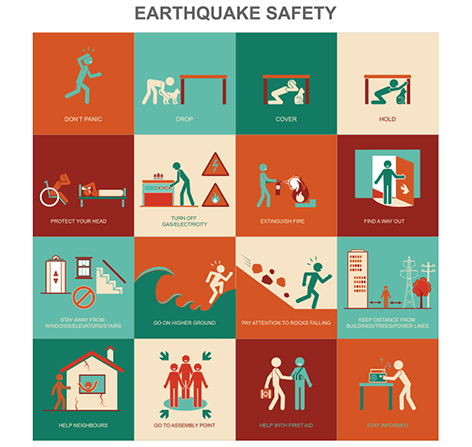
In the event of an earthquake, protect yourself straight away.

  • Do not get in a doorway.
  • Do not run outside.
  • If you are in a car, pull over and stop. Set your parking brake.
  • If you are in bed, turn face down and cover your head and neck with a pillow.
  • If you are outside, stay outside and away from buildings.
QuakeSafety.jpg


Stay Safe During an Earthquake

To stay safe during an earthquake follow these 3 steps: drop, cover, and hold on.
 
Drop
Nomatter where you are, drop down to all fours. If you’re on a wheelchair or walker with a seat, lock the wheels and stay seated until the quake stops.
 
Cover
It is important to cover your head and neck with your arms and crawl under a sturdy table or desk for shelter. Alternatively, crawl next to an interior wall, keeping away from windows. Stay on all fours or bent over to protect your vital organs as best as possible.
 
Hold On
If you are under a table, hold on to it with one hand and be prepared to move with it if it moves. If you are unable to drop to the floor, assume brace posiotion, covering your head with your arms holding on to your neck with both hands.

Thursday, 05 February 2015 12:44

My Week in Athens… March 22

The warmer weather and sunshine (finally!) really make a difference to one’s mood… Spring is here, and with it the feeling of ‘getting outside’… With this in mind, I ventured out to the Run for a Smile event on Sunday put on by the Sport Relief charity. The event was a lot of fun, great turnout, lots of families, out in the sunshine for a good cause…

In many ways the ‘main character’ of the whole day was the Alsos Syngrou (‘Syngrou Park’, Alsos means ‘grove’) – what a nice surprise! An unexpected green forest in the heart of the northern suburbs.

The park is on Kifissias Avenue, opposite the KAT hospital - with bus lines stopping right outside, or a 15-minute walk from the Marousi metro station. It is a favorite spot for walking the dog, jogging, cycling, etc. There is some parking available on Kifissias avenue outside the park gates.

There are plenty of trails for walking, jogging or cycling – and dog-owners will be in paradise. Numerous cyclist groups meet there regularly – Google it! Top off your afternoon at the park with a coffee or bite to eat in Kifissia or Kefalari – and you have the making of a perfect spring day…! The park is open daily until dusk.

See you next week!

Jack

In this weekly space, keep up with ‘Jack’ as he navigates daily life in Athens… Anecdotes, stories, hits & misses, the good, the bad and, well, the rest…

Sunday, 22 September 2024 12:06

Dial 112 In Case Of Emergency In Greece & EU

112 is an integrated emergency communications service, which includes an inbound and an outbound component. In case of emergency, individuals can dial 112 for free from anywhere in Greece and the European Union.

The outbound component allows the reception of warnings via multiple technologies and communication channels in case of an imminent or occurring dangerous situation so that individuals can take the protective actions required to stay safe.

How To Use 112 In Case Of Emergency

Individuals in the EU need only to remember this emergency number to reach any emergency service. 112 is particularly useful for anyone who finds themselves in distress and needs emergency assistance while traveling within the EU.

The number is available in all EU member states alongside the domestic emergency numbers. However, some EU countries have opted for 112 as their single emergency number.

In Greece, 112 is available 24 hours a day, every day. By dialing 112, the caller can be connected to:

  • Police
  • Fire Brigade
  • Emergency Medical Services 
  • Coast Guard
  • the European Hotline for Missing Children 116000
  • the National Helpline for Children SOS 1056
The specially trained operators speak Greek, English, and French. Depending on the caller's emergency, the operator dispatches the call to the appropriate emergency service.
 
It is worth noting that 112 operators cannot provide traffic or weather reports, road assistance, or other general information.
 
Calls to 112 can be made from landline telephones, public payphones, and mobile phones (even without a SIM card) and are free of charge. 112 works inside the range of any cellular network.
 
Callers can also reach 112 through the following alternative channels:
  • Text message (SMS) or MMS to 112.
  • Email contact@112.gov.gr
  • Through the Gov.gr application. 

When dialing 112, the emergency call taker will ask for the location of the emergency and questions to determine whether you need police, fire, medical, or other assistance. When reaching 112 by text message or email please make sure to include the following information on your message:

  • What is your emergency?
  • What is the location of the emergency?
  • Are there any casualties?

The public authority having jurisdiction for 112 in Greece is the General Secretariat for Civil Protection.


For more information on the operation of 112 in each EU country, please click here


Page 119 of 468