
XpatAthens
Homer & The Continuing Adventure: Conversations With Paul Cartledge
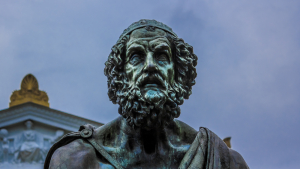
What makes the Iliad and Odyssey so pivotal to the ancient Greeks, and to world culture in general now? Why so enthralling?
All human life is there. The Greeks being non-dogmatic polytheists didn’t have an equivalent of the Christian Bible or Islamic Qu’ran. But they recognized in the two monumental epic tales not just as entertaining stories (they contain plenty of those!) but also as sources of ethical instruction.
Does The Iliad have a lot to do with the anger of Achilles?
The Iliad’s guiding narrative thread or theme is the anger of the semidivine (his mother was the goddess Thetis, his father a mortal) warrior hero Achilles. Was Achilles justified in feeling so angry with his commanding officer at Troy, angry enough to withdraw from the fighting (and skulk in his tent) thereby endangering the whole operation to recover the stolen Spartan queen Helen of Sparta? Probably not. But he had a good death!
What are some of the lessons of Odysseus’ seemingly endless journey?
And what did the travels and travails of the hero Odysseus, king of a small rocky isle off western Greece, avail – avail either him (he lost all his men on the way back home from Troy) or his readers? What they did was teach the poem’s listeners and later readers what it meant to be Greek (as opposed to a non-Greek ‘barbarian’) and how to behave towards each other, not least in the matters of marriage, hospitality and sexuality. Odysseus is seduced and seduces more than once along the way back – one reason the journey from Troy to Ithaca took him ten whole years was that he ‘dallied’ for seven of them with a goddess called Calypso on her private island!
What an ending to the Odyssey! It’s triumphalist, ritualistic and very violent. Was it overkill, so to speak?
The poem’s climax – after Odysseus takes a singularly bloody, surely excessive (see above) revenge on the 108 suitors (who’d been vying to wed his presumed widow Penelope, another Spartan woman) – is his final reunion and reconciliation with his longsuffering, steadfastly loyal wife. And the poet is careful to remind us that Odysseus’s aged father Laertes is still alive and needs looking after – his mother Anticleia had sadly died during the 20 years her son was away from Ithaca; the only reunion he could achieve with her was with her bloodless shade, deep down in the Hades underworld. So the essentially family saga of the Odyssey perfectly complemented the martial derring-do of the Iliad.
Richard Marranca is an author who teaches ancient world, myth, and religion at Montclair State University. He writes for various print and digital publications, and his upcoming book, "Speaking of the Dead: Mummies & Mysteries of Egypt," will be published by Blydyn Square Books. Richard has had the honor of receiving a Fulbright to teach at LMU Munich and spent a semester in Athens during his doctoral studies at New York University. In his career, Richard has had the privilege of interviewing esteemed classicist Paul Cartledge on topics ranging from Alexander the Great to Greek philosophy.
Eva Papadogiorgaki - The Cretan Nutritionist

Born and raised on the beaches of Crete, I developed a deep connection with nature and a passion for healthy, natural food. After moving to Canada, I studied Holistic Nutrition and spent the next decade gaining valuable experience in roles ranging from retail to corporate. Life in Greece, Canada, and the USA, along with extensive travel, has shaped my global perspective on wellness.
I believe strongly in the mind-body-soul connection and love helping others feel their best through simple, attainable nutrition and lifestyle practices. My goal is to make the journey to wellness both enjoyable and accessible—because healthy living should be fun and fulfilling!
As a Registered Holistic Nutritionist my experience and services include:
Speaking Engagements where I bring expert insights to your audience on all things wellness—from food to lifestyle.
Workshops that take your cooking skills up a notch. Whether it’s a themed session or geared to any age group, I’ll help you cook your way to better health.
Consultations (available online), where I’ll help you build simple, balanced meals and share practical tools for smart food planning and self-care.
Custom Meal Plans & Recipes crafted just for you—easy to follow, delicious, and nutritious.
Digital Goodies like ebooks, recipes, and blog content to keep your wellness journey inspiring and accessible—no matter where you are.
Each service is designed to be approachable and tailored to your life, making healthy living practical, inspiring, and enjoyable.
CONTACT INFO
Email: info@thecretannutritionist.com
Website: thecretannutritionist.com
Lake Plastira
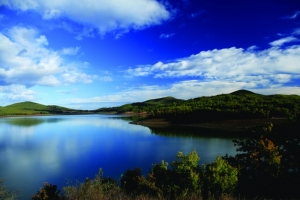
The Lake Plastiras area is known for its spectacular natural beauty. The lake itself is man-made and was built in 1959 by Prime Minister Nikolaos Plastiras, for whom the lake and its dam are named. The lake is set at an altitude of about 800 meters in the Agrafa mountain range making it a place with magnificent views no matter where you stop to look.
Covering an area of about 24km2, it is surrounded by natural beauty, beaches, restaurants, hotels and many trails within its vast forest. Here you can walk, drive or bike along fir, oak and chestnut trees down shady lanes with openings to views of immense height and the vast plains below. Fishing, sailing, kayaking, river rafting, hiking, horseback riding, mountain climbing, cross country skiing and jeep tours are only a few of the ways you can enjoy the natural beauty of this area.
There are several small villages surrounding the lake, each one preserving the history of this land. The villages of Kryoneri and Kalivia of Pezoula are well developed for tourism. Here you will find hiking tracks, hotels, places to rent various equipment for a variety of sporting activities, organized outdoor areas and the beaches of the lake.
The tourist haven and best-known village, Neochori, is worth visiting, as it was built on a slope and offers the best views of the lake. It also offers a visit to its botanical gardens, which house plants making up the ecosystem of the local area. The communities of the lake offer an Environmental Education Center, an Educational Forest, Ecological Paths, Botanical Gardens, Hydro-biological Station, Observatory, Alpine Shelters, an outdoor activity center and renting of bikes, canoes and water bicycles.
There are also important monuments and places of interest in the wider region such as the Monastery of Korona, the Sacred Monastery of Pelekiti, the Sacred Monastery of Petra, the Gaki cave and the Kaimakia cave.
Visitors to Plastiras Lake can buy local products from the producers of the region along the road. You will find honey, spoon sweets, frumenty, garden products, wine, raki and more. No matter what time of year you choose to visit Lake Plastiras, you will be swept off your feet.
To read more, please visit windmillstravel.com
Olive Bread - Eliopsomo
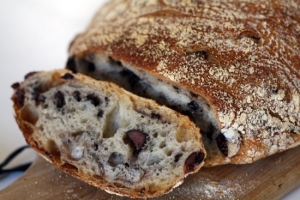
This Greek olive bread recipe is just teeming with the flavours of Greece and the Mediterranean, with the delicious rustic bread, oozing with plump, rich olives, herbs and red onions. This bread is usually made with white flour, and with so many Greek recipes, enriched with a little olive oil. There is nothing like the wonderful aroma of freshly cooked bread wafting from the kitchen to gather everyone around for a tasting. This Eliopsomo - Olive bread recipe has a lovely rich flavour, and the sight and smell of this bread tempts all the senses. Eliopsomo literally means olive bread - Elio - olive, Psomo - bread.
Serving Suggestions
You can serve this olive bread recipe instead of normal bread at a Greek meal.
Have as a light lunch with cheese and ham.
Toast it and drizzle extra virgin olive oil and a sprinkling of freshly ground salt and pepper.
Have it fresh or grilled with slices of fresh, juicy tomatoes and crumbled feta.
Cut thin slices and have with dips.
Include in a meze, with a selection of appetizers, ideal with a drink.
Use good quality, rich oily olives for this olive bread recipe, you will appreciate their flavour in the bread.
Try not to use canned ones, they will not taste as good.
For a variety, use olives marinated in herbs.
Ensure all the olives are pitted before using, you do not want any olive stones in the bread!
Ingredients
1 red onion, finely chopped
1-2 tablespoons olive oil, for frying
675g/1 1/2lb / 6 cups white bread flour
1 1/2 tsp salt
25g/1oz fresh yeast OR 2 teaspoons dried yeast
350ml / 12 fl oz /1v 1/2 cups lukewarm water
5 tbspn olive oil
175g / 6 oz/ 1 1/2 cups pitted black olives, roughly chopped
2 tbspn fresh coriander, marjoram or oregano, finely choppped
extra flour for dusting
Makes 2 small loaves or 1 large loaf
Preparation
1. Fry the onion in the olive oil until soft.
2. Remove from pan and put aside till later.
3. Sift the flour and salt into a large Mixing Bowl, and make a well in the centre.
4. If using dried yeast, add to the flour. OR
5. If using fresh yeast, blend it with half the water in a jug and then add to the flour.
6. Add the rest of the water and the olive oil.
7. Mix it all in until a soft dough, using a round bladed knife.
8. Turn out onto a lightly floured surface and knead for about 10 minutes until smooth.
9. Place in a clean, lightly oiled bowl, cover with cling film and leave to rise in a warm place until doubled in size (about 1 hour).
10. Grease 2 Baking Sheets.
11. Turn the dough onto a floured surface and knead a few times.
12. Roll the dough out into a large circle and sprinkle the olives, herbs and fried onion evenly over the dough.
13. Bring the sides up over to cover the filling and gently knead the bread until the filling is mixed through the dough.
14. Cut the dough in half and shape each half to an oval bread shape.
15. If you prefer to do rolls, just cut into many small round or elongated shapes, or alternatively 1 large loaf.
16. Place each loaf on a baking sheet.
17. Cover with lighly oiled cling film and leave in a warm place until doubled in size.
18. Place 2 or 3 diagonal cuts - about 1 inch / 2cm deep along the top of the bread to create a nice rustic appearance once cooked.
19. Dust the loaves lightly with the flour.
20. Preheat the oven to 220 oC / 425 oF / gas 7
21. Once the loaves have risen, place in a preheated oven.
22. Bake for 30 - 40 minutes or until the loaves are golden color and sound hollow when tapped on the bottom.
23. Transfer to a wire Cooling Rack and leave to cool.
If you wish to use this olive bread recipe to make rolls, you would reduce the cooking time to about 25 minutes. If you are making 1 large loaf, you would probably need an extra 10 minutes baking time.
Enjoy your olive bread recipe!
To read more, please visit http://www.macheesmo.com/2009/10/olive-bread/ and http://www.macheesmo.com
Greek Proposal For Loan Extension To Be Discussed In Brussels
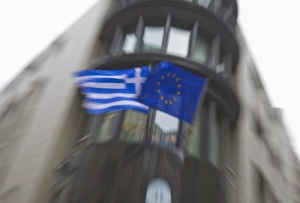
Prime Minister Alexis Tsipras spoke with German Chancellor Angela Merkel Thursday evening after a day of tense efforts aimed at securing a compromise between Greece and the eurozone ahead of a Eurogroup summit Friday where Greece’s proposal for extending its loan agreement with creditors is expected to be discussed.
Tsipras and Merkel spoke for just under an hour in a conversation that the Greek premier described on his Twitter account as being “in a positive climate” and showing “interest in finding a mutually beneficial solution for Greece and the eurozone.” Tsipras also spoke with French President Francois Hollande, sources said.
The exchanges followed hours of tensely-worded statements after the Greek government sent its keenly-awaited proposal to Eurogroup President Jeroen Dijsselbloem. The request was for a six-month extension of Greece’s loan agreement but under different conditions, government officials said in the morning. Later in the day, Finance Minister Yanis Varoufakis’s letter to Dijsselbloem was leaked to the media, indicating that the government recognizes the country’s existing bailout program as the legally-binding framework for the next six months though the document did not include the words “memorandum” or “program,” which the leftist-led government rejects. It also remained unclear which of the measures linked to the bailout program the government would commit to enforcing.
To read more, please visit ekathimerini.com
New Bus Line Links Piraeus With Athens City Center
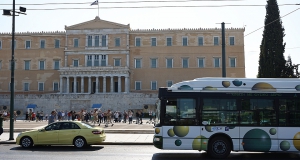
The route includes a total of 15 stops that are located near major tourist attractions in Piraeus and Athens such as the Acropolis Museum, the Archaeological Museum of Piraeus, the Planetarium, the Piraeus Municipal Theatre and the National Museum of Contemporary Art. The X80 bus also provides connections with other metro and bus routes in and around Athens.
Source: Greek Travel Pages
Rise & Dine - Athens' Top 5 Grab-And-Go Breakfasts Downtown
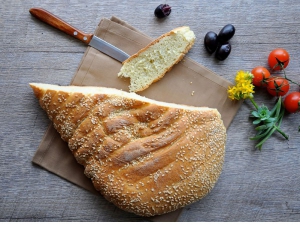
Hours: 7am-5:30pm; closed Sunday
Hours: Mon.-Fri. 7am-9pm; Sat. 7am-4pm; closed Sunday
Hours: Mon., Wed., Sat. 7am-6pm; Tues., Thur., Fri. 7:30am- 9pm; closed Sunday
Tagine Restaurant, The Moroccan Experience In Glyfada
The Muses Of Greek Mythology
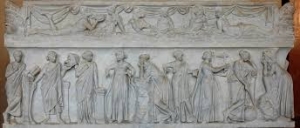
According to Greek Mythology, artists have a Muse who whispers inspiration into their ears. Without the Muse, the artist wouldn’t be able to create. The Muse is said to help writers, musicians, painters, sculptors, and other creative people. Without the Muse, inspiration wouldn’t exist.
Today, “Muse” is simply a synonym for the word “inspiration”. To the Ancient Greeks, however, it was more than that. In Greek mythology, the 9 Muses were the goddesses of the arts, sciences, and literature.
The Origin Of The Muses
The 9 Muses were the daughters of Zeus, the King of the Gods, and Mnemosyne, the Titan goddess of memory. Zeus tricked Mnemosyne by disguising himself as a shepherd. In one version, they lay together for nine nights. Each night, a different Muse was conceived. In some versions, there were only three Muses.In this instance, Mnemosyne and Zeus were together only three nights. According to the poetry of Sappho, there was a tenth Muse. Historians argue as to why there was such a variation in the number of Muses.
Bloode - An Online Community Of Blood Donors
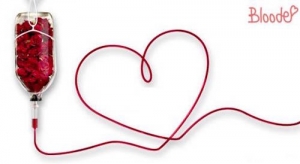
Source: Greek TV
For more information about this organization, please visit: Bloode