With Christopher Nolan's much-anticipated adaptation of The Odyssey sparking renewed global interest in Homer's timeless epic, author and educator Richard Marranca sat down with renowned classical scholar Professor Paul Cartledge to explore the enduring legacy of The Odyssey, its profound influence on Western literature and culture, and the challenges of bringing one of humanity's greatest stories to the big screen.

Paul Cartledge
Can I get you for an overview of Homer’s Odyssey?
I favour the view that, apart from all the excitements and sheer picaresque narrative thrills involving ogres and monsters of many kinds, it’s mainly all about Greekness or, to be more accurate linguistically, Hellenicity. (A sidebar: in Homer, Greeks are not called Hellenes but ‘Danaans’, ‘Argives’ or ‘Achaeans’.) How to be a Hellene in a world that was rapidly changing both geographically and culturally.
It’s always been a bit of a puzzle that the epic should focus on the ruler of a petty island-kingdom on the far west of mainland Greece, but I think the reason for that choice was mainly twofold: Ithaca was as far away from Troy while still being old-Greek as it was possible to get without leaving the mainland, and an ultimate western setting reflected the fact that from about the middle of the 8th century Greek traders, adventurers and settlers were moving west, some of them permanently, to south Italy and Sicily, passing by Ithaca en route.
How might one get a little prep, a little background, before watching the movie?
Absolutely indispensable prep is to read a version of the actual 24 book, 12,000 line original epic poem - which sometimes comes out as well in prose as in English verse translations. I myself favour verse as that gives you some - admittedly remote - sense of what it might have been like to sit at the feet of an ancient Greek bard reciting. For hours at a stretch.
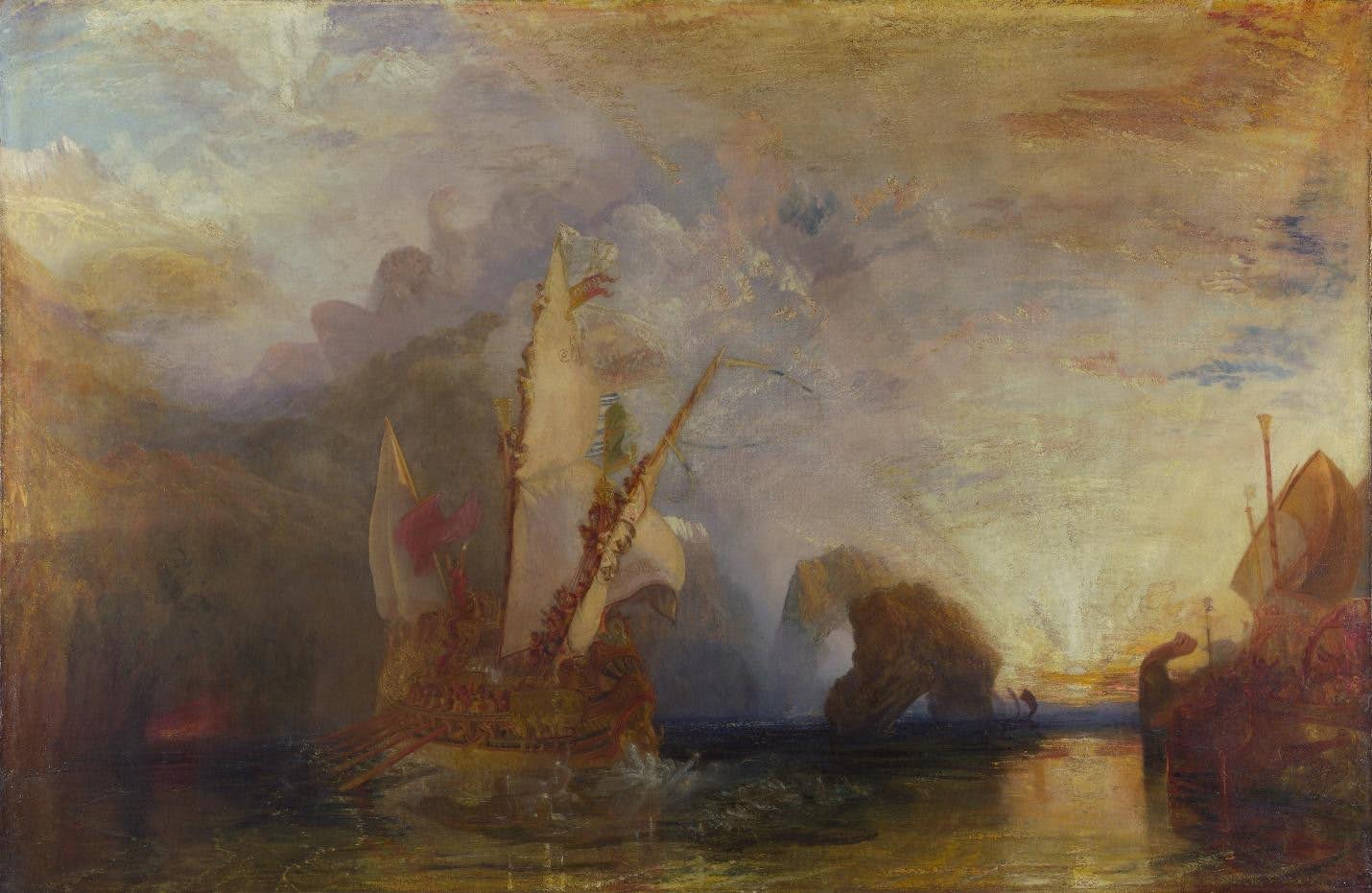
Ulysses Deriding Polyphemus (1829) by J. M. W. Turner. Courtesy of Wikimedia Commons.
What are some of the challenges in creating something so vast like adapting Homer for the big screen?
The original voyage of Odysseus from Troy to his homeland of Ithaca (wherever exactly that might have been, and whether or not it was an island - the latest research suggests it wasn't!) took him ten whole years. Ten years! Even a three-hour movie on the biggest IMAX screen can't come anywhere near to reproducing that.
The original Odyssey was not only epic but also mythical - in the sense of unreal: anyone ever seen a Scylla monster, or a giant Cyclops?? We're used to fantasy fiction, the Marvel universe etc - but not even a modern Ray Harryhausen could capture all the original Odyssey's 'special effects'. Then there's the issue of - not what to include - but what to leave out. The original is a fun-packed roller-coaster from start to gory finish.
Years ago, I had lunch with E. L. Doctorow (author of “Ragtime,” “The Book of Daniel” and other masterpieces) and he said that the movie can bring the moviegoer back to the book. You and others have the issue of having read the Odyssey many times before seeing this movie – can you reflect on that?
Finally there's the question of identification: reading the original in both Greek and in translations as often and as long as I have, I have very definite notions of what the main characters were actually like (spoiler alert: my favourite's always been Calypso - followed by Argos the dog). Christopher Nolan's vision - and that of his chosen actors - are highly unlikely to be anything much like mine... Sigh.
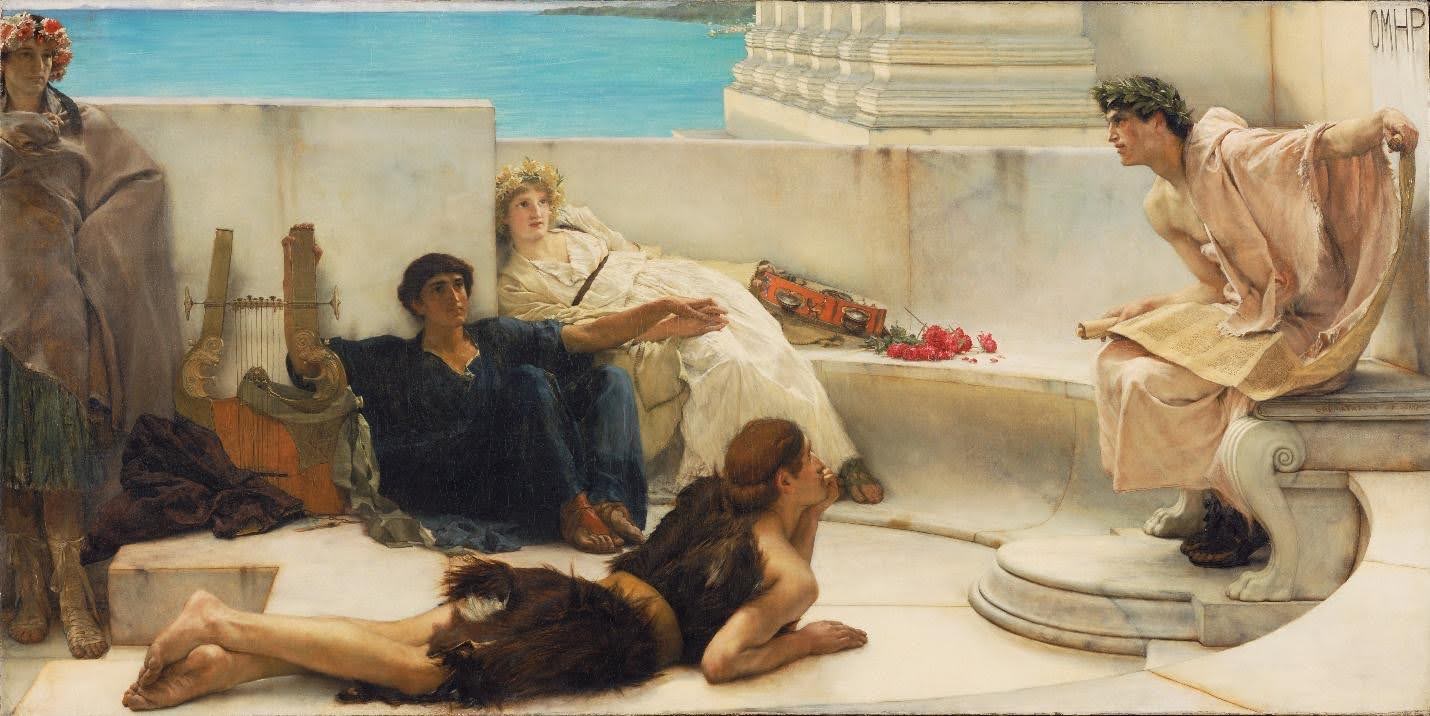
A Reading from Homer (1885) by Sir Lawrence Alma-Tadema. Courtesy of Wikimedia Commons.
Finally, can you share your movie review with us?
It's a 'curate's egg' of amovie, good in some parts - not so good in others.
Very good throughout were the spectacle - scenery, human embodiment, real live action, no CGI cartooning
Not so good were the - often muffled - dialogue, the decision to omit the (narratively crucial) Scherie-Phaecia episode, making Odysseus a PTSD-ed everyman, muffling the eventual return/reconciliation with Penelope, having Odysseus continue travelling after slaughtering the suitors etc but omitting his reunion with dad Laertes - which completes the narrative by ring composition: son Telemachus misses dad, dad O misses son and wife ... and dad Laertes, reunion with Laertes (Book 24)...
Richard Marranca is an author who teaches ancient world, myth, and religion at Montclair State University. He writes for various print and digital publications, and his upcoming book, "Speaking of the Dead: Mummies & Mysteries of Egypt," will be published by Blydyn Square Books. Richard has had the honor of receiving a Fulbright to teach at LMU Munich and spent a semester in Athens during his doctoral studies at New York University. In his career, Richard has had the privilege of interviewing esteemed classicist Paul Cartledge on topics ranging from Alexander the Great to Greek philosophy.