

Why Eating Seasonally In Greece Is One Of The Best Wellness Habits You Can Adopt
- by XpatAthens
- Friday, 17 July 2026

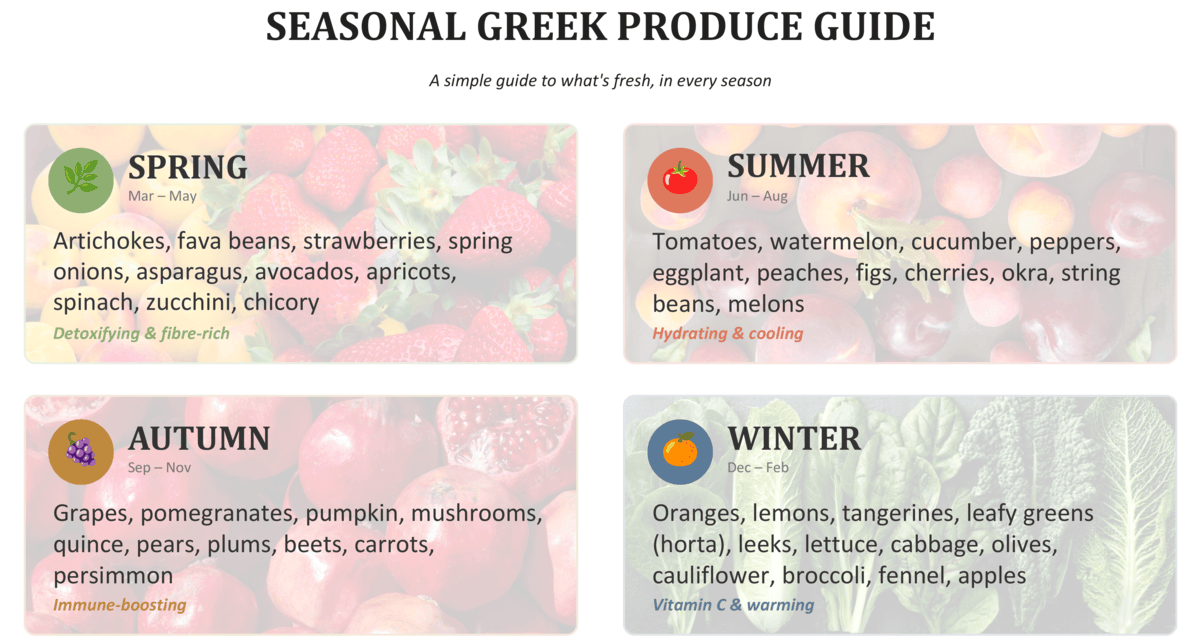
You’ve heard the vendors yelling out their prices…as the day progresses the produce gets cheaper! Any Laiki (Greek farmer’s market) you walk through in July, you’ll immediately see tables piled high with bright red tomatoes, juicy peaches, shiny eggplants and enormous watermelons. This is a fun and beautiful scene! But it’s also a wellness habit hiding in plain sight. Eating seasonally was practiced for generations by all our yiayia’s (before it was trendy) and yet it remains one of the simplest and most impactful choices you can make for your body, your community and your taste buds!
The Nutrition Factor
Produce that is picked at peak ripeness and eaten close to, or shortly after that time, retains more vitamins, more antioxidants and more flavour than produce that is picked early and left to ‘ripen’ during the long distances it’s shipped. Particularly in the summer, Greece delivers exactly what the body needs to handle the heat: watermelon and cucumber for hydration, tomatoes rich in lycopene, peppers and strawberries loaded with Vitamin C. Traditional dishes like horiatiki (the real Greek salad), briam (the Greek version of a rustic ‘ratatouille’) or yemista (stuffed tomatoes, zucchini and peppers with rice and herbs) aren’t just delicious; they’re nutritionally engineered by climate and season, giving you cooling, hydrating, antioxidant rich meals precisely when your body needs them most.
Better Flavour, Better Quality
Anyone who has tasted a tomato in July versus one in December knows the difference. Seasonal produce is harvested at its ripest rather than picked early to survive transport. What does this mean? More natural sugars, deeper flavour and colour, better texture and a higher nutritional value. In a food culture like Greece’s, a handful of ingredients need to shine on their own (think tomato, feta, olive oil and oregano), so freshness and quality isn’t optional. It’s the whole point of the dish.
Supporting Local Farmers
Choosing what’s in season, typically means choosing produce that’s grown nearby. So, buying from your local Laiki, or a neighbouring farm if you’re that lucky, instead of imported, out-of-season alternatives, keeps your money circulating in the Greek agricultural community and supports small producers to stay viable. Many Greek farms are small, family-run operations with plots of land passed down through generations. These producers can’t compete with large scale industrial farms and they rarely have the marketing budget of a supermarket private label. Therefore, when you buy from a local farmer, a much greater share of what you pay goes straight into their pocket rather than shared with distributors, shipping companies and middlemen. It also connects you with the rhythm of Greek rural life, where each month is traditionally associated with specific crops, festivals and food customs.
A Lighter Footprint
Out-of-season produce can often travel thousands of kilometers or is grown in energy-demanding greenhouses. Seasonal, local produce cuts down on transport emissions, refrigerated storage, packaging and fuel. For a country blessed with such fertile summers, choosing the lemon grown two hours away over one flown in from another continent is a small decision with real environmental weight.
A Simple Habit to Start Today
There’s no need to start worrying about changing your schedule and hitting every Laiki in a 10-kilometer radius. You don’t need a strict plan, just shop with the season in mind, buy local when you can, and let the summers abundance of peppers, melons and cherries guide your weekly menu. Your body, your wallet, your local farmers and the planet all benefit. And when in doubt, just buy what your local yiayia is buying, she always knows what’s in season!
About the author
Eva, known as The Cretan Nutritionist, is a Registered Holistic Nutritionist whose international path to wellness is rooted in her Greek heritage. Raised on the island of Crete, she grew up immersed in the Mediterranean lifestyle long before she recognized it as a wellness practice. After studying Fashion Design in Athens, her path shifted when she moved to Canada and studied Holistic Nutrition, later adding certifications in Life Coaching and the Human Microbiome. Having lived across three countries and worked in corporate, hospitality, and wellness settings, Eva brings a grounded, real-world approach to health. Through coaching, workshops and seminars, she helps clients build sustainable, joyful habits rooted in the Mediterranean way of life she was raised on.
About the author
Eva, known as The Cretan Nutritionist, is a Registered Holistic Nutritionist whose international path to wellness is rooted in her Greek heritage. Raised on the island of Crete, she grew up immersed in the Mediterranean lifestyle long before she recognized it as a wellness practice. After studying Fashion Design in Athens, her path shifted when she moved to Canada and studied Holistic Nutrition, later adding certifications in Life Coaching and the Human Microbiome. Having lived across three countries and worked in corporate, hospitality, and wellness settings, Eva brings a grounded, real-world approach to health. Through coaching, workshops and seminars, she helps clients build sustainable, joyful habits rooted in the Mediterranean way of life she was raised on.
LIFE & CULTURE