
CineDoc In November: 3 Powerful Documentaries Coming To Athens & Across Greece
- by XpatAthens
- Friday, 06 November 2026

This November, the CineDoc Documentary Film Festival presents three thought-provoking documentaries exploring different aspects of Greek history, society, memory and identity. From the mechanisms of torture during the Greek dictatorship to the personal and collective memories that shape modern Greece, and the stories of women who have survived gender-based violence, the films invite audiences to reflect on important issues through powerful personal narratives.
The November programme includes the return of the Danish documentary Your Neighbour’s Son (Din nabos søn) by Jørgen Flindt Pedersen and Erik Stephensen, alongside the award-winning Greek documentary LO by Thanasis Vasileiou. Audiences will also have the opportunity to discover Survivors: Rewriting Her Myth, a documentary by Maria Louka and Nina Maria Paschalidou that follows three women as they reclaim ancient Greek myths and transform narratives of oppression into stories of resistance and empowerment.
Screenings will take place in Athens, Volos, Larissa and Rethymno throughout November, with discussions and Q&A sessions featuring directors, journalists, researchers and other guests.
In addition, on Monday, 16 November, audiences who purchase a combined ticket will also have the opportunity to watch LO, a documentary by Thanasis Vasileiou, which received the Iris Award for Best Feature-Length Documentary from the Hellenic Film Academy in 2026.
SCREENING SCHEDULE – DANAOS CINEMA
In collaboration with Amnesty International.
-
Sunday, 15 November, 18:20
“Your Neighbour’s Son”
A Q&A session will follow with Andreas Apostolidis, director and author, and Panagis Panagiotopoulos, sociologist at the Department of Political Science and Public Administration, National and Kapodistrian University of Athens.
-
Monday, 16 November, 20:30
DOUBLE SCREENING: “Your Neighbour’s Son” and “LO”
An introduction by director Thanasis Vasileiou will take place between the screenings.
Infortmation About The Films
“Your Neighbour’s Son: How a Torturer Is Made”
How does an ordinary young man become a torturer? How is he trained to inflict violence and obey orders that, just a few months earlier, he might have considered unthinkable?
Filmed shortly after the fall of the Junta, the documentary revisits the years 1967–1974, not simply to record the regime’s crimes, but to investigate how violence was organised and taught.
Through testimonies from people who were tortured, as well as former members of EAT-ESA, the film examines the process through which young conscripts were turned into torturers. Panos Sakellariadis was part of the directing team, while Professor of Psychology Mika Haritou-Fatourou served as scientific adviser. She has conducted internationally recognised research into the psychology of torturers.
The film therefore attempts something unusual: it turns the camera not only towards the victims, but also towards the perpetrators. Among them are Michalis Petrou, who describes his training and participation in the ESA mechanism, and Spyros Moustaklis, an army officer and resistance fighter who endured brutal torture following his arrest in 1973.
“Your Neighbour’s Son” was presented in September and October through CineDoc in Athens, Volos and Rethymno, as part of the CINEMA AGAIN screening series, organised by the Hellenic Film Academy in the lead-up to the 39th European Film Awards (Athens, 2027).
“LO”
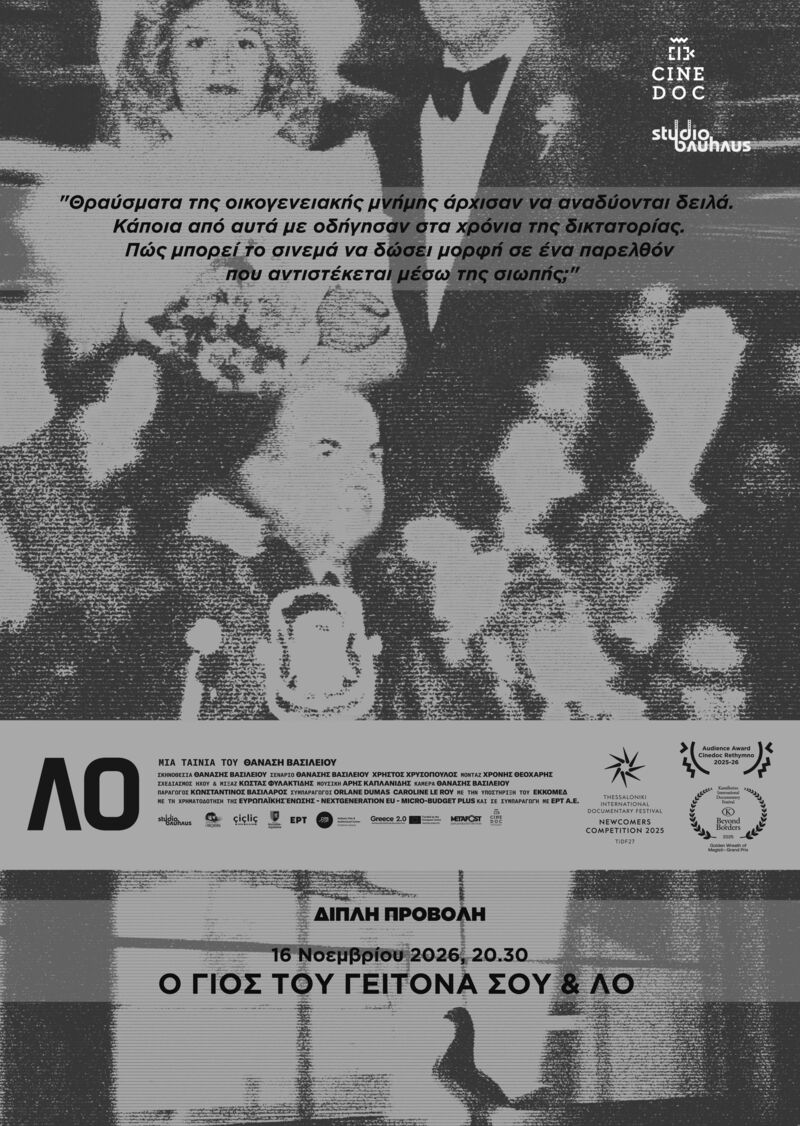
“Lo” means “be quiet” in the dialect of Epirus. When director Thanasis Vasileiou returns to his childhood apartment following his mother’s death, he is confronted with secrets that weigh heavily not only on his family’s history, but also on the history of modern Greece as a whole. Thus begins a journey in the form of a personal diary, tracing the invisible marks that connect a city and its people to their past.
A deeply personal film about all the ways in which emotional memory runs alongside collective memory, exploring trauma, the silence experienced as guilt, love and, ultimately, acceptance.
The documentary premiered at the 27th Thessaloniki Documentary Festival and won the EKOME Award for Best Emerging Director (Greek Programme). It also received the Golden Crown of Megisti (GRAND PRIX), as well as the “Odysseus” Award for Best Documentary by a Greek Director of the Diaspora at the 10th Beyond Borders – Kastellorizo International Documentary Festival. In 2026, it received the Iris Award for Best Feature-Length Documentary from the Hellenic Film Academy.
Director Thanasis Vasileiou’s Note
When I returned from France to the empty apartment of my childhood in Athens, following my mother’s death, I felt like a burglar. Everything that had remained in the shadows for decades now belonged to me. I discovered debts I had known nothing about. I uncovered lies that shook me. How do we inherit our parents’ mistakes? How do we empty their home?
Amid the fear of losing the space that held my last memories with my mother, as well as an entire childhood, I began filming the now-empty surfaces with my mobile phone. In essence, I was rediscovering forgotten gestures from the past, as before leaving Greece for France, I had worked as a camera operator for more than ten years. By placing myself behind a lens once again, I was stirring up time and reconnecting with the past of my inheritance. “Filming” thus became synonymous with “remembering”.
Fragments of family memory, silenced for years, began to timidly emerge. Some of them led me back to the dark years of the dictatorship. How can cinema give shape to a past that resists through silence.
“Survivors: Rewriting Her Myth”
Official trailer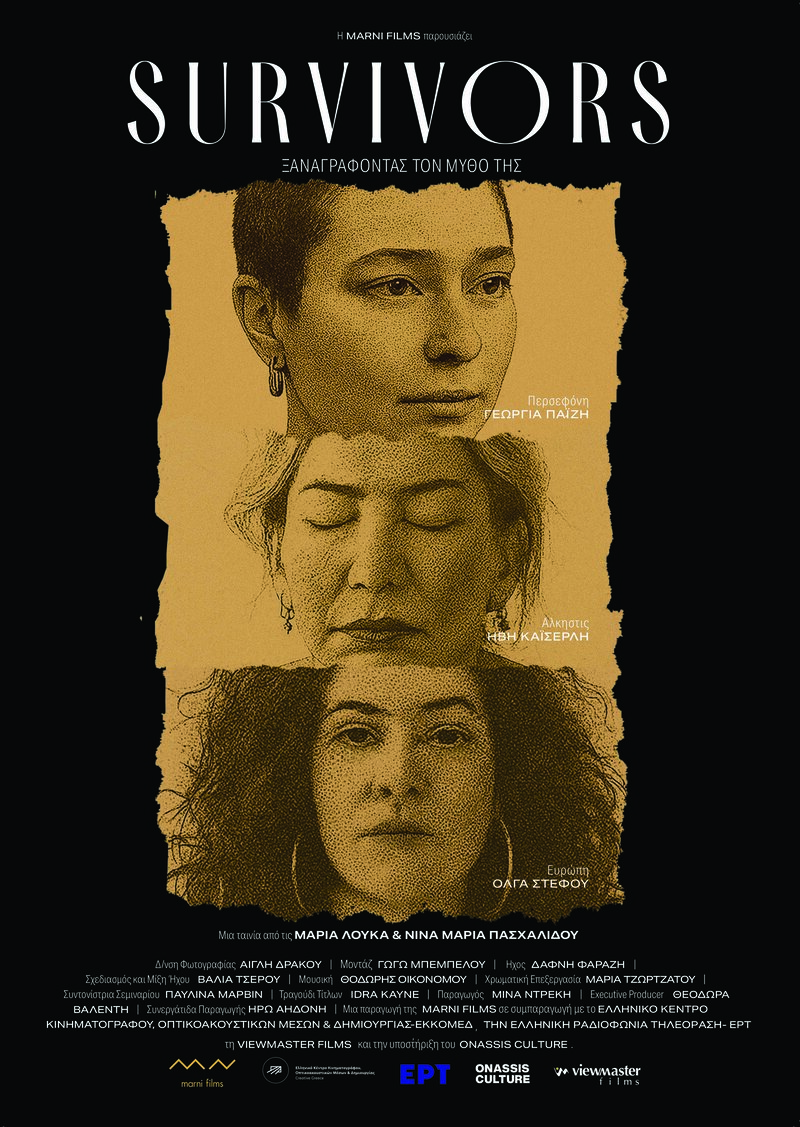
Three women who have survived gender-based violence meet in a creative writing workshop. United, they embark on a journey of renewal, rewriting ancient Greek myths and transforming patriarchal narratives of oppression.
Through the lens of Maria Louka and Nina Maria Paschalidou, the documentary Survivors: Rewriting Her Myth, produced by Marni Films, sheds light on the stories of Olga, Georgia and Ivi, who find their way towards empowerment together.
The film will be screened in Athens, Volos, Larissa and Rethymno as part of the CineDoc Documentary Film Festival 2026–27. The screenings are organised within the framework of events raising awareness about the International Day for the Elimination of Violence Against Women, observed on 25 November.
About the Film
Ancient Greek myths are rooted in the language of patriarchy, which means violence and injustice for women. Even the founding myth of Europe is based on the abduction of a woman.
The documentary follows the healing journeys of Georgia, Ivi and Olga, who have experienced different forms of gender-based violence. Through their participation in a creative writing workshop led by poet and theatre director Pavlina Marvin, they reclaim ancient myths, which serve as reflections of their own suffering, and rewrite them as stories of resistance and renewal.
Georgia is an intimacy coordinator and choreographer. She identifies with the mythical figure of Persephone, who was abducted by Hades and taken to the Underworld. Olga, a journalist and writer who has survived rape, finds points of connection with Europa, who was abducted by Zeus in the form of a bull and deprived of her freedom. Ivi, a transgender woman and sex worker who has experienced a transphobic attack, connects with Alcestis, who sacrificed herself to save her husband.
As the women revisit their trauma, the film weaves together their everyday lives with moments of writing, emotional transformation and reflection. At the end of this journey, three new heroines emerge, women who take ownership of their own lives. Through an experience of sharing and creation, Georgia, Ivi and Olga reinterpret the past and draw strength for the future.
Screening Schedule
ATHENS: 19, 20, 21 and 23 November 2026
PREMIERE
-
Thursday, 19 November, 19:30
French Institute of Greece (31 Sina Street, Athens)
A Q&A will follow with directors Maria Louka and Nina Maria Paschalidou and the film's protagonists Ivi Kaiserli, Georgia Paizi, Pavlina Marvin and Olga Stefou. The discussion will be moderated by Christina Galanopoulou, journalist at Athens Voice.
Advance tickets: Book here
FURTHER SCREENINGS
Danaos Cinema (109 Kifisias Avenue, Ampelokipoi)
Information: Danaos Cinema
Advance tickets: Ticketmaster
-
Friday, 20 November, 18:00
A Q&A will follow with Despina Kallea, mother of Kyriaki Griva; Anna Apergi, Special Advisor Expert at Diversity Charter Greece and member of the National Commission for Human Rights; and lawyer Ioanna Stentoumi.
The discussion will be moderated by Eleonora Orfanidou, journalist at Athens 9.84.
-
Saturday, 21 November, 18:00
A Q&A will follow with journalist Xenia Kounalaki and director Eva Stefani. The discussion will be moderated by Ioanna Bratsiakou, journalist at Kathimerini.
-
Monday, 23 November, 18:00
A Q&A will follow with Anna Vougiouka, researcher and social scientist, Head of Advocacy at the Diotima Centre; actress Zeta Douka; and poet Lena Kallergi. The discussion will be moderated by Niovi Anazikou, documentary filmmaker, journalist and president of WIFT GR.
LARISSA
-
Friday, 13 November, 20:00
“Hatzigianneio” Cultural Centre (59 Roosevelt Street)
Advance tickets will be available at the venue box office on the day of the screening.
A Q&A will follow with directors Maria Louka and Nina Maria Paschalidou.
VOLOS
-
Saturday, 14 November, 20:00
“Achilleion” Municipal Cinema of Volos (intersection of Koumoundourou and Iasonos Streets)
Co-organised with the Social Intervention and Culture Company (EKPOL) of the Region of Thessaly. Admission is free.
A Q&A will follow with directors Maria Louka and Nina Maria Paschalidou.
RETHYMNO
-
Saturday, 28 November, 20:00
“Simeio” Cultural Space (17 Patriarchou Athinagora Street)
Advance tickets will be available at the venue box office on the day of the screening.
A Q&A will follow with director Nina Maria Paschalidou.
Directors’ Note
As women, we have both experienced incidents of gender-based violence at times when it was very difficult to speak about such an experience and, above all, to be heard. We therefore carry this trauma in our biographies and try to process it, place it within the broader story of what it means to be a woman under patriarchy, and transform it creatively through the language of cinema. A gender perspective is present in each of our bodies of work, and it is with this background that we have collaborated on our film Survivors – Rewriting Her Myth, now turning our gaze towards life after violence.
Many women who experience gender-based violence themselves, or have someone close to them who does, suffer and feel as though they have reached a wall. What hurts them is presented through patriarchal stereotypes as a natural state of affairs, as an expression of “love”, or as their own fault. Given that, until recently, such issues remained largely silenced and women's unmediated voices rarely reached the public sphere, the film first and foremost places the words, memories, silences and physical experiences of its protagonists at its centre.
We have formed a connection and built a relationship of trust and care with the three women we follow, Olga, Ivi and Georgia. It is particularly important to us that the film gives space to their stories and, through the workshop, creates a space where these three stories meet the myths of Persephone, Alcestis and Europa. They trace the roots of gender-based violence and oppression back to the beginnings of time and rewrite mythology as they believe it should be written.
This is not a film about gender-based violence, but a cinematic journey towards healing, an exploration of the inner worlds of women who have managed to survive this devastation, move forward, grow stronger and open a path of escape and hope for women and feminine identities at risk.
(Maria Louka & Nina Maria Paschalidou)
About The CineDoc Documentary Film Festival
Download the CineDoc Documentary Film Festival 2026–27 catalogue here.
Watch the trailer for the CineDoc Documentary Film Festival 2026–27 here.
CineDoc screens and distributes award-winning Greek and international documentaries. The Festival aims to highlight documentary filmmaking as one of the most influential forms of art. We believe in its power to inspire us, change our perceptions and influence the way we see the world and our lives.
For the past 16 years, CineDoc has taken place annually from September to April, presenting one new film each month in collaboration with cultural and film organisations. The screenings are accompanied by discussions and events that bring audiences into contact with directors and experts, opening up a broader dialogue around the themes explored in the films.
The Festival is co-organised with the French Institute of Greece, Danaos Cinema, the Region of Thessaly, the Municipality of Larissa, the Thessaloniki International Film Festival, the Simeio Cultural Space in Rethymno, and the “Gymnos Ophthalmos” Film Club in Patras.
Starting in Athens, the screenings travel to Thessaloniki, Volos, Larissa, Rethymno and Patras, as well as to villages across Thessaly and Greek islands. At the same time, CineDoc continues to expand its screening network throughout the country through collaborations with film clubs, schools, local communities, and cultural and environmental organisations, with activities taking place throughout the year.
The sponsor of the CineDoc Documentary Film Festival 2026–27 is the Hellenic Film and Audiovisual Center (EKKOMED).
Follow CineDoc on Facebook and Instagram.
LIFE & CULTURE