

The Sisters On The Balcony: The Other Caryatids Of Athens
- by XpatAthens
- Wednesday, 07 January 2026

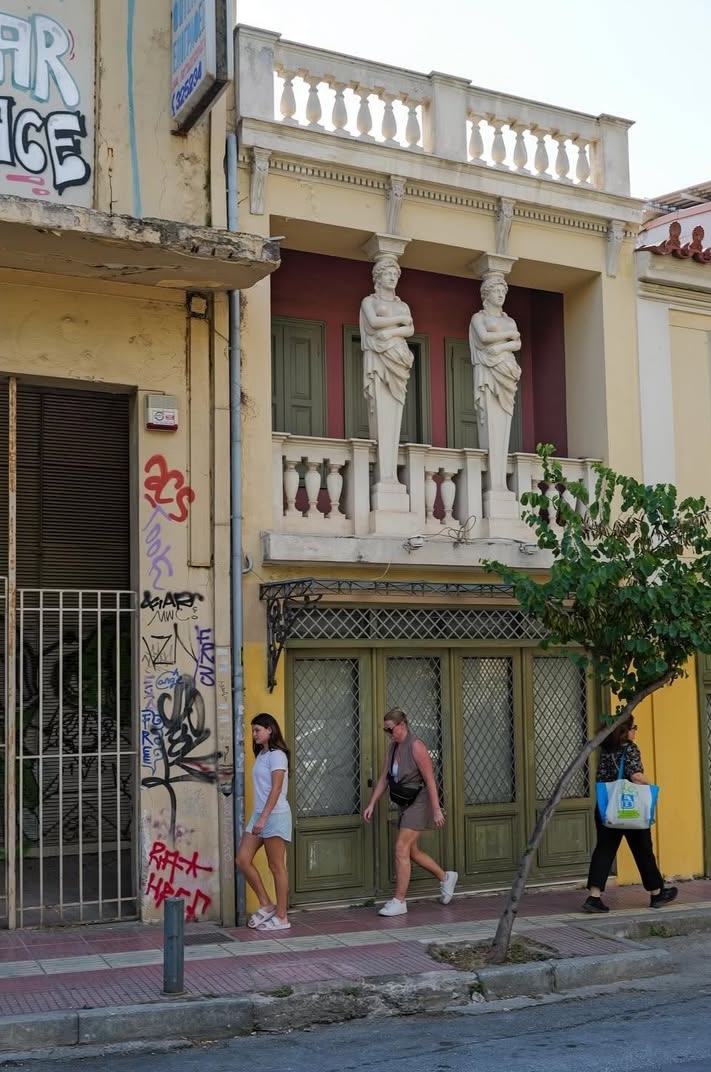
If you ever find yourself wandering through the streets of Athens, especially around the Kerameikos neighborhood, you might spot a particularly charming little building. What makes it stand out is its balcony, gracefully supported by two caryatids, those sculpted female figures that, in ancient Greece, took the place of traditional columns.
This lovely façade once belonged to the renowned sculptor Ioannis Karakatsanis, who lived and worked there until his death in 1906. Sharp‑eyed observers will notice something intriguing: the caryatids don’t quite follow the strict stylistic rules of their ancient predecessors. There’s a reason for that. These figures aren’t anonymous mythological maidens; they are portraits of Karakatsanis’ wife, Xanthi, and her sister, Eudoxia, the sculptor transforming the very simple building into a deeply personal tribute.
If the building’s unusual charm weren’t enough on its own, a popular legend adds an extra layer of mystery, all thanks to a local barber named Panagiotis Kritikakos, whose shop once occupied the ground floor (you can still spot his old sign at the entrance). To attract more customers, he loved telling visitors that the caryatids weren’t just decorative figures but actually represented Karakatsanis’ daughters, who had died young and were forever imprisoned on the balcony.
@danielgiacopelli
This lovely façade once belonged to the renowned sculptor Ioannis Karakatsanis, who lived and worked there until his death in 1906. Sharp‑eyed observers will notice something intriguing: the caryatids don’t quite follow the strict stylistic rules of their ancient predecessors. There’s a reason for that. These figures aren’t anonymous mythological maidens; they are portraits of Karakatsanis’ wife, Xanthi, and her sister, Eudoxia, the sculptor transforming the very simple building into a deeply personal tribute.
If the building’s unusual charm weren’t enough on its own, a popular legend adds an extra layer of mystery, all thanks to a local barber named Panagiotis Kritikakos, whose shop once occupied the ground floor (you can still spot his old sign at the entrance). To attract more customers, he loved telling visitors that the caryatids weren’t just decorative figures but actually represented Karakatsanis’ daughters, who had died young and were forever imprisoned on the balcony.
@danielgiacopelli
Depending on the barber’s mood, the story changed: sometimes the girls had succumbed to a rare illness, other times they had been poisoned by a wicked stepmother. And even though the sculptor’s descendants firmly debunked the tale — Karakatsanis’ daughters lived long, full lives and left behind generations of descendants — the legend of the “imprisoned young girls” still lingers in the neighborhood’s collective imagination.
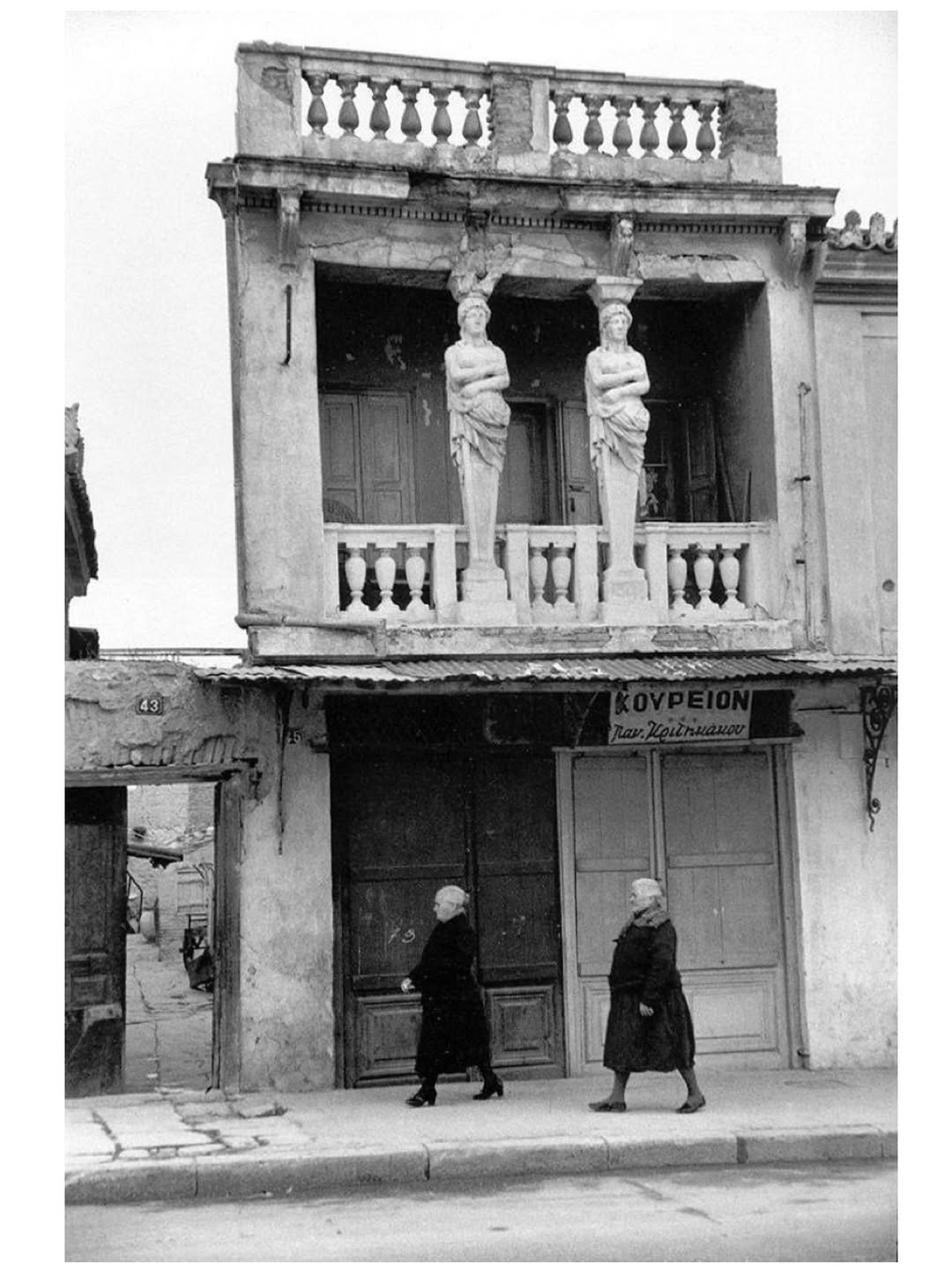
Just like many of us who stroll through Athens and suddenly fall under the spell of this unique façade, the French photographer Henri Cartier‑Bresson was captivated by it too. Naturally, it became the subject of one of his most iconic shots from his 1953 trip to Greece: two elderly women dressed in black walking past the building, perfectly framed beneath the youthful stone caryatids.
@henricartierbresson__
Just like many of us who stroll through Athens and suddenly fall under the spell of this unique façade, the French photographer Henri Cartier‑Bresson was captivated by it too. Naturally, it became the subject of one of his most iconic shots from his 1953 trip to Greece: two elderly women dressed in black walking past the building, perfectly framed beneath the youthful stone caryatids.
@henricartierbresson__
As upright, idealized, and eternally young as the figures on the balcony are, the women below are their complete opposite: older, grounded, and so real. Cartier‑Bresson later reflected on this kind of moment, saying: “I suddenly realize that photographs can achieve eternity through the moment."
The photograph carries a gentle, comforting yet slightly nostalgic message: the past is never entirely gone. For a brief instant, the caryatids seem to escape their stone “prison” and wander through the Greek capital, where ancient traces and modern life intertwine at every corner.
This famous photograph is part of a much larger collection captured during Henri Cartier‑Bresson’s successive trips to Greece, spanning from the 1930s to the 1960s. His journeys took him not only through Athens, but also across the Cycladic islands, the country’s major archaeological sites, and more remote regions such as the Peloponnese, Thessaly, and Epirus. Often described as the photographer of the “decisive moment,” Cartier‑Bresson had a gift for capturing faces, people, and everyday street scenes that reveal an authentic yet poetic vision of Greece, the gaze of a true philhellene, filled with tenderness and admiration.
His photograph of what is now affectionately known as “The House With the Caryatids” freezes in time a symbol of Greek heritage, an architectural gem delicately suspended between past and present. The original print is now displayed at the MoMA in New York.
This famous photograph is part of a much larger collection captured during Henri Cartier‑Bresson’s successive trips to Greece, spanning from the 1930s to the 1960s. His journeys took him not only through Athens, but also across the Cycladic islands, the country’s major archaeological sites, and more remote regions such as the Peloponnese, Thessaly, and Epirus. Often described as the photographer of the “decisive moment,” Cartier‑Bresson had a gift for capturing faces, people, and everyday street scenes that reveal an authentic yet poetic vision of Greece, the gaze of a true philhellene, filled with tenderness and admiration.
His photograph of what is now affectionately known as “The House With the Caryatids” freezes in time a symbol of Greek heritage, an architectural gem delicately suspended between past and present. The original print is now displayed at the MoMA in New York.
LIFE & CULTURE