

XpatAthens
Cilentio, One Of The Most Chic And Trendy

3 Matzarou St. & Solonos St, 106 72 Kolonaki, Athens, Τ: 210. 3633144
cilentio.gr
Do you have a recommendation or recipe to share? Send it to us at ideas@xpatathens.com!
Small Underwater Town Found Off Delos

Remains of an ancient town were discovered on the bottom of the Aegean Sea off the island of Delos, according to a Ministry of Culture announcement. The ruins of an ancient pottery workshop prompted archaeologists to say that this was in fact an ancient settlement. The findings lay at a depth of only two meters on the northeastern coast of Delos, near the popular island of Mykonos.
According to Greek mythology, the god Apollo and goddess Artemis were born on Delos, making it a sacred island. Hence the famous Temple of Apollo on the island.
Archaeologists found 16 terracotta pots and remains of a kiln embedded in the sea floor, similar to workshops found in Pompeii and Herculaneum, according to the ministry. The large stones in front of the workshop probably mean that they belong to the settlement’s waterfront.
Other lined stones suggest walls of structures, reinforcing the theory that this was indeed a settlement. In the past, archeologists believed that the ruins were port facilities.
The new search that was conducted by divers from the National Hellenic Research Foundation and the Ephorate of Underwater Antiquities, led to different conclusions. Rather than a dock, a pottery workshop and other buildings were once there. The structure remains were found in shallow waters, less than one meter deep.
To read more, please visit greekreporter.com
By Philip Chrysopoulos
We Suggest A Mediterranean Approach To Sea Bass
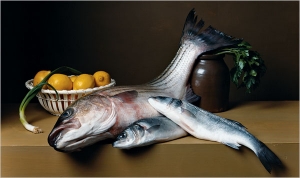
“Maybe the otolith?” another scientist suggested.
“Ah,” Panopoulos said, “the otolith.”
He worked a knife into the fish’s head and removed the pearly ear bone. Then, using his glass as a primitive magnifying instrument, he counted the otolith’s layers, which accrue like rings in a tree. “I see four,” Panopoulos said, “and they are uneven. This fish is four years old and wild.”
That the fish before us was indeed wild is a rarity in modern Greece. Never common, wild European sea bass are today one of the more overfished creatures in the Mediterranean. So rare that when you want to say you “hit the jackpot” in Greek, you say you “epyase lavraki” — you caught a sea bass. But as is increasingly the case with prized sea creatures, the end of a fish in the sea does not mean its disappearance from the plate. In fact the diminishing of a wild population is often the trigger that starts research on a new species’ domestication.
Sea-bass farming has been a long time in the works. It was piloted in France and Israel in the 1960s, and it took years to decode the biochemistry behind reproduction and diet. A final element — the warm, protected inlets of coastal Greece, turned it into a commodity.
In Greece it began, as it should, with a man at sea. In 1982, Thanasis Frentzos set sail from Kefalonia, an island some archaeologists believe was Odysseus’ Ithaca. Frentzos bears a certain resemblance to Homer’s protagonist, and so it follows that when he traveled to Sicily to purchase 100,000 inch-long sea-bass juveniles, his return trip was interrupted by a fierce gale known as the donkey mistral, and 90,000 bass perished in the storm. He installed the surviving bass in a pen and grew them to maturity. From this first farm (now called Kefalonia Fisheries), Greece came to dominate world sea-bass production, and the Selonda company has emerged as an international leader, with exports to the United States growing to more than a million pounds in 2004 from 10,000 pounds in 2000.
American appreciation of foreign bass has risen in inverse proportion to the decline of our own domestic striped bass. Similar in shape to European sea bass, American striped bass were recently found through DNA analysis to be so closely related as to share a common genus (Morone). With their meaty white flesh, “stripers” were a favorite from the Carolinas to Maine all the way back to Colonial days. Fishing pressure on stripers mounted progressively until the mid-’70s, when the catch plunged. By the early ’80s, just as Thanasis Frentzos was sailing for Sicily, conservationists were suggesting stripers for the Endangered Species List.
But while Europeans generally turn to the farm when fish go missing, Americans tend to look to the wild. In a major conservation act, a consortium of states halted striped-bass fishing in the ’80s, and a program was introduced to rebuild the breeding stock in the Chesapeake Bay. One scientist the government engaged was Yonathan Zohar, an Israeli-born biologist at the University of Maryland at Baltimore who helped decode European sea-bass reproduction. Zohar, who refers to himself as an “OB-GYN for fish,” got wild striped bass to spawn in captivity in a predictable manner. Supplementation combined with fishing moratoriums yielded results. Today striper populations are listed as “fully rebuilt,” and the fish has once again appeared on seafood menus — alongside branzino.
To read more, please visit nytimes.com
By Paul Greenberg
'Travel Bloggers Greece' Attends TBEX Asia 2015. Next Stop; WTM London

The first Greece-based travel blogger network joined over 600 travel bloggers and online writers worldwide from 50 countries to exchange knowledge and ideas, and learned about Thailand — discovering Thainess.
“TBG’s members are committed to improving their blogs and helping to promote a positive image of Greece”, said Elena Sergeeva, co-founder of TBG and publisher of travel blogs Passion for Greece and PassionforHospitality.
“Events such as TBEX are a great opportunity to gain new insights on the latest travel blogging trends, learn new practices and to connect with professionals from around the world.”
Lane Sea Lines & Aegeon Pelagos Launch E-ticket System To Make Ferry Travel Easy

To read this article in full, please visit: Greek Travel Pages
Greek Woman Is Candidate For Nobel Peace Prize

To read this article in full, please visit: USA Today
London Tube Sign Shares Kazantzakis' Message

April 3 - Greek Easter Customs & Traditions

Athens Celebrates World Music Day With Ancient Greek Instruments

How CO2 Causes Climate Change