
SUPPORT US

XpatAthens
Cinedoc Presents: Lo

When director Thanasis Vasileiou returns to his childhood apartment after his mother’s death, he confronts secrets that weigh not only on his family’s history but also on the history of modern Greece. Thus begins a journey—a personal diary—through the invisible traces connecting the city and its people to their past.
A deeply personal film, cinematographically minimalist and emotionally profound, exploring the ways emotional memory intersects with collective memory, addressing trauma, the silence felt as guilt, love, and ultimately acceptance.
The documentary premiered at the 27th Thessaloniki Documentary Festival, winning the EKKOMED Award for Best Debut Director (Greek Program), as well as the Grand Prix “Golden Wreath of Megisti” and the “Odysseas” Award for Best Documentary by a Greek Diaspora Director at the 10th Beyond Borders – International Documentary Festival of Kastellorizo.
From November 13, Lo will be released in Athens, screening daily at Danaos Cinema. Screenings will include Q&A sessions with the creators and guest experts, including historians and members of the academic community. Screenings will also take place in Larissa (Nov 21), Volos (Nov 22), Thessaloniki (Dec 10), and Rethymno (Dec 13), with the presence of director Thanasis Vasileiou. Additional screenings across Greece will be announced soon through the CineDoc network.
The film is nominated for the Audience Award in Athens, Volos, and Rethymno.
Director’s Note
When I returned from France to my empty childhood apartment in Athens after my mother’s death, I felt like an intruder. Everything that had remained in the shadows for decades was now mine. I discovered debts I hadn’t known about. I uncovered lies that shook me. How do we inherit our parents’ mistakes? How do we empty their home?
Amid the fear of losing a space that held my last memories with my mother—and an entire childhood—I began filming the now-empty surfaces with my phone. I was essentially rediscovering forgotten gestures from the past, as I had worked as a cameraman for over ten years before leaving Greece for France. Putting myself behind a lens again stirred time and reconnected me with the heritage of the past. For me, “filming” became synonymous with “remembering.”
Fragments of family memory, silenced for years, began to cautiously surface. Some led me to the dark years of the dictatorship. How can cinema give shape to a past that resists through silence?
Screening Program
Screenings are supported by the French Institute and Unifrance, while the distribution of the documentary in Greek cinemas is supported by the Hellenic Film Center, Audiovisual Media & Creation (E.K.K.O.M.E.D.) – Creative Greece.
ATHENS – French Institute (Sina 31, Athens)
Tuesday, November 11, 2025 (avant-première)
Doors: 19:00 | Start: 19:30
Tickets
Opening remarks by Athena Kartalou, Director General of Cinema, EKKOMED. Presence of director Thanasis Vasileiou and the team, followed by Q&A. Wine reception at the French Institute bistro.
ATHENS – Danaos Cinema (Kifisias 109, Ampelokipoi)
Daily from Thursday, November 13, 2025, at 18:20
Tickets
Special Q&A sessions at Danaos Cinema:
-
Nov 13: with the filmmakers, hosted by Depy Vrettou (ERT radio producer)
-
Nov 14: with the filmmakers, hosted by Thodoris Chondrogiannos (Reporters United)
-
Nov 15: with the filmmakers and Tasos Sakellaropoulos, historian, Benaki Museum Archives
-
Nov 16: with the filmmakers, hosted by Kostas Kostakos (Old Boy), film critic (elculture.gr)
-
Nov 17: with the filmmakers and historian Tasoula Vervenioti
-
Nov 18: with the filmmakers and Christos Dermentzopoulos, Professor, Dept. of Communication, Media & Culture, Panteion University
-
Nov 19: with the filmmakers and Vangelis Karamanolakis, Professor of Modern & Contemporary History (NKUA)
LARISSA – Chatzigiannio Cultural Center
Friday, Nov 21, 20:00 – Presence of director Thanasis Vasileiou
VOLOS – New Ionia Cultural Center
Saturday, Nov 22, 20:00 – Presence of director Thanasis Vasileiou
Tickets: ENTEKA – Digital Prints | Info: https://www.facebook.com/CineDocVolos
THESSALONIKI – Limani, “Stavros Tornes” Hall
Wednesday, Dec 10, 19:00 – Presence of director Thanasis Vasileiou
Tickets
RETHYMNO – “Simeio” Cultural Space
Saturday, Dec 13, 20:00 – Presence of director Thanasis Vasileiou
Tickets: Box office | Info: https://bleproductions.gr/simeio/
Parallel Activities
Masterclass with director Thanasis Vasileiou in Athens and Volos
and VR screening at Danaos Cinema
As part of Lo screenings, audiences in Athens and Volos can participate in parallel events. During Danaos Cinema screenings, CineDoc attendees can access the VR documentary 548 Days Without My Name by Yolanda Markopoulou (2024, 14’) with ticket purchase. The director will also conduct two masterclasses in Athens and Volos.
VR Screening at Danaos Cinema Foyer
548 Days Without My Name by Yolanda Markopoulou (2024, 14’)
The screening is part of a new CineDoc VR series, inaugurated this year with 548 Days Without My Name (Nov ‘25) and The Exploding Girl by Caroline Poggi & Jonathan Vinel, co-produced with Greek company Byrd (Feb ‘26).
With a Lo ticket, festival-goers can watch the VR film. Reservation required HERE!
Screening dates: Nov 13, 14, 15, 16, 21, 22, 23 | 18:00–21:00
Synopsis:
In 1943, 10-year-old Rozina writes her diary from hiding in a small apartment in central Thessaloniki, using the false name Roula Karakotsou. This was her only way to escape the Nazis, spending 548 days of anonymous life in silence. Viewers experience her story through her child’s perspective while she remains in hiding.
Based on the book 548 Days Under Another Name: Thessaloniki 1943 / Memories of War by Rozina Asser Pardo.
Produced by the Jewish Museum of Greece in collaboration with Wonder Immersive.
Implemented under the Operational Program “Competitiveness, Entrepreneurship and Innovation” (ESPA 2014–2020), co-funded by the European Regional Development Fund (ERDF), EU.
Official participation: FIPADOC 2025, TiDF27
Masterclasses in Athens & Volos
Heritage, Rupture, Self-Portrait. Stages of Creating the Documentary LO (2025)
Thanasis Vasileiou, director and Professor of Film Studies at Université de Poitiers, gives masterclasses in Athens and Volos, exploring the making of Lo, a personal and reflective documentary on memory, the inheritance of silence, and recent political history. Through the management and concealment of personal narratives, the film examines heritage as both rupture and material for a cinematic self-portrait.
Schedule:
-
Athens | Wed, Nov 19, 13:30–15:30 | Lycurgos Stavrakos School, 28th October 65, Athens 10433 | Free entry, first-come-first-served
-
Volos | Fri, Nov 21, 9:30 | a) University of Thessaly – Dept. of Culture + Creative Media & Industries b) 2nd Model Gymnasium of Volos
Audience Awards – E.K.K.O.M.E.D.
CineDoc introduces local Audience Awards in Athens, Volos, and Rethymno through the Votemo platform. Lo is nominated in Athens and Volos. Audience members vote online via QR code during screenings; voting remains open 24 hours after the screening. Awards sponsored by Hellenic Film Center, E.K.K.O.M.E.D. – Creative Greece. Ceremony in April 2026.
Director Biography
Thanasis Vasileiou is a director and screenwriter based in Poitiers, France, where he teaches film theory and practice as Associate Professor of Film Studies (Université de Poitiers). His short films Traces (2017) and Our Last Week (2016) were screened and awarded at international film festivals. Lo is his first feature-length film.
About StudioBauhaus
StudioBauhaus, founded in Athens in 2014 by producer Konstantinos Vasilaros and director Orfeas Peretzis, specializes in production and co-production of feature films and documentaries, emphasizing original storytelling and international collaborations. Award-winning films include Agia Emy (Special Mention, Locarno Film Festival; 2 Independent Spirit Award nominations) and Milk Teeth (Venice Film Festival world premiere). Recently completed Riviera by Orfeas Peretzis (São Paulo Festival world premiere; awards at Thessaloniki and Cottbus Festivals). The company continues developing film and TV projects and participates as co-producer in international productions.
Top 5 Cozy, Character-Filled Cinemas In Athens
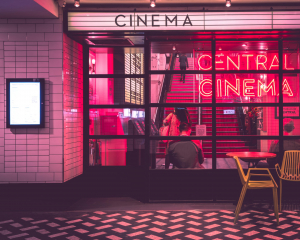
The air is getting crisp, the city smells like rain on warm pavement, and Athens has officially entered its coziest season. While it's tempting to pull up a blanket, light a candle, and let Netflix automatically play the next episode, autumn in Athens has a better alternative: the city’s charming, small-scale cinemas.
These theaters are more than places to watch a film — they’re community hangouts, cultural landmarks, and secret escapes from the fast pace of the city. Grab a warm drink, your favorite sweater, and explore the Top 5 Cinemas in Athens that prove movie nights are better outside the living room.
1. Astor
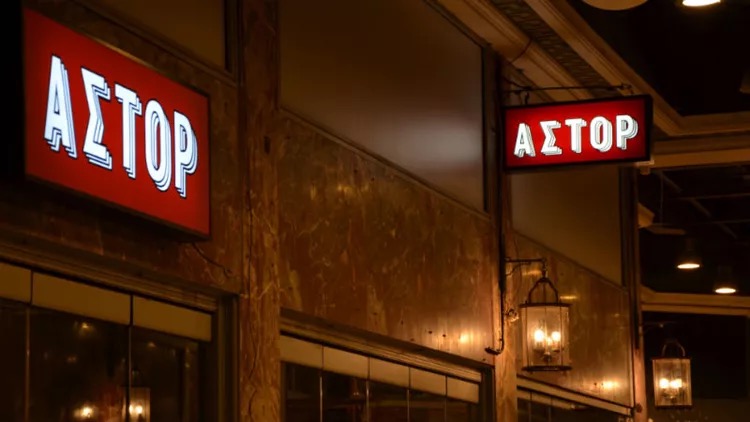
📍 Stoa Korai, Panepistimio
A legendary underground cinema, operating since the 30s, with a cult following, Astor is known for its curated selection of indie films, retrospectives, and classic screenings. The vibe is warm, nostalgic, and slightly retro — the kind of place where you can watch Casablanca on a Tuesday and a silent film accompanied by live music on a Thursday.
✨ Best for: cinephiles, date nights with an “old-school romantic” twist.
2. Trianon Cinema
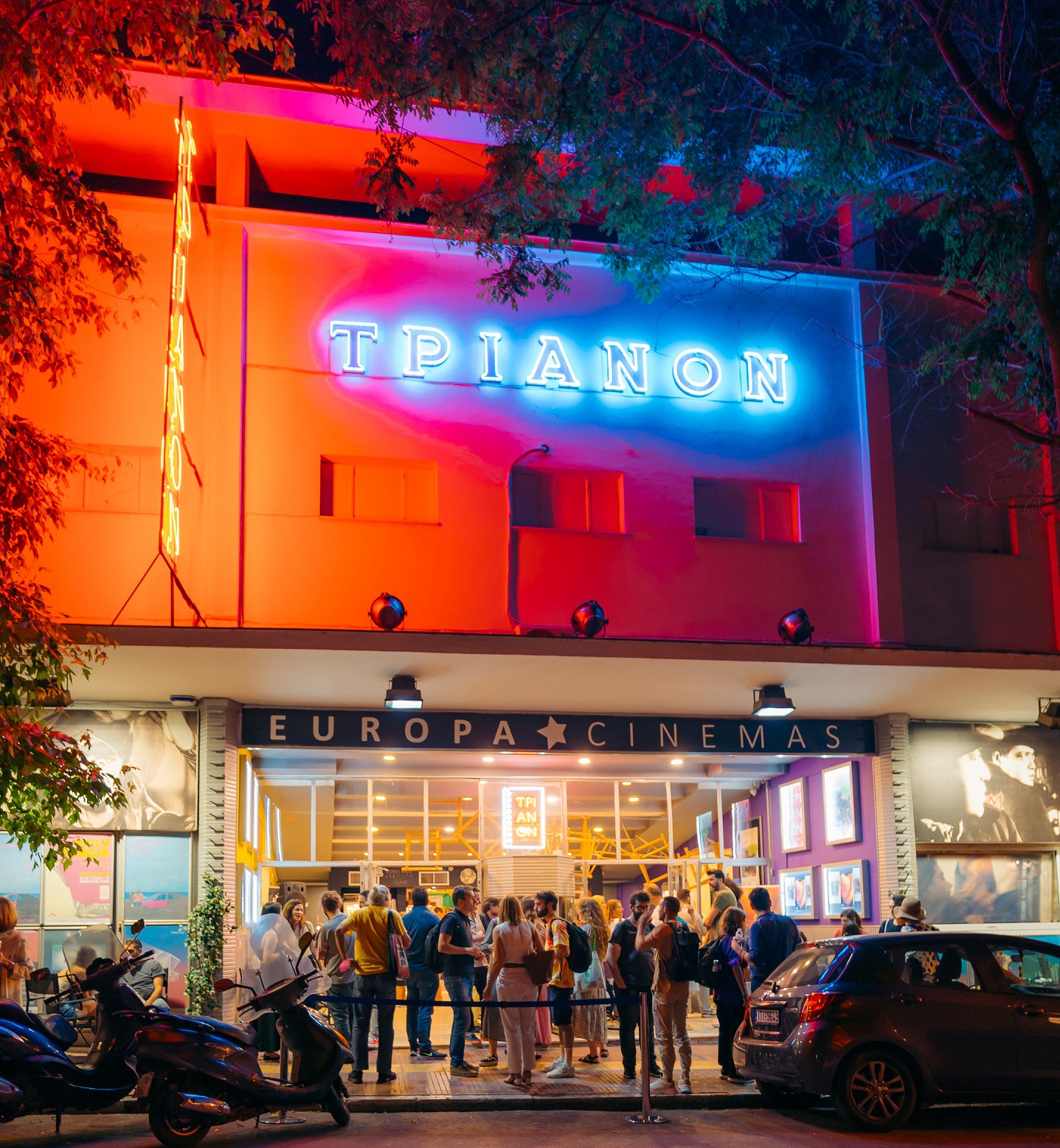
📍 Patission / Victoria Square
A true Athenian classic and one of the few cinemas focusing on international film festivals, documentaries, and art films. Occasionally, Trianon doubles as a live performance venue or a cultural space for talks and special screenings. The façade alone screams vintage cinema magic.
✨ Best for: film festivals, premieres, artsy crowd energy.
3. Danaos Cinema
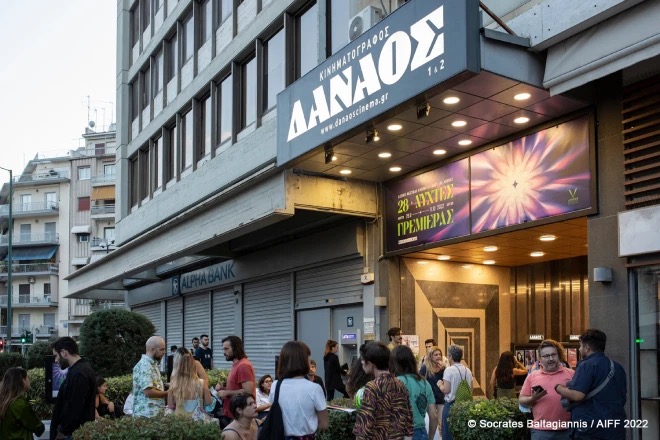
📍 Amphitheas Avenue, Fix
A modern but charming independent cinema known for showing the best European cinema releases. Danaos regularly participates in Athens’ film festivals and hosts Q&As and special events with filmmakers. The seating is comfortable, the sound is great, and the atmosphere still feels personal.
✨ Best for: those who want the film quality of a big-chain cinema without the mall energy.
4. Foivos
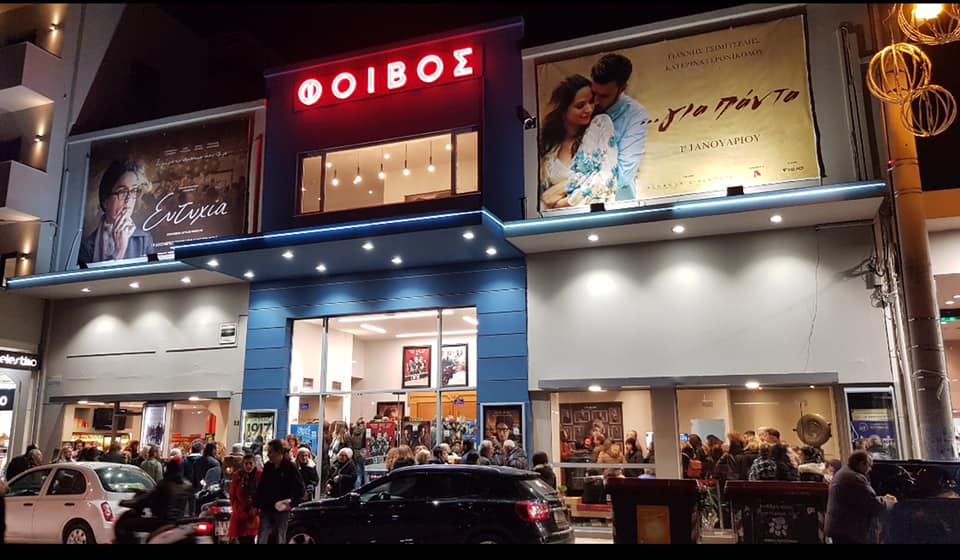
📍 Ethnikis Antistaseos 3, Peristeri
Built in 1953, Foivos is a true neighborhood treasure. Foivos feels like cinema therapy — intimate hall, relaxed atmosphere, affordable tickets, and an audience that genuinely cares about movies. If you want to feel like a local, this is your spot.
✨ Best for: heartfelt indie experiences & cozy autumn walks afterward.
5. Studio New Star Art Cinema
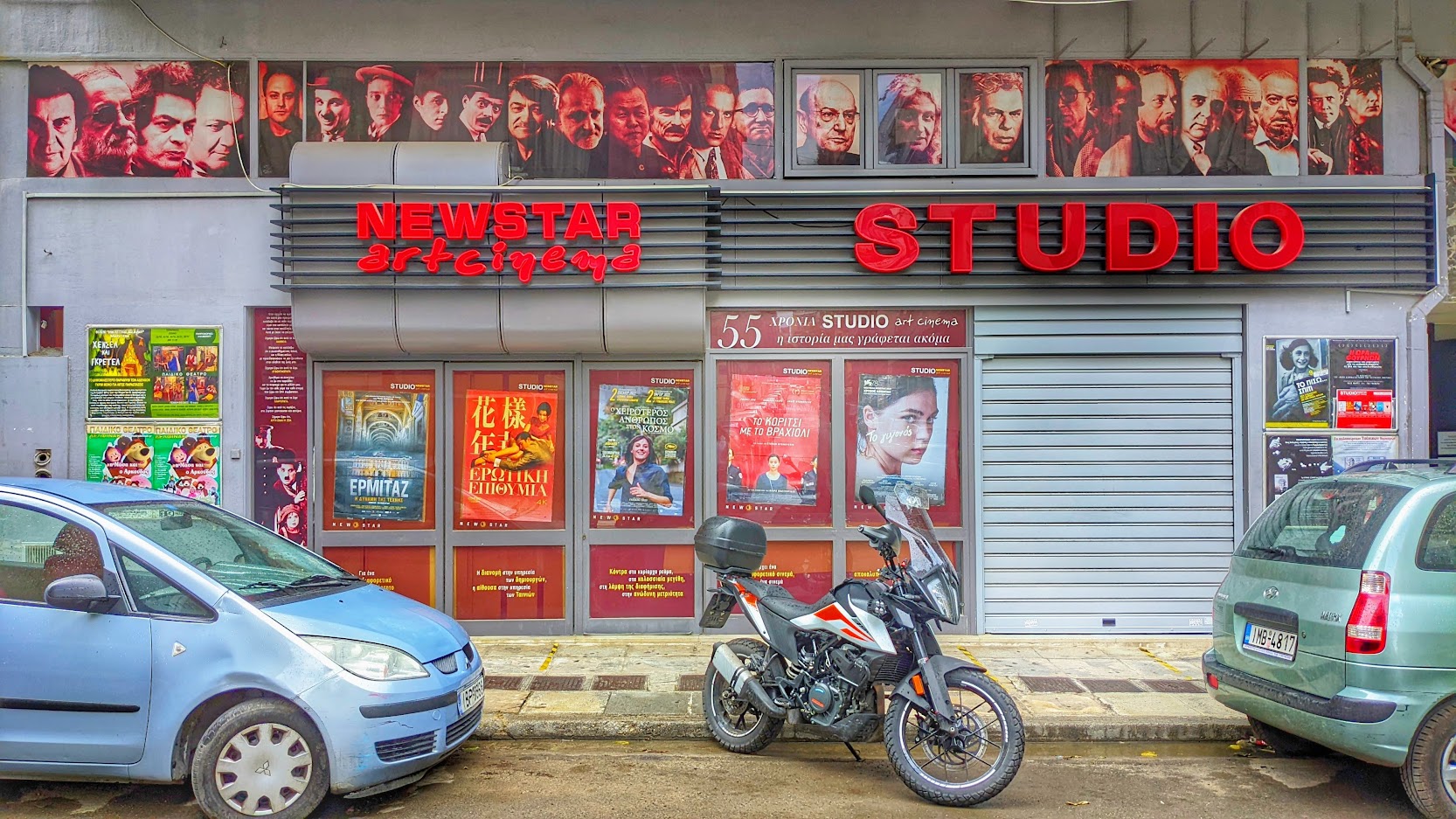
📍 Stavropoulou 33, Athens
A historic arthouse venue that champions world cinema, independent productions, rare films, and retrospectives you won’t find anywhere else. If you love the kind of movies that don’t hit mainstream theaters, Studio will feel like home.
✨ Best for: discovering films you didn’t know you needed.
November At Technopolis

05–06.11 || Athens Bar Show 2025
As every year, since 2010 when it first began, the Athens Bar Show will once again be a “celebration” of the bartending industry, hospitality, dining, and distillates. Dozens of exhibitors and thousands of professionals from around the world, talks, events, tastings, as well as appearances by famous names from the Greek and international bartending “industry” await the visitors of the two-day exhibition. Try products, find solutions for your own bar, attend seminars and talks by distinguished professionals, and get inspired by what’s happening right now in the best bars in the world.
This year, for the 12th time, the Christmas Factory opens its gates again, bringing the magic of Christmas to the heart of the city! The new Christmas town—named by the children themselves, “Bright City”—invites young and old to experience the magic of the game “Find Your Star.” Ten missions, ten stars, and a bright path filled with smiles, light, and love. Santa Claus and the elves light up the world differently this year—not only the city, but also all our hearts. Because the light wins… and Christmas begins from within us!
Tel: 210 3460981 | Wednesday, Thursday, Friday & Sunday 10:00–18:00 | Email: shop@athens-technopolis.gr
Crete Becomes The Meeting Point For 12 Countries At CEV Beach Volley European Cup Final


Greek Phrases That Sound Hilariously Confusing In English

Here are some of the most iconic examples.
What it really means: “Let me tell you something surprising.”
Greeks instruct people to listen… in order to see. The phrase mixes senses (hearing and sight) into one idiomatic expression that means: “Wait till you hear what happened.” To a non-Greek speaker, it sounds like a glitch in human anatomy.
2. «Δεν έχω ξαναπάει ποτέ»
Literal translation: “I have never been again, ever.”
What it really means: “I have never been before.”
Grammatically, it's a paradox. The combination of “ξανα–” (again) and “ποτέ” (never/ever) suggests the speaker has never been somewhere again, which implies they were there once, but also that they've never been at all.
In reality, Greeks use it to strongly emphasize that they have never visited a place before.
3. «Δεν τρέχει τίποτα»
Literal: “Nothing is running.”
Meaning: “It’s fine / no problem / no big deal.”
In English, the phrase sounds like we’re reporting the status of a piece of software: “Nothing is running.” In Greek, it's emotional reassurance.
4. «Καλά κρασιά»
Literal translation: “Good wines.”
Meaning: “Yeah, sure… as if.” / “Let’s not kid ourselves.”
It has nothing to do with actual wine. It’s used when someone is being unrealistic or when a situation is going nowhere. Imagine replying to someone’s complex plan with “Good wines.” It’s the Greek “dream on.”
5. «Ό,τι να ’ναι»
Literal translation: “Whatever it may be.”
Meaning: “This is nonsense / chaotic / makes no sense.”
Used to evaluate situations, behavior, or decisions that are totally irrational. The tone usually implies dramatic disappointment, a very Greek thing if you ask us.
6. «Πάμε καλά;»
Literal translation: “Are we going well?”
Meaning: “Are you serious?” or “Is this for real?”
A polite-ish way to express disbelief… usually accompanied by a raised eyebrow and slight exasperation.
7. «Τέλος πάντων»
Literal translation: “The end of everything.”
Meaning: “Anyway / never mind / let’s move on.”
Greek drama in two words. Perfect for dismissing minor annoyances or just adding flair to any conversation.
Piano Lessons By Experienced Professional

Lessons are tailored to each student’s level and goals, with a focus on steady progress and practical results. Sessions take place at the studio on Astydamantos 22 in Pagrati.
More information: davidjohnsonpianist.blogspot.gr
Children First
What American Expat Parents Should Know When Raising Infants In Greece

Understanding Maternity, Parental Leave, and State Support
Greece has expanded support for new parents in recent years. In 2024, the government raised the tax-free income threshold by €1,000 for families with children. It also extended the maternity allowance from four to nine months and increased the heating allowance from €3,000 to €5,000 per child.
These measures aim to ease financial stress for young families. A key part of this support is the birth allowance, a one-time payment for every child born in Greece. Effective from 2024, the amount is now graduated. For the first child, parents receive €2,400, rising to €3,500 for the fifth and subsequent child, providing meaningful relief for growing families.
If you’re an American living and working in Greece, you may qualify for certain local benefits depending on your residence and employment status. Parents who contribute to Greece’s national insurance (EFKA) can apply for maternity and parental leave allowances. Eligibility often depends on your work contract, so confirm with your employer or local EFKA office.
Families also receive child benefits that vary by income and family size, ranging from about €28 to €70 per child. These payments are made six times annually in bi-monthly installments by OPEKA. Applications must be submitted through the government’s digital portal. Local municipalities and expat groups can help guide you through the process.
Infant Formula, Pricing, and Regulation in the Greek Market
Many expat parents are surprised by how expensive infant formula is in Greece. According to Le Monde, an 800-gram container of powdered formula can cost up to €27, nearly double the price in other European countries.
Newsday Greece reports that the rising prices forced the government to implement a 7% profit cap on baby formula. Greek authorities also fined several international companies for violating these caps. For parents, this means pricing is now more regulated, but selecting the right formula still requires care. When buying baby formula, always check for EU labeling and safety approval.
Pharmacies across Greece stock many EU-certified brands, and pharmacists can help you choose the right one for your baby. Imported U.S. brands are harder to find and cost more. Many American parents follow product safety news back home. You may have read about the Similac lawsuit in the U.S., which raised concerns about specific infant formulas.
According to TorHoerman Law, various Similac products were linked to necrotizing enterocolitis, a severe intestinal condition in premature infants. However, this case applies only in America and does not affect Greek or EU-regulated products. Still, staying informed about recalls can help you make safer choices, especially if you import formulas from abroad.
Food safety in Greece follows strict EU standards, and local products are regularly inspected. If you live on an island or in a rural area, keep an extra tin or two, since delivery delays are common during peak seasons.
Healthcare, Pediatric Access, and Vaccination Norms
Greece has both public and private healthcare systems, and expat parents often use a mix of both. The public system provides reliable pediatric care through regional hospitals and health centers, but wait times can be long. Private clinics, while more expensive, offer faster appointments and English-speaking pediatricians.
To access public healthcare, register with the national insurance system (EFKA) and obtain an AMKA number. This gives your family access to child health visits and vaccinations. Most vaccinations in Greece follow the World Health Organization’s schedule, so you won’t find major differences compared to the U.S.
A helpful tip for expat families: in many Greek neighborhoods, pediatricians still make house calls for newborn checkups. This can be a big comfort, especially during your baby’s first few weeks. Local parent groups can recommend trusted doctors who speak English or are familiar with the needs of foreign families.
If you plan to split time between the U.S. and Greece, carry a record of your baby’s vaccination history to avoid duplication. Pharmacies in Greece also provide over-the-counter baby medications, but you’ll need a doctor’s prescription for antibiotics or specialized formulas.
Once your child’s healthcare needs are met, the next challenge is managing day-to-day essentials such as formula and supplies, especially outside major cities.
Managing Baby Supplies & Daily Life Across Greece
Outside of Athens and Thessaloniki, access to baby supplies can vary. Pharmacies are the primary source of baby formula, diapers, and baby care items. In smaller towns or islands, it’s smart to order in bulk or through online Greek pharmacies that deliver nationwide.
Shipping from the U.S. can be unpredictable due to customs and inspection delays. Rely on EU-certified brands found locally when possible. These products meet high safety standards and are easier to replace if lost or recalled. Island residents should plan around ferry schedules and delivery slowdowns, especially during holidays.
Keep a small emergency kit, formula, diapers, wipes, and basic medication, for times when stores close early or shipments are delayed. To understand daily living costs, consider the example of an American family that relocated from Texas to Greece. According to CNBC, they found life more affordable and balanced.
The family, earning about $136,000 annually, reported spending roughly $1,400 per month on rent and utilities. Additionally, they spend $1,900 on food and $1,200 on medical expenses during their first month. Although their initial relocation cost about $15,000, they described the Greek lifestyle as more fulfilling, and financially lighter compared to the U.S.
While day-to-day logistics can take effort, most expat families adapt quickly. Many American parents say that once they understand how local systems work, they find Greece a welcoming and supportive place to raise children.
Frequently Asked Questions
1. What documents do American expats need to access healthcare in Greece?
American expats need an AMKA number (social security ID) to access Greece’s public healthcare. You can apply for it through your local KEP (Citizens’ Service Center) with your passport, residence permit, and proof of address. Private health insurance is recommended to cover services not included in the public system.
2. What are the private childcare options for infants in Greece?
For infants under 4 years old, you'll find both municipal and private infant care centers (Vrefonipiakoi Stathmoi). Private crèches (daycare) can admit babies as young as 2–6 months, though public centers often start closer to 6 months. For personalized care, private nannies or babysitters are also widely available.
3. How can American parents find English-speaking pediatricians in Greece?
Most major cities, such as Athens, Thessaloniki, and Heraklion, have English-speaking pediatricians who cater to expat families. You can find them through private hospitals, embassies, or expat Facebook groups. Many clinics list English fluency on their websites, and some even offer telehealth consultations for added convenience.
Raising infants in Greece as an American expat comes with adjustments, but the rewards typically outweigh the challenges. Understanding how to access parental support, manage formula choices, and navigate healthcare will make your family’s transition smoother.
Greek culture deeply values children and community, so you’ll find many locals willing to offer advice or lend a helping hand. With the right preparations and local insights, you can create a safe, nurturing environment for your little one to thrive under the Mediterranean sun.
Great Escape Rooms Around Athens

1. Woman in Black – Coven Escape Rooms
📍 Sapfous 143, Kallithea
⏱ 1h 40m | Difficulty: 8/10 | Horror | Greek & English
Step into the haunted village of Grithin Gifford, where locals whisper about a mysterious woman dressed in black, a shadowy figure said to bring death to anyone who dares cross her path. You’re sent from London to find the will of the last tenant of the decaying mansion across the marsh road, but beware: some secrets are best left buried.
Not for the faint-hearted — this experience is strictly 18+ and not recommended for players with heart or breathing conditions, claustrophobia, epilepsy, or panic attacks.
2. Monika’s Diary – Bang Bang Theory Escape Rooms
📍 Aristotelous 19, Kallithea
⏱ 1h 30m | Difficulty: 9/10 | Horror | Greek & English
At just 12 years old, Monika disappeared without a trace after years of grief over her mother’s suicide. Her father, Frank, was left behind in the old family house, where strange sounds and shadows still linger. Now, years later, new evidence has surfaced, and the case is reopened.
You and your team are among the investigators stepping into the house to uncover what happened, but nothing is what it seems. And when a certain object comes alive… run.
P.S. Frank is one of the best actors you'll come across in an Escape Room!
3. Paradox Project 2: The Bookstore – Paradox Project
📍 Charokopou 93, Kallithea
⏱ 3h 20m | Difficulty: 9.5/10 | Investigation | Greek & English
One of the most acclaimed escape rooms in the world, The Bookstore is an epic, cinematic experience that continues the story from The Mansion and precedes The Music Academy.
After your last adventure, you’ve left something behind and the consequences are now catching up with you. Shadows from your past are closing in, and the line between truth and illusion begins to blur.
Awards:
-
#2 Best Escape Room in the World (TERPECAs 2019 & 2020)
-
#1 Best International Escape Room (Escape Room Awards 2021)
-
#1 Top Live Escape Room (Escape Roomers DE Awards)
-
Golden Lock Award (Room Escape Artist, 2020)
This one’s an absolute must-try.
4. Truth or Dare – Clock Escape Rooms
📍 Dorieon 7 & Lagada, Agia Paraskevi
⏱ 1h 50m | Difficulty: 9/10 | Investigation | Greek & English
In 2005, a drunken joyride after a graduation party ends in tragedy; a hit-and-run that’s buried deep in the past. Eighteen years later, the five friends responsible receive a mysterious invitation: someone knows their secret.
It’s a gripping psychological thriller full of moral dilemmas, plot twists, and dark revelations. Truth or dare, which will you choose?
5. The School of Burning Souls – Lockdown Escape Rooms
📍 Paleon Patron Germanou 12, Nea Ionia
⏱ 1h 40m | Difficulty: 7/10 | Horror | Greek & English
In 1986, tragedy struck Bloodwood Elementary School when a fire consumed everything, except a few survivors. Decades later, you return to uncover the truth of what really happened that night.
As you walk through the charred remains of your childhood school, memories and phantoms intertwine. Some ghosts never rest… and some memories are better left forgotten.
6. Anna’s Dream
📍 Eleftheriou Venizelou 111, Nea Ionia
⏱ 1h 30m | Difficulty: 7/10 | Séance Activity | Greek Only
If you’ve ever wondered what it’s like to sit in a real séance, candles flickering, whispers in the dark, and the feeling that something unseen is watching — this room is for you.
Unlike traditional escape rooms, here the goal isn’t to escape, but to enter another world. Guided by the story of a Victorian medium, you’ll be invited to communicate with her restless spirit and uncover the dream that haunted her until death.
Prepare for a unique, spine-tingling experience where logic takes a backseat to atmosphere, instinct, and courage.
7. Left Alone – Dark Matter Escape Rooms
📍 Aristidou 16, Agioi Anargyroi
⏱ 1h 40m | Difficulty: 7.5/10 | Horror | Greek & English
“My beloved grandchildren… when will you visit me?”
Haunting, emotional, and deeply psychological, Left Alone explores loneliness, fear, and regret through the eerie story of an elderly woman left behind. Is it just grief haunting this house or something much darker?
This room will stay with you long after you leave it.
Whether you’re chasing jump scares, solving intricate puzzles, or diving deep into cinematic storytelling, Athens’ escape room scene is unmatched. With hundreds of options scattered across the city, you can find a room that suits your mood, from light-hearted mystery to full-blown horror.
So grab your friends, steady your nerves, and prepare to get locked in. The real question is… can you escape?
Where Legends Live: A Day In The Athens Olympic Museum
A Time Capsule Opens
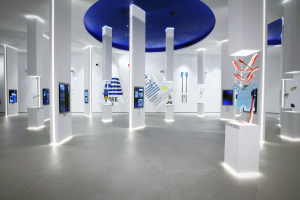
The journey begins in a space that feels less like a gallery and more like a portal. The centerpiece is a 3D projection shaped after the κότινος, the olive wreath once placed on the heads of Olympic champions. Award-winning in its design using the technology of video mapping, the exhibit glows in the hushed light, alive with scenes and memories from past Olympics, accompanied by the music of Evanthea Reboutsika. Already, the past feels near enough to touch.
The second gallery resembles a cave, an otherworldly chamber where myths breathe again. Small “nests” shelter objects and stories: Hercules cleaning the Augean stables; Pelops charging forward in his chariot; the Curetes dancing, their shields clashing to drown out infant Zeus’ cries; and finally, the head of formidable Zeus, crowned with a wreath, a vision inspired by the lost golden statue.
From Myth to History
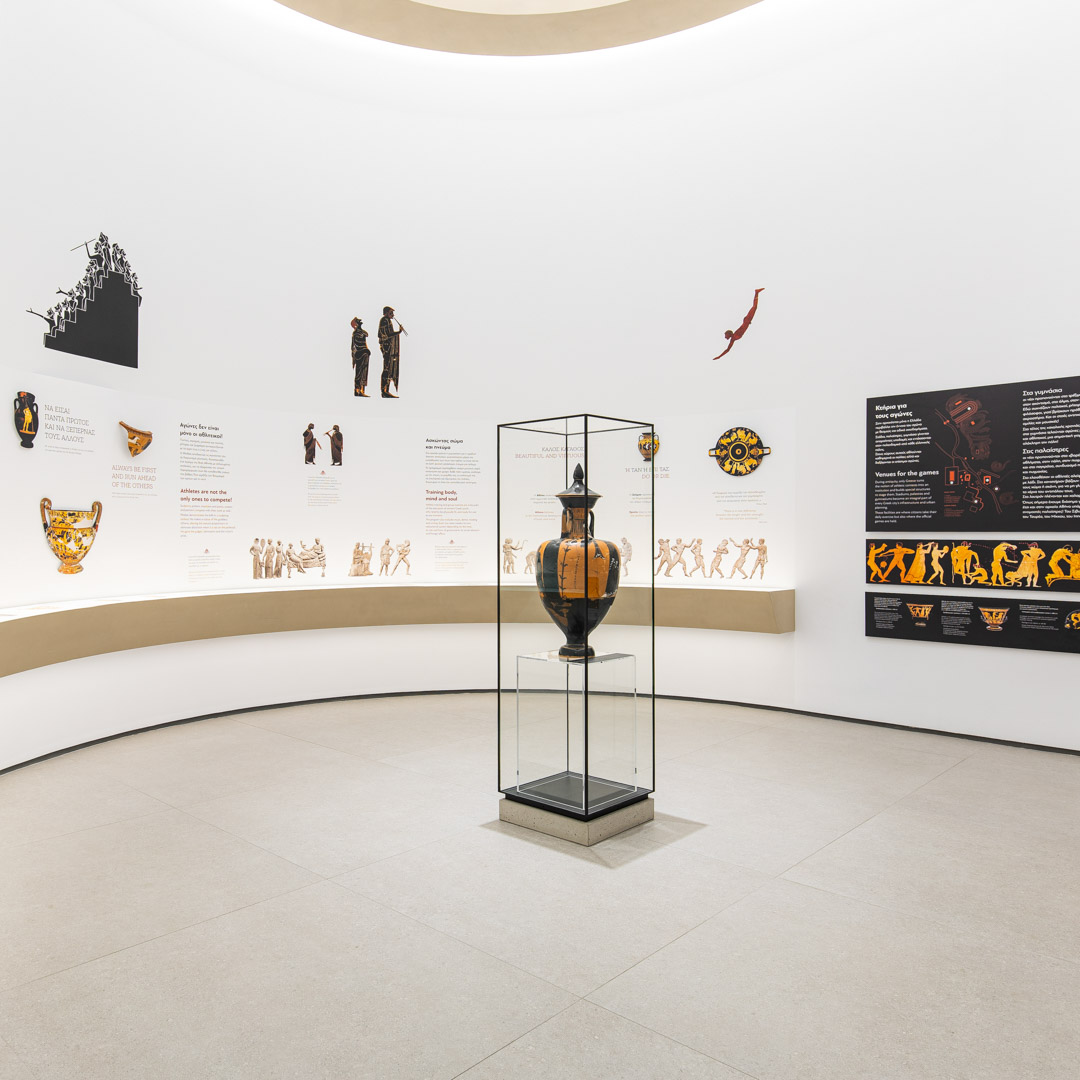
Stepping onward, we find ourselves surrounded by the world of competition throughout ancient Greek times. A great wall lays out the Panhellenic Games, not only the Olympics, but also the Isthmian, Pythian, and Nemean contests, as well as a special tribute to the Panathenaia. In this moment it becomes clear: this museum tells not just the story of the Olympics, but of Greece itself, and by extension, of the world.
On the opposite wall, Athens and Sparta confront one another in a timeless contrast. Athens proclaims καλός καγαθός, “beautiful and virtuous”, while Sparta answers with the uncompromising ἢ τὰν ἢ ἐπὶ τᾶς, “with your shield, or on it.” We also see an amphora, a faithful replica of those once full of olive oil, the treasured prize awarded to winners of the Panathenaic Games.
The fourth gallery adds a modern twist: an interactive video map. With a touch, we uncover the meaning of the sacred truce (ἱερή ἐκεχειρία) and read about the Discus of Ifitos, reminders that even in times of war, the Games called for cease of fire and harmony across the world.
Experiencing the Ancient Games
Then comes the fifth gallery, perhaps the most thrilling in the section of antiquty. Here, the stadium of Olympia unfolds before us in scale, and visitors are invited to run the δρόμος, the ancient sprint. High above, the statue of Nike by Paionios watches silently. The walls around us speak of rules: no biting, no foul play, and the ritual of ἀπαγορεύειν, where an athlete admitted his defeat by raising his finger.
The Hellanodikai, the judges of the Games, come into view, alongside the question: who could truly become an Olympic champion? At the tactile station, visitors can feel the shape of a κότινος olive wreath, or the crimson woolen ribbon once tied around the Olympic champions. The ribbon, it was believed, carried strength to its wearer. A “book of fame” completes the gallery, and we can turn the pages to reveal champions whose names still echo through time.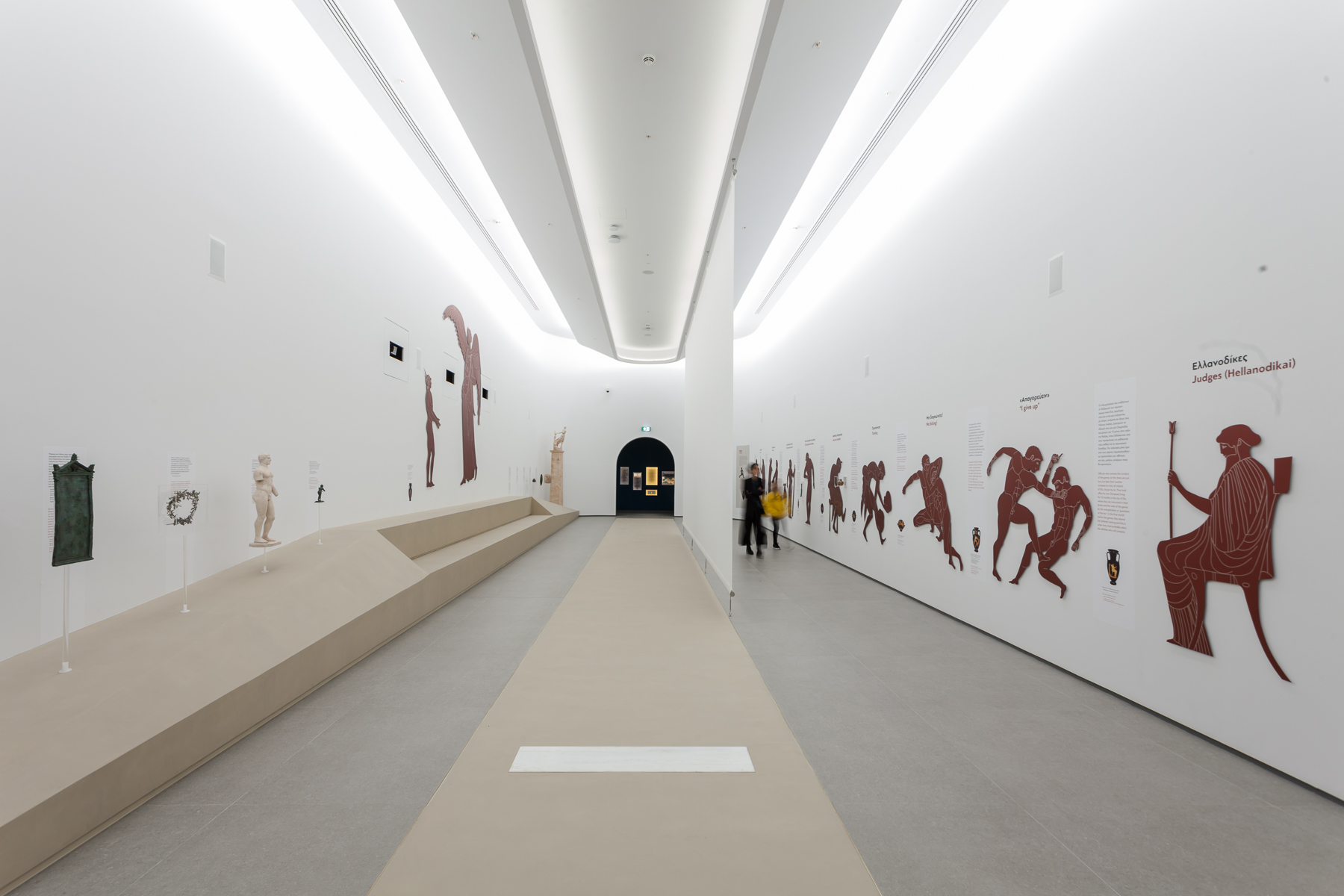
From Byzantium to the Revival
As we follow the route to the next gallery, the mood shifts dramatically. Designed to resemble a Byzantine church, with fonts, music, and aesthetics from the era, the gallery takes us from a period when the Games had faded and stopped, to the travels of the Europeans seeking to rediscover Olympia. A photograph of the excavations, bathed in light, symbolizes the rebirth of the ancient historical site.
The narrative continues with the path to the revival of the Games, leading us to Pierre de Coubertin and the Greek intellectual Demetrios Vikelas. Exhibits include extracts from their lengthy correspondence, Vikelas’ actual office desk, and a sizeable variety of documents from the 1896 Athens Olympics: letters, guides, flyers, and commemorative stamps on the occasion of that first modern celebration.
Into the Stadium Once Again
Next, we step inside a projection and exhibition hall designed as the Panathenaic Stadium. Sitting among its seats, we relive the atmosphere of the first modern Olympics. We learn how medals were originally awarded, with only the first two places recognized, as gold was introduced later in the history of the Games, and how participation was firstly limited to men.
We step into history as we learn all about the first modern Olympic Games of 1896. On the walls, we even see the figures of Harilaos Vasilakos and Spyros Louis, running towards the finish line—witnessing their struggle, their triumph, and their determination.
A Timeline of Every Games
In the next gallery, the story expands. A timeline of every Olympic Games edition - both Summer and Winter - unfolds before us, enriched with a collection of objects from each era, among which medals and athletes’ memorabilia. We learn so many meaningful facts and stories like how in 1932 Lake Placid, Mollie Phillips became the first woman to carry the British flag at the Winter Olympics. Or in 1964 Innsbruck, Italian bobsledder Eugenio Monti famously lent a part of his own sled to the British team, allowing them to win gold while his team took bronze, a story of true Olympic spirit.
Perhaps most exciting of all is the interactive touchscreens that let us explore what took place historically in the world during each Olympiad, proving once more that the Athens Olympic Museum is far more than a museum about the Games; it’s living chronicle of history itself.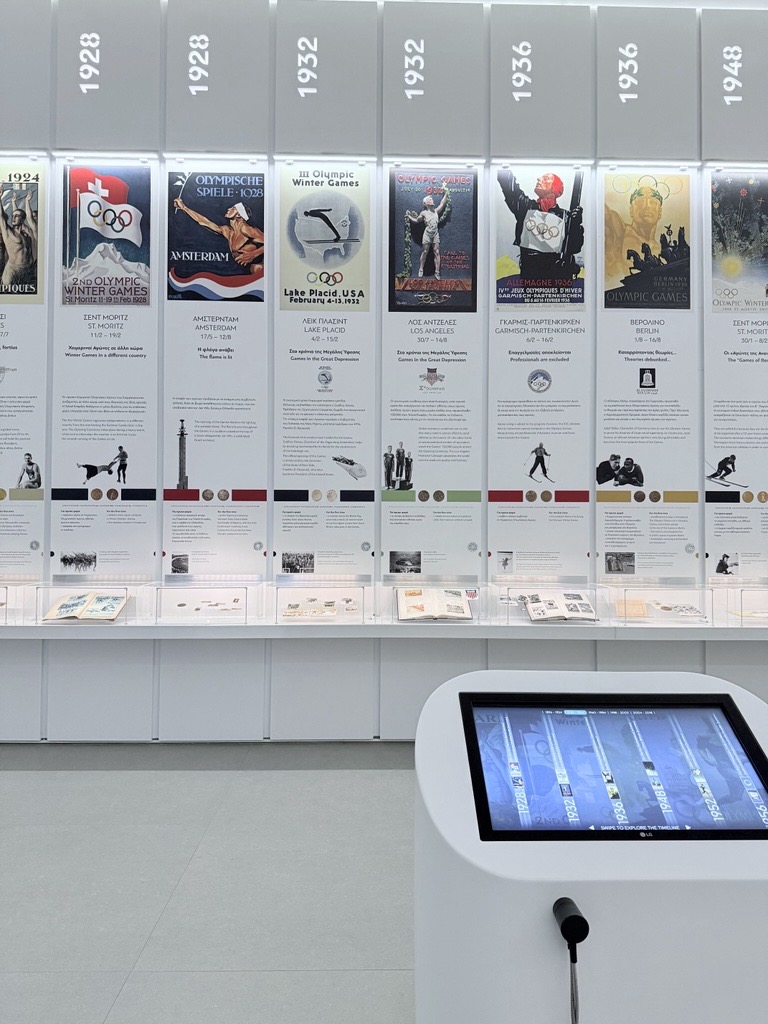
Athens 2004: The Games Return Home
Then, the journey brings us back home. The next exhibition gallery is an allusion to the Olympic Stadium of Athens (OAKA) and is dedicated to the Athens 2004 Olympics. We saw original sketches of Kouroudis’ Olympic sports “pictograms,” inspired by Cycladic figurines, as well as of the first medal engraving featuring Paionios Nike of Olympia ascending from the Panathenaic Stadium of Athens, designed by Elena Votsi; the permanent design of every summer edition ever since.
We follow the journey of the 2004 Olympic Torch Relay across all 5 continents, mapped in an artistic wall installation, and meet the mascots Phevos and Athena, inspired by the archaic ceramic daidala. On a video wall, we trace the massive public works that transformed Greece to host the Games.
The surprises continue: a parade of the original performers’ costumes, including the imposing Centaur, which the visitors can even touch, transfers us to the night of the Athens 2004 Opening Ceremony. Here also lies another treasure of memory, the medal of the decorated taekwondo Olympian Alexandros Nikolaidis, offered to the Museum for exhibition by his family.
And then, the focus shifts to the Athens 2004 Paralympic Games, presented through an audiovisual production and a collection of objects. A tactile station allows visitors to feel the 2004 Paralympics medal design featuring the Parthenon, and the neighborhood around the Acropolis, as well as a carefully reproduced larger tactile version making it accessible to visitors with visual impairments. This thoughtful detail captures the essence of the Games: accessibility, inclusivity, and the celebration of every athlete’s achievement.
Then the timeline of the modern Olympics continues in the next gallery where we encounter some empty slots waiting patiently to be filled with items of the future editions.
Kids will especially love the many close-up looks of the many mascots, before we see the Games motto in Latin that takes us to the next section of the exhibition. 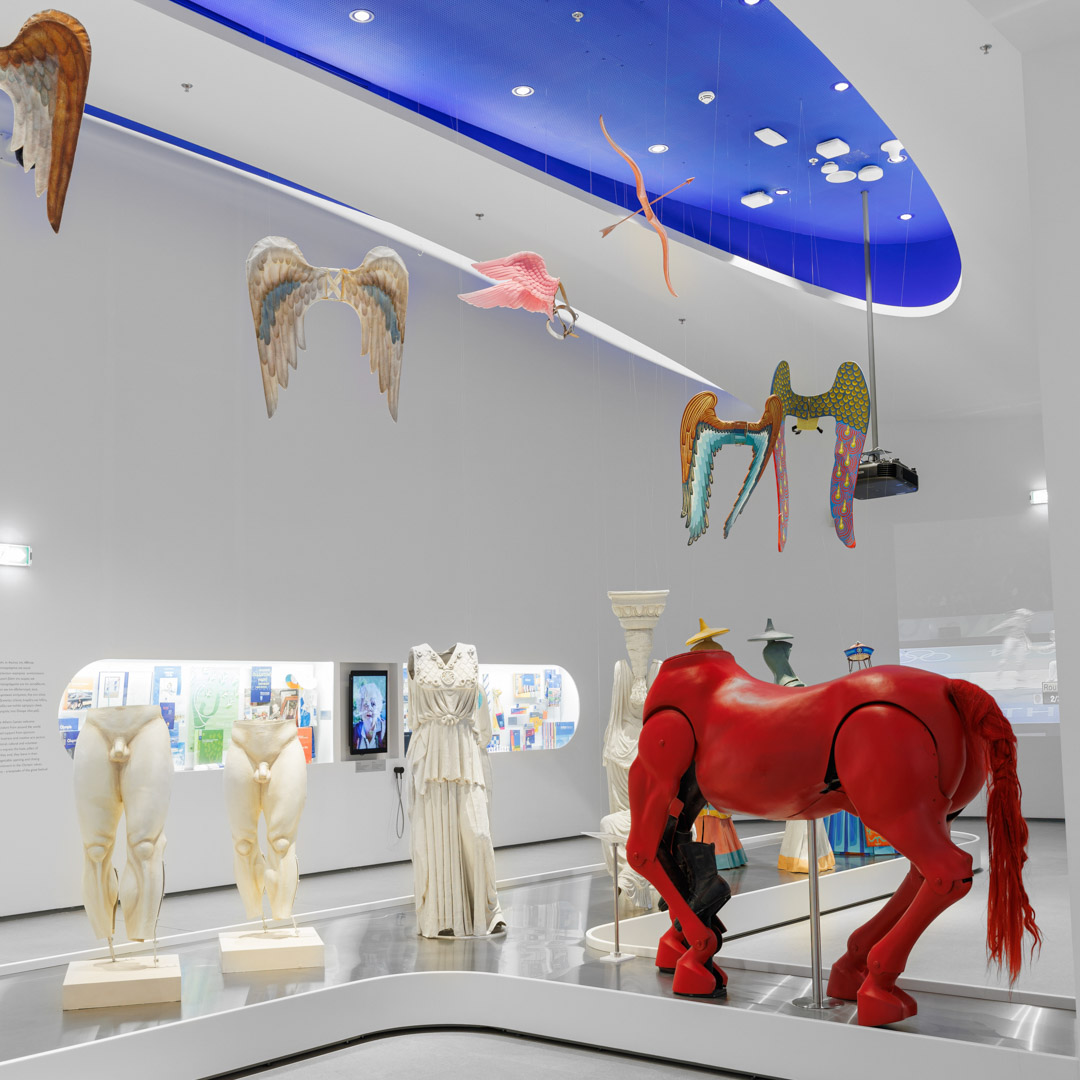
Symbols You Can Touch
The visit continues into a gallery where the Olympic symbols are presented together. Under the Olympic Flag we, again, find a tactile station, where visitors are invited to hold two original torches (δάδες) and to run their hands across the embossment of the Olympic rings symbol. For visitors with visual impairment especially, this is a revelation: the Games are not only something to watch, but something to feel, a universal language made tangible.
On display is the priestess’s chiton of Artemis Ignatiou, the current choreographer of the ceremony of the lighting of the Olympic Flame, a garment woven with tradition and ritual. Around us, the walls present the Museum’s collection of Olympic Torches, each design carrying its own meaning, each flame its own journey.
The visit in the gallery cannot skip the innovative central interactive installation, which received an Ermis award in 2021. It features a “seemingly unwritten” large book that come to life when its pages are flipped. The book is inspired by the Olympic Charter and vividly presents the Olympic Movement, the symbols and the philosophy of Olympism.
Stories Stitched in Fabric
In the next gallery, we find two large digital stations that let us dive deeper in discovering the stories of every Greek Olympic and Paralympic medalist, their victories, and seeing excerpts from their performances. Around the gallery we see their performance apparel and equipment from their participation to the Games, some instantly recognizable, others less known, like the Paralympic sport boccia. Before us the tribute to one of the legends: Pyrros Dimas, with the entire collection of the singlets he wore across his Olympic career. Then inclusivity takes center stage. At first glance, a simple piece of equipment whose purpose isn’t obvious. But then its significance soon emerges: it is the running tether worn by the blind sprinter Paraskevi Kantza, the link connecting her to her guide as they competed side by side. Suddenly, it’s no longer just an object, but a story of resilience, determination, trust, and teamwork. 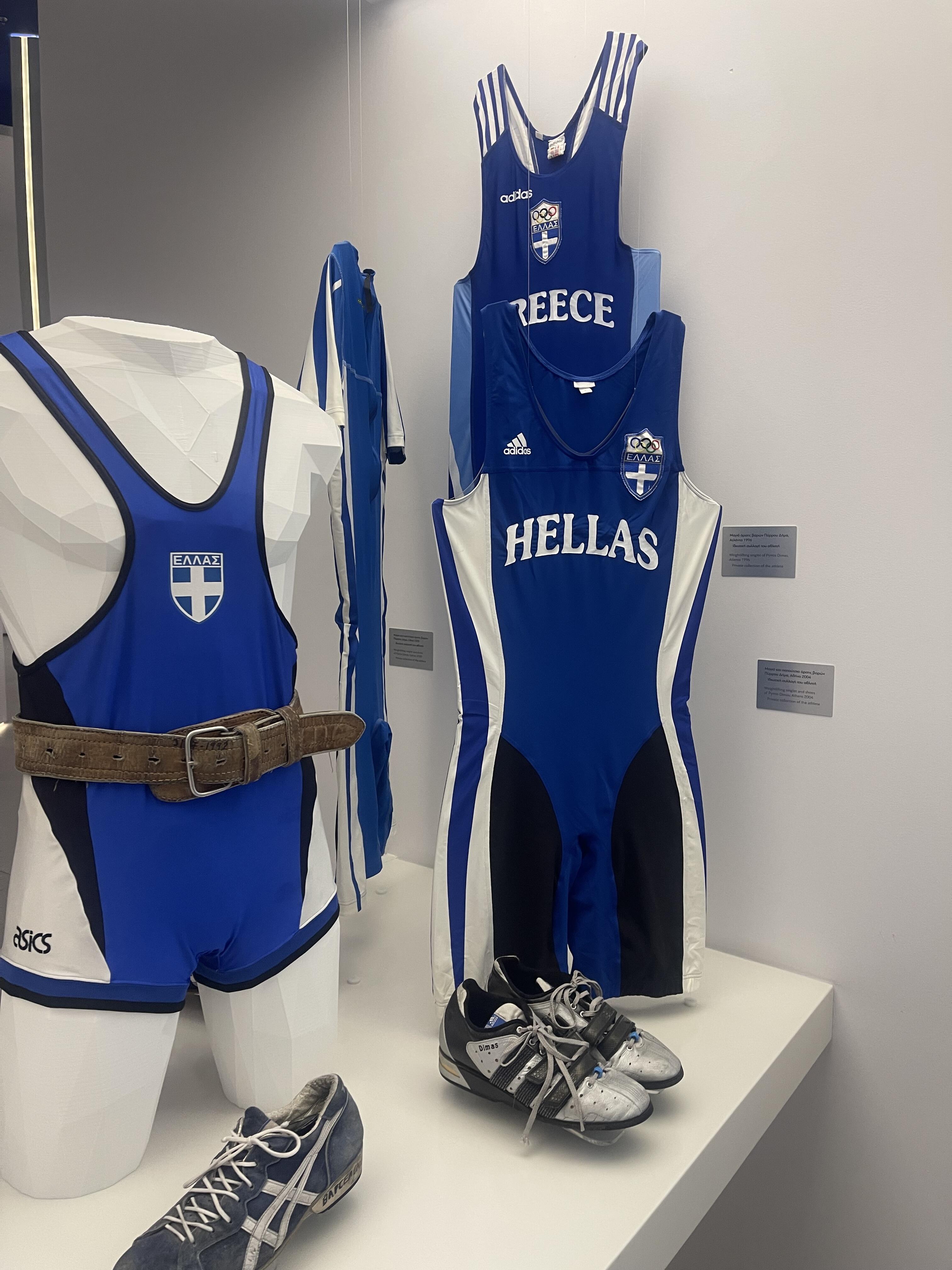
Become an Olympian
This is where the exhibition shifts from being a spectator to being a participant. We are invited to become athletes ourselves, to use a real Olympic bow in archery (Summer Olympics), to feel the rush of wheelchair racing (Paralympics), and to balance ourselves on the slopes in skiing (Winter Olympics).
For children, especially, this is a revelation: to learn by doing, to understand how difficult -and how extraordinary - the life of an athlete truly is.
The back wall glows with a Hall of Fame, but it is not only about medals and records. In the same gallery we meet athletes as people, their struggles as real as their triumphs. We learn about Michael Phelps, who faced the shadows of depression even as he stood on the podium and how Nikolaos Kaklamanakis thought his greatest rival was none other than himself. The exhibition host his sail of the 2004 Games, centrally presented in front of a mirror that is there to remind us that we too battle our own rivals within.
This is where the line between athlete and visitor blurs, as we can see our paths from the perspective of their stories.
An Inspiring Farewell
The exhibition closes with a large audiovisual show. An audiovisual production without words, without narration, sweeps across the large screen. We see some of the most powerful moments in Olympic history: the struggle of the athletes such as the emblematic barefoot marathon runner Abebe Bikila, the tears, the embraces, the impossible victories. With no explanation, only music, the images speak directly to the heart.
And so, the tour ends where it began, with silence, with awe, with the timeless flame of the Olympic spirit.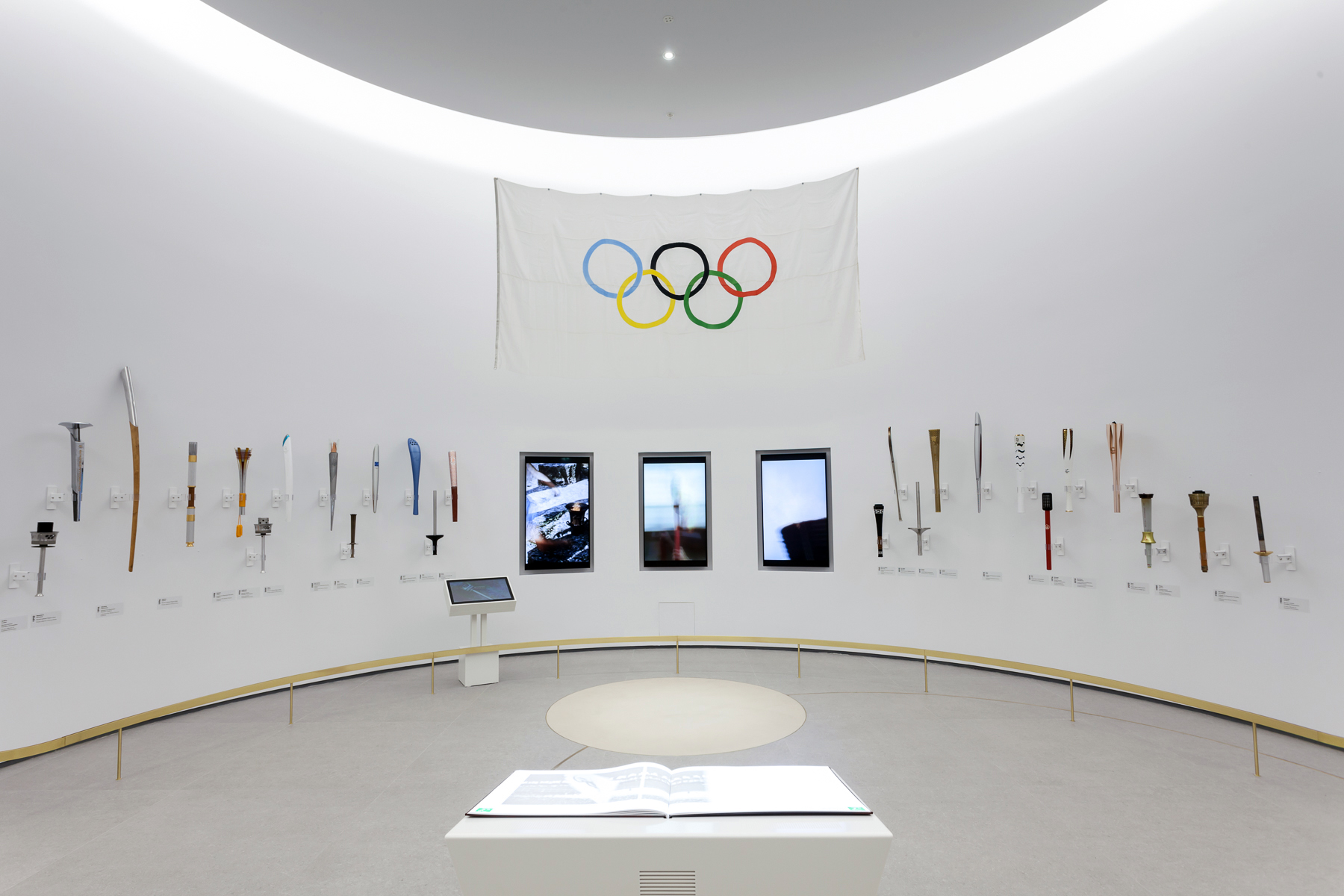
A Must-Visit for Everyone
What struck us most about the Athens Olympic Museum is how every detail has meaning. Nothing is random: every gallery, every symbol, every object is part of a carefully curated story. We loved how seamlessly it blends myth, history, personal stores and living memory into one journey. For children, blind and visually impaired visitors, the tactile stations, audio descriptions and narrations, as well as the interactive exhibits make the experience deeply, movingly inclusive and the Games’ stories accessible in a way that truly touches the heart.
The museum’s reach extends far beyond its walls. Its educational program “Μουσειοβαλίτσα” (AOM Suitcases) available in Greek, English, French, Arabic, and Farsi, brings the Olympic ideals to every classroom, group and community it reaches. Meanwhile, Live online Tours bring the history of Olympism to every corner of the globe. It’s a reminder of its mission to share values of inclusivity, excellence, and peace across languages and cultures. And yet, as much as we saw, we realized we had barely scratched the surface. The exhibition is so rich, the storytelling so layered, that the just one visit feels like an introduction, a welcome to the world of Olympism. We left with the sense that we must return, because there is always more to learn, more to feel, and more to discover in this place where history, humanity, and hope meet. The Olympic Museum is not just worth visiting; it is worth visiting again and again.